O (annealed)
For bending, coiling, flaring and expanding into fins. Often supplied in coils for refrigeration and instrument lines.



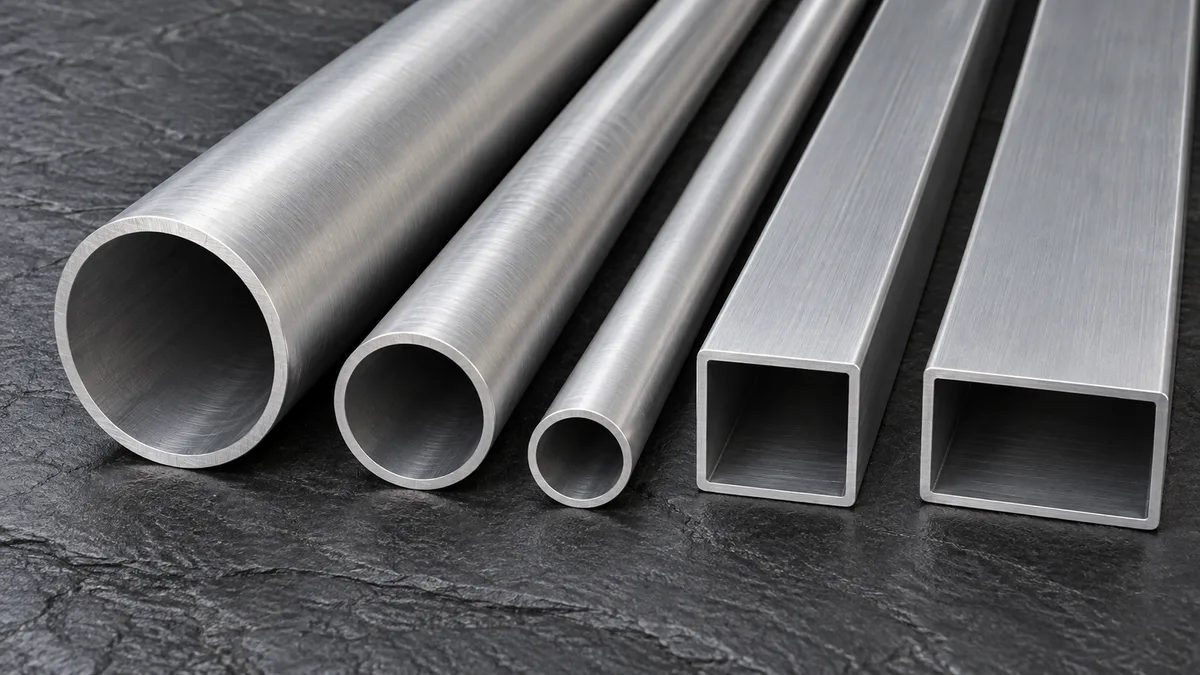
1100 aluminium tube is commercially pure (99.0 % minimum) aluminium, drawn or extruded into round, square and coiled tube. It is the most formable and one of the most corrosion-resistant and conductive tube grades, used for heat-exchange lines, chemical and food-handling tubing, instrument lines and decorative work. Metline supplies 1100 tube in O, H14, H18 and H112 to ASTM and EN standards, worldwide.
1100 is the commercially pure grade of the 1xxx series: at least 99.0 % aluminium with a small, deliberate copper content of 0.05 – 0.20 %. It cannot be heat-treated; any extra strength comes from cold work, which is why its tempers are designated O and H.
As tube, 1100 is chosen for what it does well rather than for strength. It bends, flares, expands and swages without cracking, even in tight radii; it resists corrosion in fresh water, many chemicals and food products; and it conducts heat and electricity far better than alloyed grades. Annealed 1100 tube can be hand-bent into coils and fitted with flare or compression fittings.
Its weakness is low strength: about 90 MPa tensile in the O temper, roughly a third of 6061-T6. If the line carries significant pressure, vibration or structural load, 3003 (about 20 % stronger) or 6061 is usually specified instead. For many heat-transfer, instrumentation and fluid-handling jobs, though, 1100 is the simplest and most forgiving choice.
Limits are the registered Aluminum Association values, also used for EN AW-1100 (Al99.0Cu) under EN 573-3.
| Element | Limit (wt %) | Note |
|---|---|---|
| Aluminium (Al) | 99.00 min | Commercially pure |
| Silicon + iron (Si + Fe) | 0.95 max | Main impurities |
| Copper (Cu) | 0.05 – 0.20 | Deliberate small addition; slightly raises strength |
| Manganese (Mn) | 0.05 max | |
| Zinc (Zn) | 0.10 max | |
| Others, each / total | 0.05 / 0.15 |
Typical values from Aluminum Association and ASM data. Specified minimums for drawn tube are listed in ASTM B210 and for extruded tube in ASTM B221 and B241; they vary by temper and wall thickness and are reported on the mill certificate.
| Temper | Condition | Tensile strength | Yield strength | Elongation | Hardness |
|---|---|---|---|---|---|
| O | Annealed, softest | 90 MPa / 13 ksi | 34 MPa / 5 ksi | 35 – 45 % | 23 HB |
| H12 | Quarter hard | 110 MPa / 16 ksi | 103 MPa / 15 ksi | 12 – 25 % | 28 HB |
| H14 | Half hard (common drawn temper) | 124 MPa / 18 ksi | 117 MPa / 17 ksi | 9 – 20 % | 32 HB |
| H18 | Full hard | 165 MPa / 24 ksi | 152 MPa / 22 ksi | 5 – 15 % | 44 HB |
| H112 | As extruded, with property limits | Typically 75 – 105 MPa | About 20 – 35 MPa | High | — |
For bending, coiling, flaring and expanding into fins. Often supplied in coils for refrigeration and instrument lines.
The standard straight-length drawn temper: stiffer, holds its shape, still bends to moderate radii.
Full hard for maximum strength and stiffness where the tube is used straight, such as antenna or decorative tubing.
Extruded tube supplied as pressed, for larger diameters and thicker walls where cold drawing is not needed.
| System | Designation | Tube standard |
|---|---|---|
| Aluminum Association / UNS | 1100 / A91100 | ASTM B210 (drawn seamless), B221 (extruded), B241 (seamless pipe and extruded tube), B483 (drawn tube for general purpose) |
| ASME | 1100 | SB-210, SB-241 |
| European (EN) | EN AW-1100 (Al99.0Cu) | EN 754-2 (drawn), EN 755-2 (extruded), EN 573-3 |
| ISO | Al99.0Cu | ISO 6363 (drawn), ISO 6362 (extruded) |
| Japan (JIS) | A1100 | JIS H4080 (A1100TD drawn, A1100TE extruded) |
Some national designations are close to 1100 but not identical in composition. Specify the governing standard on the order rather than an equivalent name.
Mass per metre is π × (OD − t) × t × 2.71 g/cm³. Quick reference values; use the tube weight calculator for other sizes.
| OD (mm) | Wall (mm) | ID (mm) | Mass (kg/m) |
|---|---|---|---|
| 6 | 1 | 4 | 0.043 |
| 8 | 1 | 6 | 0.060 |
| 10 | 1 | 8 | 0.077 |
| 12 | 1 | 10 | 0.094 |
| 12.7 | 1.24 | 10.22 | 0.121 |
| 16 | 1.5 | 13 | 0.185 |
| 19.05 | 1.65 | 15.75 | 0.244 |
| 20 | 2 | 16 | 0.306 |
| 25 | 2 | 21 | 0.392 |
| 25.4 | 1.65 | 22.1 | 0.334 |
| 32 | 2 | 28 | 0.511 |
| 40 | 3 | 34 | 0.945 |
| 50 | 3 | 44 | 1.200 |
| 63.5 | 3 | 57.5 | 1.545 |
| 76.2 | 3.2 | 69.8 | 1.989 |
| 100 | 5 | 90 | 4.044 |
O-temper tube bends tightly with simple tooling; use a mandrel or spring for thin walls to prevent kinking. H14 needs larger radii.
Very ductile, so it accepts flare fittings and mechanical expansion into fin packs without splitting.
TIG and MIG weld easily with ER1100 or ER4043 filler. Strength in the weld zone falls to the O level.
Brazes readily with Al-Si filler (4047 or 4343-clad parts) because of its high melting point.
Soft and gummy; use sharp, polished tools with large rake angles and plenty of lubricant.
Anodises to a clear, bright finish and polishes well for decorative tube.
| Property | 1060 | 1100 | 3003 | 6063-T6 |
|---|---|---|---|---|
| Aluminium content | 99.6 % min | 99.0 % min | About 98 % | About 98.5 % |
| Typical tensile (O / T6) | 70 MPa (O) | 90 MPa (O) | 110 MPa (O) | 241 MPa (T6) |
| Thermal conductivity | Highest (about 234 W/m·K) | About 222 W/m·K | About 193 W/m·K | About 200 W/m·K |
| Formability | Excellent | Excellent | Very good | Fair |
| Typical use | Electrical, chemical | Heat exchange, general | HVAC, heat exchangers | Architecture, structures |
3003 is the usual upgrade when 1100 is too soft: same easy fabrication, about 20 % more strength. See 3003 tube.
Heat-exchanger and refrigeration lines, chemical and food-processing tubing, instrument and pneumatic lines, electrical conductors and decorative tube: jobs that need formability, conductivity and corrosion resistance more than strength.
No. 1100 is non-heat-treatable; strength comes only from cold work (H tempers). Annealing returns it to the soft O temper.
O is fully annealed, about 90 MPa tensile, and bends and flares easily. H14 is half hard, about 124 MPa tensile, stiffer and better for straight lengths, but needs larger bend radii.
3003 is about 20 % stronger with similar formability and corrosion resistance, so it is preferred for pressure lines and HVAC. 1100 has higher conductivity and slightly better ductility.
Yes, very easily by TIG or MIG using ER1100 or ER4043 filler. It is also readily brazed.
Yes, annealed 1100 tube in small diameters and thin walls can be supplied in coils, as well as straight lengths cut to size.
Send size, temper, form (straight or coil), quantity and destination for a delivered quote.





