Extrusion
Window and door profiles, curtain wall, solar mounting rails, heat sinks, tubes, bars and automotive crash structures, mostly from 6xxx billet.



An aluminium billet is a long, round, cast log of alloy that is the starting stock for extrusion, forging and, after working, machined parts. Most billet is direct-chill (DC) cast, homogenised and cut or scalped to length, in diameters from about 6 to 20 inches. This guide explains how billet is made, which alloys suit which process, standard sizes and weights, and the quality checks that separate good billet from scrap-prone stock.
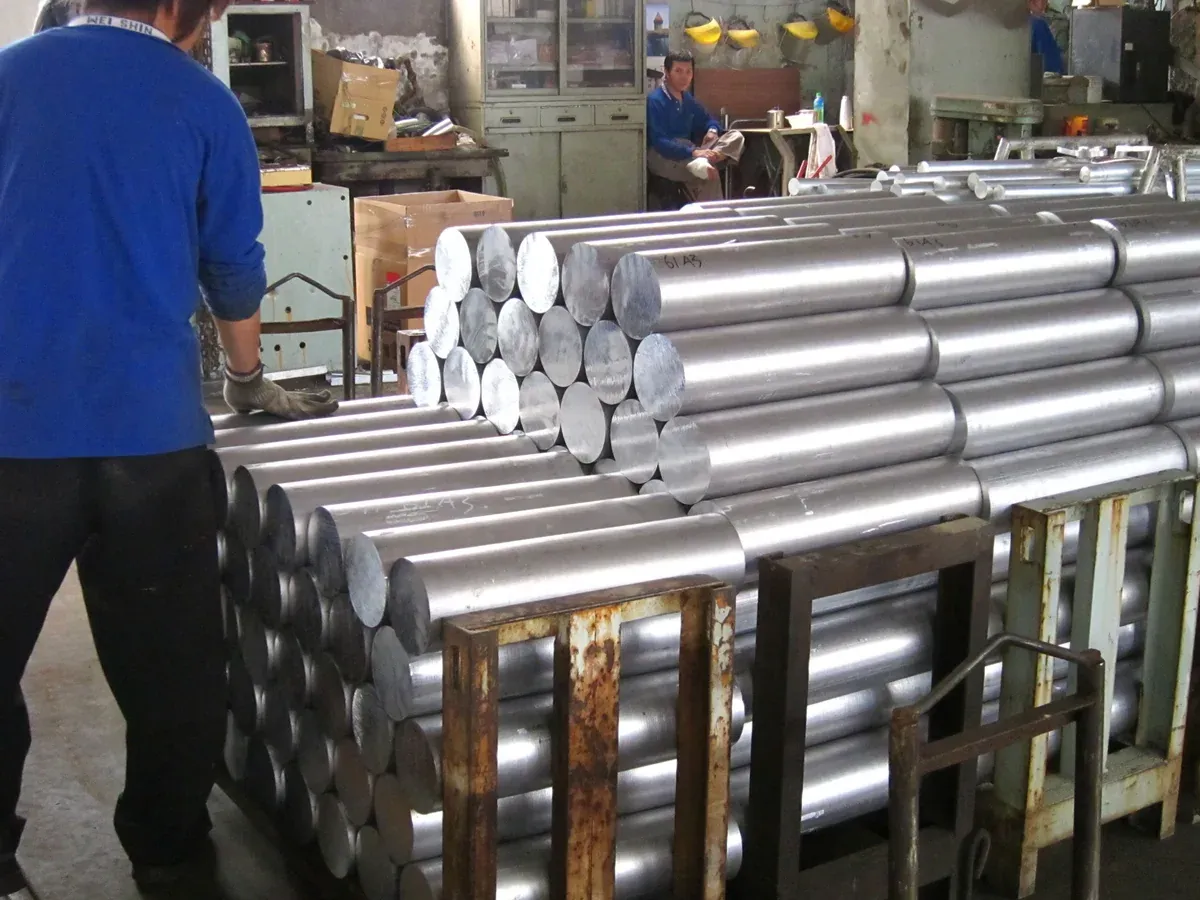
In the aluminium industry, billet means a cast cylinder intended for further hot working. It sits between primary metal (ingot, sow or molten metal) and finished wrought products. Rolling mills use rectangular slabs or rolling ingots; extruders and forgers use round billet.
The word is used in two other ways that cause confusion. Machinists talk about "billet aluminium" parts, meaning parts CNC-machined from solid wrought bar, plate or block rather than cast to shape. And forgers sometimes call a sawn length of extruded or rolled bar a "forging billet" or "forging stock". This guide covers all three, but focuses on cast billet for extrusion and forging.
Billet quality matters more than its humble appearance suggests. Inclusions, porosity, coarse grains or poor homogenisation in the billet show up downstream as tearing and pick-up on extrusions, surface streaks after anodising, cracks during forging or ultrasonic rejects in finished parts. Buyers of aerospace forgings and high-finish architectural extrusions therefore specify billet as carefully as the final product.
Older and smaller plants may use horizontal continuous casting for small diameters, and some forging stock is produced by extruding a cast billet into bar first, which refines the structure further. For critical aerospace forgings, the specification often defines which route is allowed.
| Alloy series | Common grades | Main process | Typical end products |
|---|---|---|---|
| 1xxx | 1050, 1060, 1070, 1350 | Extrusion | Electrical conductors, heat-exchanger tube, busbar |
| 2xxx | 2011, 2014, 2017, 2024, 2219, 2618 | Forging and extrusion | Aircraft fittings, wheels, pistons (2618), free-machining bar (2011) |
| 3xxx | 3003, 3103 | Extrusion | Heat-exchanger and HVAC tube, microchannel tube |
| 4xxx | 4032 | Forging and extrusion | Forged pistons, compressor parts; low expansion and good wear resistance |
| 5xxx | 5052, 5083, 5086, 5754 | Extrusion (slow) | Marine profiles, tube and bar |
| 6xxx | 6060, 6063, 6061, 6082, 6005A, 6351 | Extrusion and forging | Architectural and industrial profiles, automotive parts, forged suspension arms |
| 7xxx | 7003, 7005, 7020, 7050, 7075, 7A04 | Forging and extrusion | Aerospace forgings and extrusions, sports goods, high-strength transport profiles |
The large majority of extrusion billet is 6xxx, because 6060 and 6063 extrude fast with an excellent surface and 6061, 6082 and 6005A give structural strength. 2xxx and 7xxx billets extrude several times more slowly and need tighter casting control, which is why they cost more and are often bought from specialist casthouses. For a single alloy in depth, see our 7075 billet guide.
Chemistry within the registered limits also matters. Extruders often specify a narrower window, for example controlled Mg and Si in 6063 for consistent anodising, or a defined Mg2Si balance for strength. Aerospace billet is typically cast to AMS or customer specifications with tighter impurity limits (especially Fe and Si) for better toughness.
Billet diameter is chosen to fit the extrusion press container or the forging operation. Common sizes are quoted in inches. Logs are typically cast around 4.8 – 5.8 m (about 190 – 230 in) long and sawn to press length, often 0.5 – 1.5 m. Weights below use 2.70 g/cm³; 7xxx and 2xxx alloys are 2 – 4 % heavier.
| Nominal diameter | Diameter (mm) | Weight (kg/m) | Weight of a 5.8 m log (kg) | Typical use |
|---|---|---|---|---|
| 6 in | 152 | 49.0 | 284 | Small presses, tube and rod |
| 7 in | 178 | 67.2 | 390 | Architectural profiles |
| 8 in | 203 | 87.4 | 507 | Most common general extrusion |
| 9 in | 229 | 111.2 | 645 | Industrial and window profiles |
| 10 in | 254 | 136.8 | 794 | Larger profiles |
| 11 in | 279 | 165.1 | 957 | Structural and transport profiles |
| 12 in | 305 | 197.3 | 1144 | Large sections, forging stock |
| 14 in | 356 | 268.8 | 1559 | Large presses, forgings |
| 16 in | 406 | 349.6 | 2027 | Heavy forgings and wide profiles |
| 20 in | 508 | 547.3 | 3174 | Very large extrusions and forgings |
Smaller diameters (3 – 5 in) and larger ones (up to about 24 in or more) are made for special presses and forging work. Scalped billet is supplied with a diameter tolerance agreed to suit the container clearance; as-cast logs carry a wider tolerance. For extra-large round stock, see large diameter bar and billet.
| Check | What it shows | When it is required |
|---|---|---|
| Chemical analysis (OES) | Composition of each cast against the registered and customer limits | Every cast |
| Hydrogen measurement | Dissolved gas level after degassing; high hydrogen means porosity | Routine for extrusion; tight limits for aerospace |
| Macro-etch slice | Grain size, cracks, cold shuts, segregation and inclusions across the section | Per cast, or by sampling plan |
| Microstructure | Homogenisation response: dissolved phases and precipitate size | Extrusion and forging qualification |
| Ultrasonic testing | Internal voids, cracks and inclusions (e.g. to AMS-STD-2154 or ASTM B594 classes) | Forging and aerospace billet |
| Dimensions and surface | Diameter, straightness, end cut squareness and surface defects | Every delivery |
A good billet extrudes at high speed without tearing, gives a uniform anodised finish, and leaves little back-end scrap. A poor billet shows its problems as die lines, blisters, streaks, low press speeds or cracked forgings. If you see these, ask for the cast numbers and homogenisation records: most root causes trace to melt cleanliness, hydrogen or homogenising practice.
Window and door profiles, curtain wall, solar mounting rails, heat sinks, tubes, bars and automotive crash structures, mostly from 6xxx billet.
Aircraft fittings, landing-gear parts, automotive control arms and knuckles, wheels and pistons in 2xxx, 4032, 6061/6082 and 7xxx.
Large discs, rings and blocks for aerospace, defence and industrial equipment.
Racing parts, enclosures, moulds and prototypes machined from bar or block that started as billet.
Small billet slices (slugs) for cans, tubes and housings, usually 1xxx, 3xxx or 6xxx.
Some billet is traded as feedstock for other casthouses and foundries.
Common mistakes include buying unhomogenised billet to save cost (and then losing far more in press speed and scrap), choosing a diameter that does not match the container, and accepting billet without cast-number traceability, which makes it impossible to investigate downstream defects. Metline supplies billet in all common alloys with mill test certificates and export packing, on EXW, FOB, CIF or DAP terms worldwide. Full product data is on our extrusion billet product page.
Ingot is usually a small block or sow of primary or alloyed metal made for remelting. Billet is a round DC-cast log of a specific wrought alloy, homogenised and sized for direct use in extrusion presses or forging.
It means the part was CNC-machined from a solid piece of wrought aluminium (bar, plate or block) rather than cast to shape. These parts have the higher strength and integrity of wrought metal, typically 6061-T6 or 7075-T6.
As-cast billet has segregation and coarse intermetallic phases. Homogenising dissolves and redistributes them, which allows faster extrusion, a better surface and anodising response, and better forgeability. Unhomogenised billet usually costs more downstream than it saves.
Common sizes are 6, 7, 8, 9, 10, 11 and 12 inches for extrusion, with 14 – 20 inches and larger for big presses and forgings. The right diameter is set by your press container or forging plan.
6061 or 6082 for general and automotive forgings, 2014 or 2618 for heat-resistant parts, 4032 for pistons, and 7075 or 7050 for high-strength aerospace parts. The forging specification usually names the alloy and inspection class.
Yes. Billet can be supplied as full logs or sawn to press length, as-cast or scalped, with chemistry, macro-etch and ultrasonic reports as required, and mill test certificates to EN 10204 3.1.
Send the alloy, diameter, length, quantity and inspection requirements, and our team will reply with options and a delivered quote.






