Keep walls uniform
Large differences in wall thickness make metal flow unevenly through the die, causing distortion and surface streaks. Try to keep the thinnest wall at least half the thickness of the thickest.



A custom aluminium extrusion is a profile made through a die cut specifically for your cross-section, so the part arrives with its ribs, slots, screw ports and hollows already formed. Most custom profiles are extruded in 6063 or 6060 for fine detail and finish, or 6061, 6082 and 6005A for structural strength. Metline manages the whole route from drawing review and die to finishing, machining and certified delivery for customers worldwide.
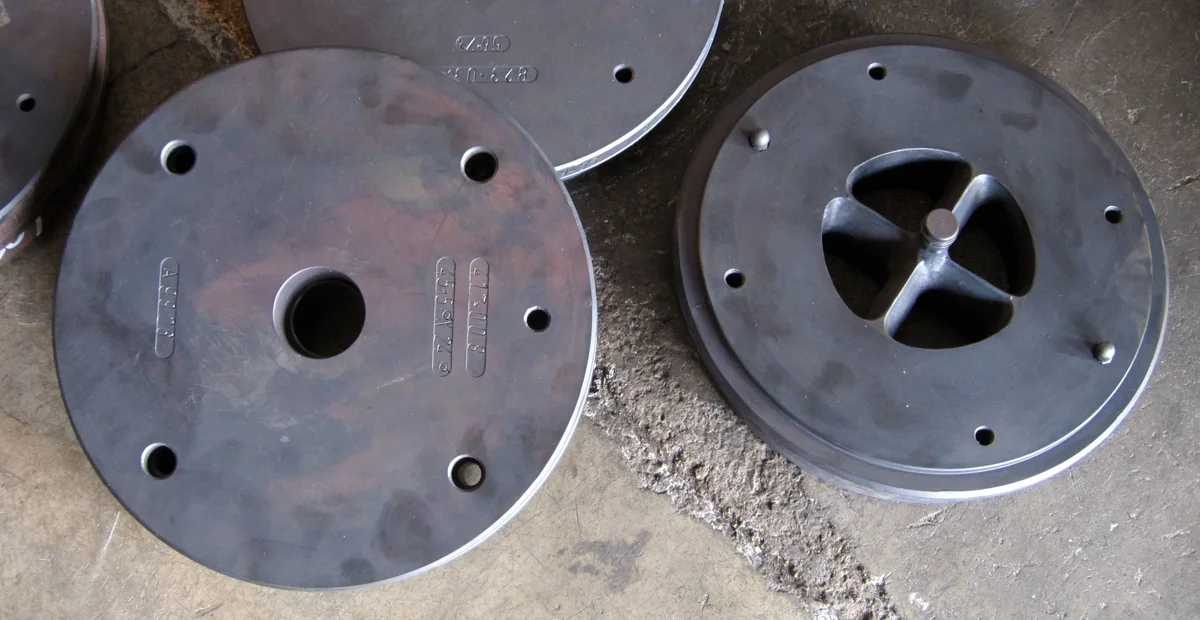
Extrusion pushes a heated aluminium billet through a shaped steel die, much like toothpaste from a tube. Because the die is relatively inexpensive compared with casting or forging tools, it is economical to design a cross-section that does exactly what your product needs instead of building it from standard bars, angles and tubes.
A well-designed profile can combine several parts into one: a heat sink with integral mounting slots, a window frame with thermal-break grooves, a battery tray side member with cooling channels, or a machine frame with T-slots and cable ducts. Fewer parts means fewer fasteners, less machining and fewer assembly errors. Material is placed only where it carries load or heat, so custom profiles are often lighter than the standard sections they replace.
The trade-off is the up-front die and sampling effort. Custom extrusion pays back when the profile is used repeatedly, when it removes machining or assembly steps, or when no standard section gives the required function.
The alloy controls how fast and how thin a profile can be extruded, how it looks after finishing and how strong it is. Softer alloys extrude faster and fill fine detail; stronger alloys need more press pressure, slower speeds and thicker walls.
| Alloy | Extrudability | Strength | Finish | Best for |
|---|---|---|---|---|
| 6060 | Excellent | Low – medium | Excellent | Window, door and façade systems, decorative trims |
| 6063 | Excellent | Medium | Excellent | Architectural, furniture, heat sinks, enclosures |
| 6463 | Very good | Medium | Bright, polishable | Bright-dip trim, reflectors |
| 6005A | Good | Medium – high | Good | Thin-walled structural, rail and bus profiles |
| 6061 | Fair | High | Good | Structural frames, machine parts, marine |
| 6082 | Fair | High | Good | Structural sections, trailers, scaffolding |
| 7003 / 7020 | Fair – difficult | Very high | Fair | Crash members, bumper beams, defence |
| 1xxx / 3003 | Excellent | Low | Good | Heat-exchanger tubes, electrical conductors |
| Alloy and temper | Tensile strength, min. | Yield strength (0.2 %), min. | Typical use |
|---|---|---|---|
| 6063-T5 (wall ≤ 12.5 mm) | 150 MPa / 22 ksi | 110 MPa / 16 ksi | Architectural and trim sections, anodised profiles |
| 6063-T6 (wall ≤ 3.2 mm) | 205 MPa / 30 ksi | 170 MPa / 25 ksi | Frames and lightly loaded sections that still need a fine finish |
| 6060-T66 (EN, wall ≤ 3 mm) | 215 MPa | 160 MPa | European window, door and façade systems |
| 6005A-T6 (wall ≤ 5 mm) | 270 MPa | 225 MPa | Thin-walled structural and transport profiles |
| 6061-T6 / T6511 | 260 MPa / 38 ksi | 240 MPa / 35 ksi | General structural channels, beams, frames |
| 6082-T6 (wall 5 – 25 mm) | 310 MPa | 260 MPa | Heavier structural sections, Europe and India |
| 7075-T6 / T6511 | 540 MPa / 78 ksi | 483 MPa / 70 ksi | High-stress sections where weldability is not needed |
Specified minimums from ASTM B221 and EN 755-2 for the wall bands shown. Typical values are higher; design to the minimum.
Large differences in wall thickness make metal flow unevenly through the die, causing distortion and surface streaks. Try to keep the thinnest wall at least half the thickness of the thickest.
The smallest circle that encloses the profile (CCD) decides which press can make it. Larger CCDs need bigger presses and allow fewer die openings, so cost rises with size.
For 6063 a wall around 1 mm is possible on small profiles; walls of 1.5 – 3 mm are more practical. Stronger alloys and larger profiles need thicker walls.
A slot much deeper than it is wide leaves a weak tongue of die steel that can deflect or break. Keep the depth-to-gap ratio moderate, or make the feature semi-hollow by agreement.
Sharp inside corners concentrate stress in the die and the part. Inside radii of 0.5 – 1 mm help metal flow and improve anodised appearance.
Hollow profiles need porthole or bridge dies with welding seams, which cost more and may need checking for seam quality. Use a hollow only where torsional stiffness or a closed channel is really needed.
Show which surfaces are visible so the die can be oriented to keep die lines and handling marks on hidden faces.
Small grooves or ribs help assemblers orient the part and can mark which side is up after anodising.
Standard tolerances suit most features; tighten only the dimensions that mate with other parts.
| Item | Standard |
|---|---|
| Mechanical properties and chemistry | ASTM B221; EN 755-2 with EN 573-3 |
| Profile tolerances (general) | EN 755-9; ANSI H35.2 |
| Precision profiles in 6060 / 6063 | EN 12020-2 |
| Anodised finish | EN ISO 7599; Qualanod specifications for architectural work |
| Powder coating | Qualicoat or AAMA 2603/2604/2605 class as specified |
| Inspection certificate | EN 10204 type 3.1 |
Tolerances in EN 755-9 and ANSI H35.2 depend on the alloy group, the size of the dimension, whether it crosses a hollow, and the CCD. Precision profiles under EN 12020-2 are held closer and are the normal choice for window and door systems. Straightness, twist, flatness and angularity are specified separately from cross-section dimensions; tell us if the profile must slide in a mating part or seal against glass, so the critical features can be measured at every die change.
Clear, bronze, black and colour anodising; hard anodising for wear. 6060 and 6063 give the most uniform appearance.
Any RAL colour, architectural or industrial grades, with masking where needed.
Brushing, polishing and bead blasting before anodising for a satin or bright surface.
Drilling, milling, tapping and end machining on CNC centres to drawing.
Precision saw cutting to length, notching and punching of holes and slots.
Stretch or roll bending, thermal-break crimping, and assembly with fittings.
The die is normally paid for by the customer and dedicated to their profile, though it remains at the extrusion plant. Ownership and replacement terms should be stated in the quotation.
In 6063 on small profiles, walls around 1 mm are possible, but 1.5 – 3 mm is more economical and more consistent. The minimum rises with profile size and with stronger alloys such as 6061 and 6082.
Choose 6063 for complex shapes, thin walls and the best anodised appearance. Choose 6061 or 6082 when the profile carries significant load and needs roughly 40 – 50 % more yield strength.
A dimensioned 2D drawing (DXF, DWG or PDF) of the cross-section, plus a 3D model if the part is machined. Include alloy, temper, finish, length, critical tolerances and expected annual volume.
Yes. Profiles can be cut, CNC machined, punched, bent and anodised or powder coated, then packed ready for assembly.
EN 755-9 or ANSI H35.2 for general profiles, and EN 12020-2 for precision 6060/6063 profiles, unless tighter limits are agreed on the drawing.
Send it to our team for an extrudability review, die proposal and delivered price, with finishing and machining options.






