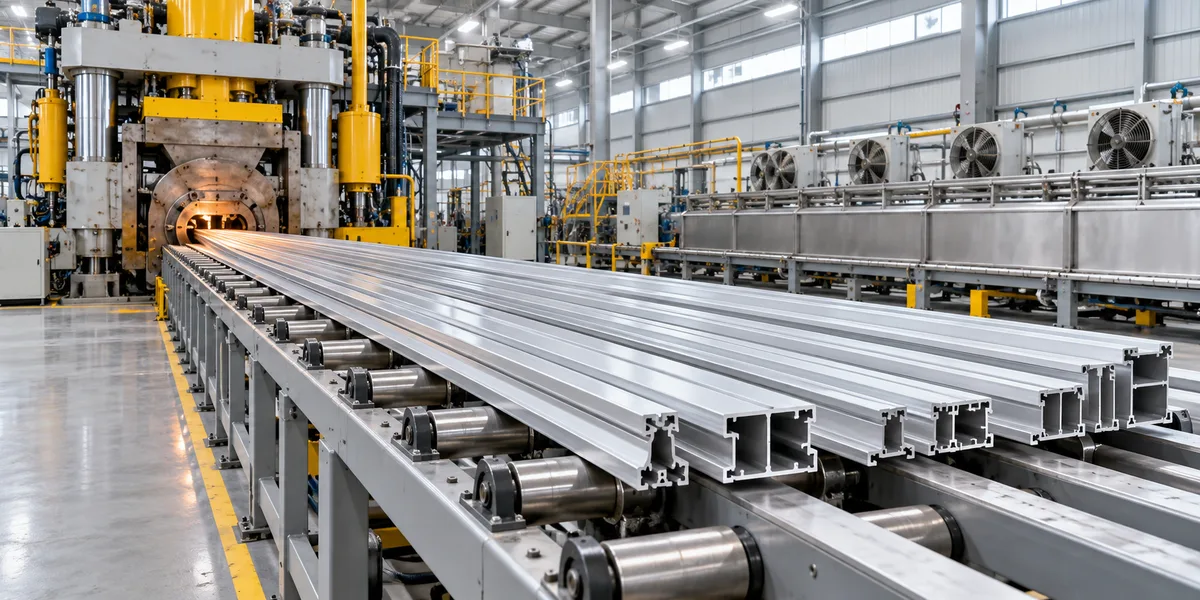
Custom Aluminium Extrusions: How the Service Works, from Drawing to Delivery
A custom aluminium extrusion is a profile made to your own cross-section using a die cut specifically for it, so the part arrives close to its final shape and needs little or no machining. This guide walks through the whole service: how extrusion works, which alloys and die types suit which profiles, the design rules that keep tooling simple and tolerances achievable, finishing options, what drives cost, and the common defects to guard against. Metline manages custom extrusion projects for customers worldwide, from drawing review to certified, export-packed delivery.
Extrusion forms aluminium the way a piping bag forms icing: a heated billet is pushed through a shaped opening and comes out as a long bar with that exact cross-section. A custom extrusion simply means the opening (the die) has been designed for your profile rather than taken from a catalogue of standard shapes.
Because the cross-section is produced in one operation, features that would take hours to machine, such as screw bosses, snap-fit grooves, cooling fins, T-slots, internal ribs and hollow chambers, are built into the profile from the start. Dies for most profiles are relatively inexpensive compared with casting moulds or stamping tools, so custom extrusion becomes economical at modest volumes, and once the die exists the cost per metre is close to that of a standard shape.
The process suits aluminium better than almost any other metal. 6xxx alloys flow readily at 400 – 500 °C, can be quenched straight off the press, and reach their final strength by artificial ageing, so a complex, thin-walled profile can leave the line already in T5 or T6 temper. The resulting parts are light, corrosion-resistant, recyclable and easy to anodise or paint.
Custom profiles are everywhere: window and curtain-wall systems, solar mounting rails, LED and electronics housings, heat sinks, EV battery enclosures, truck and trailer floors, rail car body panels, machine frames, medical equipment and consumer products. The common thread is a part that is long compared with its cross-section and would otherwise be built up from several pieces or machined from solid.
Process
How custom extrusion works, step by step
Drawing reviewThe profile drawing is checked for extrudability: circumscribing circle size, wall thickness, tongue ratios, corner radii, tolerances and the alloy and temper requested. Suggested changes are agreed before the die is cut.
Die design and manufactureA die maker designs the die (solid, semi-hollow or porthole) and machines it from hot-work tool steel such as H13, typically by CNC milling and wire EDM, followed by heat treatment and nitriding.
Billet preparationCast billets of the chosen alloy, homogenised for good extrudability, are cut to length and heated, usually to about 420 – 500 °C depending on alloy.
ExtrusionThe billet is loaded into the press container and the ram pushes it through the die. Metal flow, exit temperature and speed are controlled to protect surface quality and dimensions.
QuenchingThe profile is cooled by air, mist or water as it leaves the die. The cooling rate needed depends on the alloy: 6063 can be air cooled, while 6061 and 6082 usually need water or intense mist quenching to reach T6 properties.
Stretching and cuttingProfiles are stretched about 0.5 – 3 % to straighten them and relieve stress, then sawn to length.
AgeingArtificial ageing in an oven (typically several hours at 160 – 200 °C) brings 6xxx alloys to T5 or T6 temper.
First-article inspectionSamples from the first run are measured against the drawing and the tolerance standard and approved before volume production.
Finishing and fabricationAnodising, powder coating, cutting to length, machining, bending and packing as specified.
The first two steps are where most of the value is created. A profile that is easy to extrude runs faster, scraps less and holds tolerance better, and a few small changes at the drawing stage often save more money than any later negotiation on price per kilogram.
Profile types
Solid, semi-hollow and hollow profiles
Profiles are classed by whether they enclose a void, because that determines the type of die and therefore the cost and difficulty of the tooling.
A partly enclosed void whose opening is narrow compared with its area (a high "tongue ratio")
Semi-hollow or porthole-style die with a supported tongue
Deep narrow channels, C-slots, some T-slot profiles
Hollow
One fully enclosed void
Porthole (bridge) die: a mandrel held by bridges; metal splits and re-welds inside the die
Round, square and rectangular tube, frames, rails
Multi-void hollow
Two or more enclosed voids
Porthole die with several mandrels
Window and door frames, battery tray sections, floor planks, microchannel tube
Porthole dies produce longitudinal weld seams where the metal streams rejoin. These seams are sound in properly run 6xxx alloys and are accepted for structural, architectural and most mechanical uses, but they are a concern for high-pressure tube and for hard alloys such as 2024 and 7075, which do not re-weld reliably. For those, hollows are made seamless on a press with a piercing mandrel. Our extruded tube guide covers the difference in detail.
Die design is a specialist subject in its own right; see our article on the aluminium extrusion die for die types, design features and what affects die life.
Materials
Choosing an alloy for a custom profile
Alloy choice decides strength, surface finish, how complex the profile can be and how fast it can be extruded. In general, the softer and leaner the alloy, the thinner the walls and the more intricate the shape that can be produced, and the lower the cost per metre.
Alloy
Extrudability
Strength (typical T6/T5)
Strengths
Typical custom profiles
6060
Excellent
Moderate
Best surface and anodising, very thin walls
Architectural profiles, trims, furniture, thermal-break systems
6063
Excellent
Moderate (T6 about 240 MPa tensile)
Fine detail, decorative anodising, good corrosion resistance
Windows, curtain walls, LED housings, heat sinks, frames
6005A
Very good
Medium-high
Higher strength than 6063 while still allowing hollows and thin walls
Rail and bus structures, solar rails, ladders, scaffolding
6061
Good
High (T6 about 310 MPa tensile)
Strength, toughness, machinability
Machine frames, transport parts, marine fittings, structural sections
6082
Good
High
European structural alloy; strong in thicker sections
Seawater resistance, weldability without heat treatment
Marine sections, tanker parts
7005 / 7020
Fair
High
Weldable 7xxx alloys that recover strength after welding
Bicycle frames, sports gear, armoured and transport structures
7075 / 2024 / 2014
Difficult
Very high
Highest strength and fatigue performance
Aerospace and defence sections, high-load components; simple shapes only
1050 / 1070 / 3003
Excellent
Low
Conductivity, formability, brazing (3003)
Heat-exchanger and microchannel tube, conductors, heat sinks
If you are unsure, start with 6063-T6 for appearance-led profiles and 6061-T6 or 6082-T6 for load-bearing ones. Our 6061 vs 6063 comparison explains the trade-off in detail, and the alloy data pages list composition and properties for each grade.
Design for extrusion
Design rules for a cost-effective custom profile
Good extrusion design is mostly about helping the metal flow evenly through the die. Uneven flow causes distortion, poor surface and dimensional drift; very thin or deep features shorten die life. These rules are widely used across the industry, including in the Aluminum Extruders Council design guidance:
Keep the section compact
Size is measured by the circumscribing circle diameter (CCD), the smallest circle that encloses the profile. Smaller CCDs fit more presses, run faster and cost less. Profiles with a CCD under about 200 mm (8 in) and a modest weight per metre are the easiest to source.
Balance wall thickness
Aim for uniform walls. Where thickness must change, make the transition gradual. A thin wall next to a heavy one cools and flows differently and is a common cause of twist and wavy surfaces.
Respect minimum walls
Minimum practical wall depends on alloy and CCD: 6060 and 6063 allow the thinnest walls, 6061 and 6082 need slightly more, and 7xxx and 2xxx alloys need substantially thicker walls. Ask for a check rather than designing to the absolute limit.
Round the corners
Use radii of at least 0.5 – 1 mm on internal and external corners. Sharp corners slow metal flow, crack dies and act as stress raisers in service.
Limit tongue ratios
Deep, narrow channels (high depth-to-gap ratio) need a long, unsupported die tongue that can deflect or break. Widen the gap, reduce the depth or convert the feature to a hollow.
Use symmetry
Symmetrical profiles fill the die evenly, distort less and are easier to straighten. Where a profile is asymmetric, small balancing ribs can help.
Mark visible faces
Show which surfaces are decorative. The die can be arranged so those faces avoid weld lines, contact with the run-out table and handling marks.
Design in function
Screw bosses, grooves for gaskets, snap fits, interlocks, index marks and drill guide lines cost nothing extra in the die and save fabrication time.
Tolerance only what matters
Apply tight tolerances to functional dimensions only, and give datum features. Over-tolerancing every dimension raises scrap and price without improving the part.
Two further points help assembly-heavy designs. First, decide early whether a hollow is really needed: a well-designed open profile with a closing cover or an interlock can be cheaper than a multi-void hollow. Second, if the profile will be machined, cut, bent or anodised, tell the extruder at the start, because alloy, temper and surface specification all change accordingly. Our extrusion design and production guide covers how to integrate the profile with its fabrication.
Size range
From miniature to large and thin-wall profiles
Custom extrusions span a very wide size range. Which part of it your profile falls into decides the class of press required, the achievable tolerances and how many sources can make it.
Category
Typical characteristics
Typical uses
Design notes
Miniature profiles
CCD of a few millimetres to about 75 mm (3 in); very light weight per metre; precision tolerances possible
Medical devices, electronics, optics, instrument parts, small tubes
Usually 6063 or 6061; tight tolerances are achievable but must be agreed in advance
Standard industrial profiles
CCD about 50 – 250 mm; the bulk of the market
Frames, housings, rails, systems profiles, heat sinks
Widest choice of presses and the most competitive pricing
Large profiles
CCD above about 300 mm, wide panels and heavy sections; produced only on large presses
Rail car bodies, trailer and container floors, ship decks, battery trays, bridge decks, large heat sinks
Fewer sources; plan die and trial times; wide panels may be friction stir welded from narrower sections
Thin-wall profiles
Walls well under 1 mm in 6063 and lean alloys
Heat-exchanger tube, light-duty housings, decorative trim
Requires lean alloys, careful die design and controlled handling
Lengths are typically supplied at 3 – 6 m for handling and shipping convenience, but extrusion lines can produce much longer profiles; containerised export usually limits practical length to just under 12 m unless break-bulk or flat-rack shipping is used. See our page on large custom extrusions for the heavy end of the range.
Quality
Tolerances, standards and inspection
Unless the drawing states otherwise, custom profiles are made to the general tolerance tables of a published standard. Name the standard on the drawing so everyone measures against the same rules.
Standard
What it covers
EN 755-1 / 755-2
Technical delivery conditions and mechanical properties of extruded profiles
EN 755-9
Tolerances on dimensions and form of general extruded profiles (CCD up to 800 mm)
EN 12020-2
Tighter tolerances for precision profiles in EN AW-6060 and EN AW-6063, including thermal-break profiles
ASTM B221 / B221M
Extruded profiles, bar and tube: chemistry, tempers, mechanical properties
ANSI H35.2 / Aluminum Standards and Data
Standard dimensional tolerances used with ASTM orders
EN 15088
Aluminium structural products for construction works
JIS H4100 / GB/T 6892
Japanese and Chinese standards for extruded profiles
EN 10204
Inspection documents: type 3.1 mill test certificate
Tolerances widen with profile size and are tighter for 6060 and 6063 than for 6061, 6082 and harder alloys. Wall thickness tolerances in EN 755-9 also depend on whether the wall encloses a void, because walls around a hollow are harder to control. If a dimension must be tighter than standard, state it on the drawing as a special tolerance; it can usually be met by die design and process control, at some cost.
First-article inspection: full dimensional check of samples from the first run against the drawing
Production checks: regular measurement of critical dimensions, straightness, twist and angles
Material tests: chemistry, tensile tests or hardness and conductivity checks per lot
Surface inspection: visible faces checked for die lines, scratches and finish defects; coating thickness for anodised and painted profiles
Documentation: EN 10204 3.1 certificate, inspection report, and third-party inspection on request
Secondary processing
Finishing and fabrication options
Most custom profiles go through at least one secondary process. Ordering them with the extrusion simplifies logistics and makes one supplier responsible for the finished part.
Process
What it gives
Notes and standards
Anodising
Hard, corrosion-resistant oxide layer; clear or coloured
Architectural grades to EN ISO 7599 and Qualanod; 6060/6063 give the most even colour
Hard anodising
Thick, wear-resistant coating for sliding and wear surfaces
Typically 25 – 75 µm; specify thickness and sealing
Powder coating
Wide colour range, good weather resistance
Qualicoat classes or AAMA 2603/2604/2605 for façades
Wet painting / PVDF
Long-life architectural finishes
Common on curtain-wall and cladding profiles
Electrophoretic coating
Thin, uniform, glossy coating over anodising
Used on some window and interior systems
Wood-grain transfer
Timber appearance on powder-coated profiles
Doors, windows, furniture, interiors
Mechanical finishes
Brushed, polished, bead-blasted surfaces
Usually before anodising; consistent direction matters
Cutting
Profiles cut to exact length, mitred or angled
Saw cutting with deburring
CNC machining
Holes, slots, pockets, threads, end features
Drilling, milling, tapping, turning to drawing
Bending and stretch forming
Curved and formed profiles
Easier in T4 or O, then aged; 6063 bends best
Punching and notching
High-volume holes and cut-outs
Economical for repeated features
Thermal-break assembly
Insulating strips rolled into window profiles
Polyamide strips to EN 14024
A useful rule: decide the finish before cutting the die. Decorative anodising shows every die line and alloy variation, so it may call for 6060 or 6063 and particular attention to the visible face, whereas a powder-coated or hidden profile can tolerate a wider choice of alloy and surface.
Cost
What drives the cost of a custom extrusion
A custom extrusion has two cost components: a one-time tooling cost for the die, and a recurring price per kilogram or per metre for the profile.
Die (tooling) cost depends on
Profile type: solid dies cost least, porthole dies for hollows more, multi-void dies most
Size (CCD) and the press class it needs
Complexity: thin walls, fine details, high tongue ratios and tight tolerances
Alloy: dies for hard alloys work harder and wear faster
Number of die openings (cavities) for small profiles
Profile price depends on
Aluminium market price (LME plus regional premium) and the alloy
Weight per metre: heavier profiles usually cost less per kg to extrude
Extrusion speed and recovery, which fall with complexity and hard alloys
Temper, quench and testing requirements
Finish, machining, cutting, packing and freight
Order quantity and how often the die is set up
Ways to reduce cost without compromising the part:
Simplify the section and remove hollows that are not structurally needed
Use the leanest alloy that meets the strength requirement (6063 or 6005A before 6061 or 7075)
Even out wall thicknesses and add radii, which raise extrusion speed and yield
Ask whether an existing standard or catalogue die can be used, or adapted with light machining
Order in fewer, larger runs to reduce set-up and die changes
Tolerance only critical dimensions and specify finishes only where they are visible
Quality problems
Common extrusion defects and how they are prevented
Defect
What it looks like
Typical causes
Prevention
Die lines
Fine longitudinal lines on the surface
Worn or damaged die bearing, pick-up on the die
Die polishing and nitriding, correct bearing design, regular die maintenance
Blisters
Raised bubbles on the surface, often after heat treatment or anodising
Trapped air or gas, billet surface contamination, lubricant
Clean billets, correct billet scalping or skinning, controlled burp cycle
Streaking
Bands of different appearance after anodising
Uneven metal flow, weld seams on visible faces, coarse grain
Die layout that keeps weld seams off visible faces, alloy and billet control
Tearing and speed cracking
Transverse cracks at edges and corners
Excessive exit temperature or speed, sharp corners
In-process measurement, die correction, process control
Back-end defect
Oxide or skin entrained near the end of the billet
Billet surface metal drawn into the profile
Correct discard (butt) length and billet quality
Weak weld seams
Seam failure in hollow profiles
Insufficient pressure or temperature in the welding chamber, contamination
Die design, process control, seamless tube for critical pressure uses
Most of these defects are prevented at the design and die stage rather than caught at inspection. A profile with balanced walls, radiused corners and weld seams placed away from visible faces will run consistently for the life of the die.
Applications
Custom extrusions by industry
Industry
Typical alloys
Typical custom profiles
Key requirements
Building and construction
6060, 6063, 6005A
Window, door and curtain-wall system profiles, thermal-break sections, louvres, railings
Finish quality, tolerances to EN 12020-2, structural design to EN 1999
T-slot framing, linear guides, machine frames, conveyor profiles
Straightness, flatness, machinability
Solar and energy
6005A, 6063, 6061
Mounting rails, clamps, frame profiles
Corrosion resistance, long service life
More detail on these sectors is on our building, automotive, transportation and solar energy pages. For building systems, Metline supplies the extruded profiles and accessories to fabricators and system companies; it does not fabricate or install finished windows, doors or façades.
Alternatives
When another process is the better choice
Process
Better than extrusion when
Less suitable when
CNC machining from plate or bar
Very small quantities, prototypes, parts with features that vary along the length
Long parts or volumes where machining time and scrap dominate cost
Die casting
Complex 3D shapes, closed ends, high volumes
Long uniform parts; cast alloys are weaker and less ductile than wrought
Roll forming of sheet or coil
Thin, constant-thickness open sections in very high volumes
Sections need varying wall thickness, hollows or integrated features
Press-brake bending of sheet
Simple angles and channels, short runs, no die budget
Tight tolerances, complex shapes, long lengths
Forging
Highly stressed parts needing grain flow and through-thickness strength
Long constant sections
Extrusion and machining often work together: a near-net profile is extruded, then cut and machined to add holes, threads and end features. This combination is usually the cheapest route for parts that are mostly constant in section but need some local detail.
Working with Metline
How a custom extrusion project runs with Metline
EnquirySend the drawing, alloy and temper, finish, lengths, annual and first-order quantities, standards and destination.
Technical reviewWe review extrudability and tolerances, suggest design changes that cut cost or risk, and confirm whether a new die is needed.
QuotationYou receive the tooling cost, profile price, finishing and processing costs, documents and delivery terms (EXW, FOB, CIF or DAP).
Die and samplesAfter approval the die is made and a trial run produces samples for dimensional and finish approval.
Production and inspectionVolume production with in-process checks, final inspection and an EN 10204 3.1 certificate.
Packing and shippingProfiles are protected with film or interleaving, bundled or crated for export and shipped by sea or air.
Keep the die drawing and approved samples on file, and agree how the die will be stored and maintained between orders. A well-maintained die can run many repeat orders, which is where the real economics of custom extrusion pay off.
How much does a custom aluminium extrusion die cost?
It depends mainly on the profile type, size and complexity. A die for a small solid profile is the cheapest tooling in metal forming; porthole dies for hollow and multi-void profiles cost more, and large-press dies more again. Send the drawing and we will quote the tooling and profile price together.
Who owns the extrusion die?
The customer normally pays for the die and it is reserved for their profile. Agree in writing how it is stored, maintained and replaced when worn, and whether it can be transferred.
Can a custom extrusion be supplied finished and machined?
Yes. Profiles can be anodised, powder coated or painted and then cut, drilled, milled, tapped, bent or punched to drawing, so the parts arrive ready to assemble.
What tolerances can custom extrusions hold?
General profiles are made to EN 755-9 or ANSI H35.2 tables; precision profiles in 6060 and 6063 can be made to the tighter EN 12020-2 tables. Specific critical dimensions can be held tighter by agreement, and machining can be used where extrusion alone cannot meet the drawing.
Which alloy is best for custom extrusions?
6063 for complex, thin-walled or decorative profiles, 6005A when more strength is needed in hollows, 6061 or 6082 for structural and machined parts, and 7075 or 2024 only where very high strength justifies simpler shapes and higher cost.
How can I reduce the cost of my extrusion?
Shrink the circumscribing circle, even out wall thickness, add corner radii, avoid unnecessary hollows, choose the leanest suitable alloy, tolerance only critical dimensions and order in larger, less frequent runs.
Do you supply custom extrusions outside India?
Yes. Metline ships custom profiles worldwide with export packing, EN 10204 3.1 certificates and EXW, FOB, CIF or DAP terms.
Ready to develop a custom profile?
Send your drawing, alloy, finish and quantities. Metline will review extrudability and come back with tooling, pricing and delivery options.