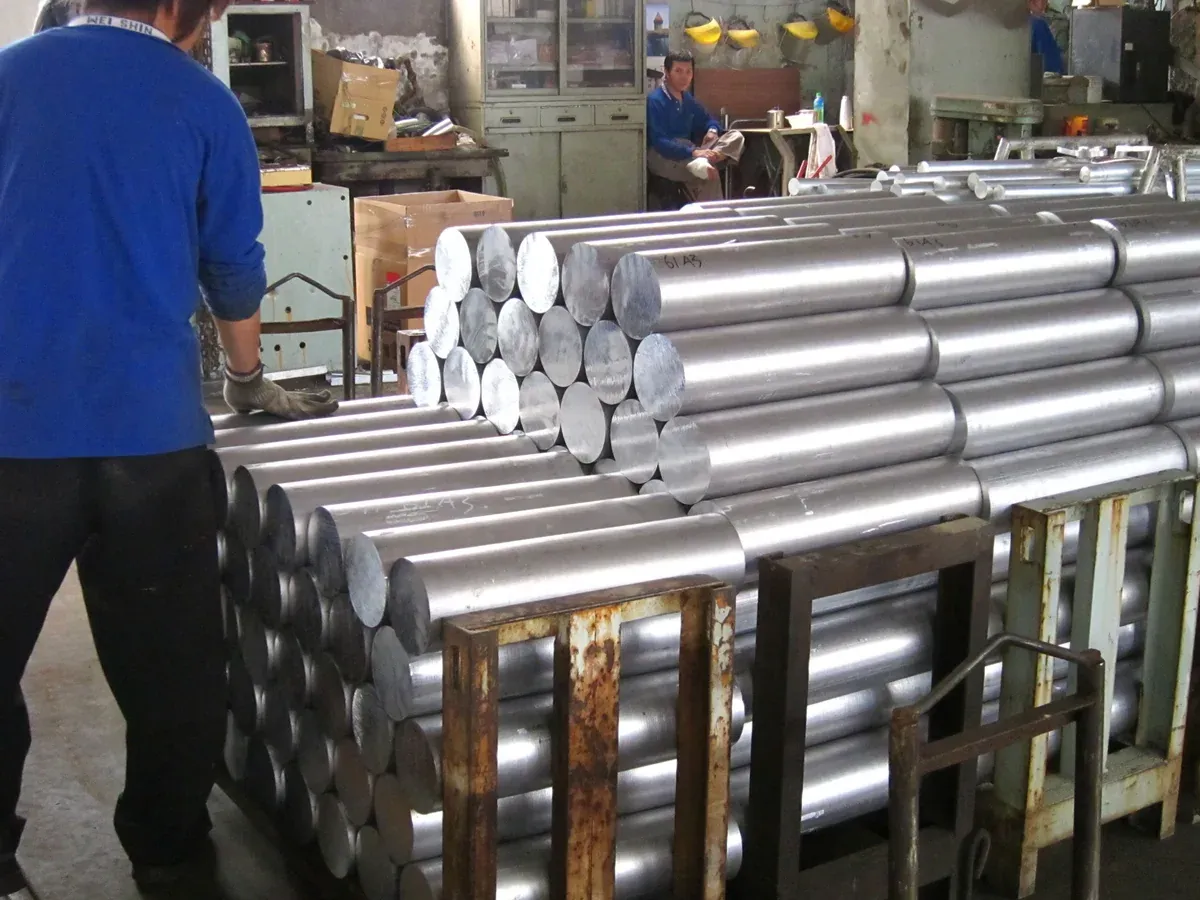
7075 aluminium billet is direct-chill (DC) cast, homogenised round stock that forging shops and extruders convert into high-strength 7075 parts and profiles. Its value lies in what you cannot see: melt cleanliness, low hydrogen, a fine and uniform grain and an even chemistry from surface to centre. This guide explains how 7075 billet is made, the diameters available, which quality checks matter and how to specify it.
What is 7075 billet, and how is it different from bar?
A billet is upstream feedstock: a cylindrical casting that has not yet been hot-worked into its final product. A 7075 bar, by contrast, has already been extruded or forged, heat-treated to a temper such as T651 and is ready for machining. Buyers of billet are usually forging plants, extrusion plants and makers of large machined blanks who control their own hot working and heat treatment.
Because the billet has a cast structure, its quality decides how the final product behaves. Oxide films, porosity and coarse intermetallic particles in the billet end up inside the forging or profile, where they lower fatigue life and can cause ultrasonic rejections. A good 7075 billet is therefore judged on internal soundness and consistency, not just diameter and chemistry.
Melting and alloyingPrimary aluminium and controlled scrap are melted, then zinc, magnesium, copper and chromium are added to hit the 7075 window. Chemistry is checked by spectrometer before casting.
Melt treatmentIn-line degassing removes dissolved hydrogen, which would otherwise form porosity, and ceramic foam or deep-bed filters capture oxide inclusions.
Grain refiningAn Al-Ti-B or Al-Ti-C refiner is fed into the launder to produce fine, equiaxed grains and reduce cracking risk during casting.
Direct-chill castingMetal is solidified in water-cooled moulds and sprayed directly as it leaves the mould. 7075 has a wide freezing range and high casting stresses, so casting speed and cooling are tightly controlled to avoid cold and hot cracks.
HomogenisationLogs are soaked at a high temperature, typically in the region of 460 – 480 °C, for many hours. This dissolves low-melting phases, evens out micro-segregation and forms the chromium-bearing dispersoids that later control grain structure.
Sawing, scalping and inspectionLogs are cut to length; large forging billets may be scalped or turned to remove the cast skin. Ultrasonic testing, macro-etch slices and chemistry records complete the lot documentation.
Chemical composition
7075 billet composition (wt %)
7075 billet follows the same registered limits as wrought 7075 products. Some aerospace programmes ask for tighter iron and silicon (for example Fe ≤ 0.25 %, Si ≤ 0.15 %) to improve toughness and fatigue life; state these on the order if your end customer requires them.
Element
Minimum
Maximum
Role in the alloy
Silicon (Si)
—
0.40
Impurity; kept low for toughness
Iron (Fe)
—
0.50
Impurity; forms coarse constituents that cut fatigue life
Copper (Cu)
1.2
2.0
Adds strength and improves stress-corrosion behaviour
Manganese (Mn)
—
0.30
Minor grain control
Magnesium (Mg)
2.1
2.9
Combines with Zn to form the MgZn2 strengthening phase
Chromium (Cr)
0.18
0.28
Controls recrystallisation and stress-corrosion cracking
Zinc (Zn)
5.1
6.1
Main alloying element
Titanium (Ti)
—
0.20
Grain refiner
Others, each / total
—
0.05 / 0.15
Aluminium (Al)
Remainder
About 87 – 91 %
Supply range
7075 billet diameters, lengths and weights
Typical supply range
Diameter
About 73 – 630 mm, matched to extrusion container or forging plan
Length
Logs of about 3 m or 6 m, or sawn billets cut to your press length
Surface
As-cast, or scalped / turned for forging stock
Condition
Homogenised, with homogenising records on request
Tolerances
Diameter, ovality, end squareness and straightness agreed per press
Documentation
Chemistry, cast and lot number, ultrasonic report, EN 10204 3.1 certificate
Weight of a round billet is π/4 × D² × L × 2.81 g/cm³. The table shows weight per metre for common diameters.
Diameter (mm)
kg per metre
Typical use
78
13
Small extrusion presses, forging slugs
102
23
Extrusion of small profiles and rod
127
36
Extrusion of bar and tube
178
70
Medium presses, open-die forgings
254
142
Large extrusions, closed-die forgings
305
205
Heavy forgings, large rod
406
364
Large forgings and blocks
508
570
Rolled rings, very large forgings
610
821
Heavy-press forgings
Quality
Quality checks that matter for 7075 billet
Ultrasonic soundness
Immersion or contact ultrasonic testing finds porosity, cracks and inclusion clusters. Agree the acceptance class (for example by flat-bottom-hole size) before ordering, since forgings for aircraft parts are later tested to AMS-STD-2154 or equivalent.
Hydrogen content
Low dissolved hydrogen, measured on the melt or on samples, prevents porosity that would show up as blisters after heat treatment.
Grain size and macro-etch
A transverse slice etched to reveal the grain should show fine, uniform equiaxed grains with no feathery crystals, cold shuts or centre cracking.
Inclusion level
Filtration and clean handling reduce oxide films. Some buyers specify a PoDFA or similar melt-cleanliness test.
Chemistry uniformity
Analysis from several positions or casts confirms there is no strong segregation of zinc or copper across the diameter.
Traceability
Each billet should carry its cast number so that any later defect can be traced back to the melt and homogenising batch.
Downstream processing
Forging, extrusion and machining with 7075 billet
Extrusion. 7075 is one of the hardest common alloys to extrude. Billets are preheated to roughly 380 – 440 °C and pushed at low ram speeds, giving exit speeds of only a few metres per minute, to avoid surface tearing and incipient melting. Containers and dies must be designed for high pressures. The profiles are then solution treated, quenched, stretched and aged, normally to T6511 or T73511.
Forging. For open-die and closed-die forgings, billets are heated in a narrow window, typically around 380 – 440 °C, because 7075 becomes crack-prone if forged too cold and risks incipient melting if overheated. Forged parts are heat-treated to T6, T652, T73 or T7352, with the stress-relieved "52" tempers produced by cold compression after quenching.
Direct machining. Billet is occasionally machined into parts without hot working, but cast-and-homogenised material has lower ductility, fatigue strength and toughness than wrought 7075. For structural parts, use plate, bar or forgings instead.
Applications
End uses of 7075 billet
Aerospace forgings: landing-gear components, wing fittings, bulkheads and brackets made by closed-die forging
Aerospace and defence extrusions: stringers, seat tracks, spars and missile structures in T6511 or T73511
Sporting goods: extruded tubes for bicycle frames, arrows, tent poles and climbing equipment
High-load machinery: forged levers, couplings and housings that need strength above 6xxx alloys
Moulds and tooling: forged blocks used as feedstock for blow-moulding and rubber moulds
Automotive and motorsport: forged wheels, suspension uprights and brake components in performance vehicles
Ordering
How to specify and order 7075 billet
SizeDiameter and tolerance, length (log or cut billet), and quantity in pieces or tonnes.
Chemistry7075 to the Aluminum Association / EN 573-3 limits, plus any tighter Fe, Si or Zr limits your customer specifies.
ConditionHomogenised; as-cast or scalped surface; end-cut squareness.
InspectionUltrasonic acceptance level, macro-etch, hydrogen and any third-party witness.
ShippingBanded bundles on timber skids or crates, with EN 10204 3.1 certificates, on EXW, FOB, CIF or DAP terms.
What is the difference between 7075 billet and 7075 bar?
7075 billet is cast and homogenised feedstock for hot working; it has no heat-treated temper and is not meant for direct service. 7075 bar has been extruded, drawn or forged and heat-treated (usually to T6 or T651), so it is ready to machine into parts.
What diameters of 7075 billet are available?
Round billet is commonly cast from about 73 mm up to around 630 mm diameter, in logs of about 3 or 6 m or sawn to press length. The right diameter depends on the extrusion container or the forging reduction you need.
Why is 7075 billet homogenised?
Homogenisation dissolves low-melting eutectic phases, reduces segregation and forms the dispersoids that control grain structure. Without it, 7075 extrudes poorly, cracks more easily during forging and responds less evenly to heat treatment.
Can 7075 billet be machined directly into parts?
It can, but the cast structure gives lower ductility, toughness and fatigue strength than wrought 7075. For load-bearing parts, use 7075 plate, bar or a forging instead.
What inspection should I ask for on 7075 billet?
At minimum, chemistry by cast and an ultrasonic soundness test to an agreed acceptance level. For aerospace forging stock, add macro-etch grain checks, hydrogen measurement and full traceability, documented on an EN 10204 3.1 certificate.
Sourcing 7075 billet?
Tell us the diameter, length, quantity, inspection level and destination port. We will confirm availability and documentation.