3003 honeycomb core
Cost-effective, easy to bend and shape. Used for building panels, doors, partitions, signage, cleanroom walls and general industrial panels.



A honeycomb sandwich panel bonds two thin facings to a lightweight cellular core, giving very high stiffness for its weight. The core material, cell geometry, facing and joining method together decide strength, temperature range, fire behaviour and cost. This overview compares the main core materials and panel types, explains how to choose between them, and shows where Metline's aluminium honeycomb core and panels fit.
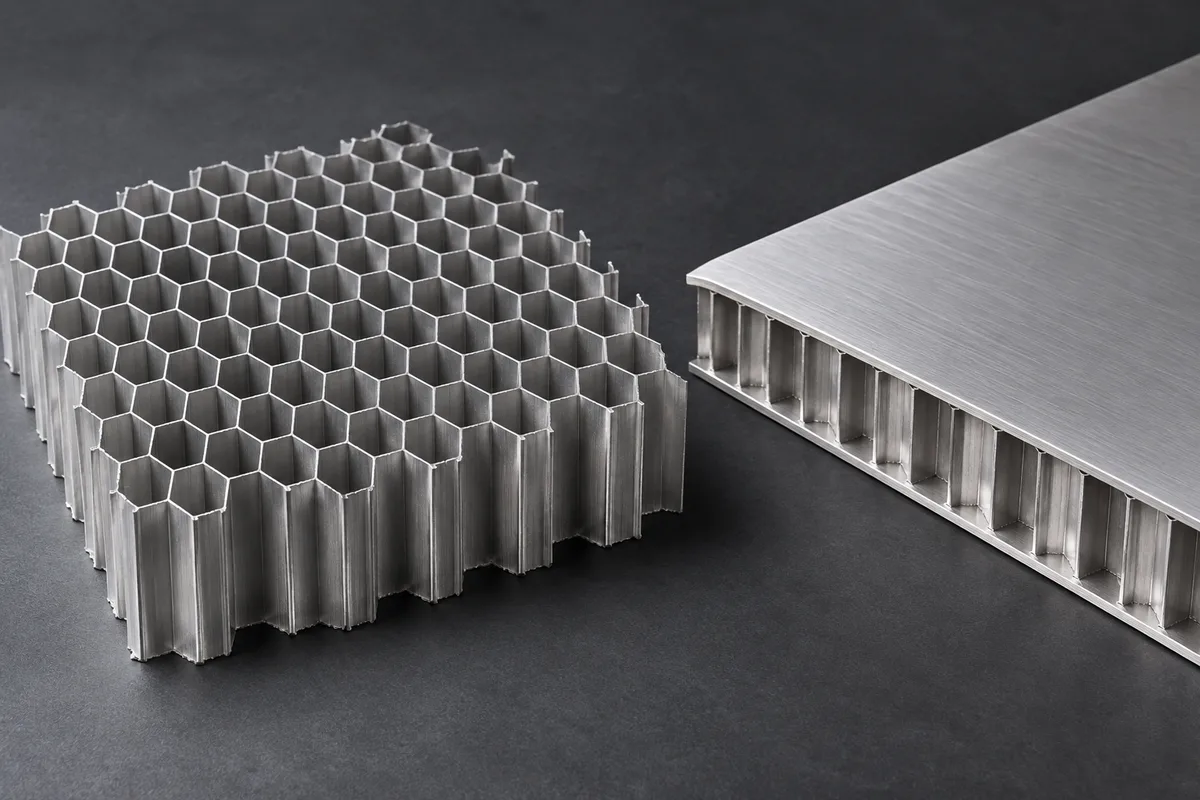
A sandwich panel behaves like an I-beam spread out into a sheet. The two facings act as the flanges, carrying bending as tension on one side and compression on the other. The core acts as the web: it keeps the facings apart, carries transverse shear and supports the facings against wrinkling and buckling. Because bending stiffness rises with the square of the distance between the facings, a thicker core adds a great deal of stiffness for very little weight.
| Construction | Relative bending stiffness | Relative bending strength | Relative weight |
|---|---|---|---|
| Solid sheet of thickness t | 1 | 1 | 1 |
| Same material split into two facings with core, total 2t | About 7 | About 3.5 | About 1.03 |
| Same facings with core, total 4t | About 37 | About 9 | About 1.06 |
Classic illustration published by honeycomb producers for a lightweight core; actual gains depend on core shear stiffness and facing material.
Honeycomb is the most efficient core shape for flat panels because the hexagonal cell walls run straight through the thickness and give high compressive and shear strength at very low density. Foams, balsa and corrugated cores are alternatives, but at equal weight a well-chosen honeycomb is usually the stiffest and strongest option.
The table compares the core families most often considered for sandwich panels. Metline supplies aluminium honeycomb; the other materials are shown so you can see where each one is the better engineering choice.
| Core material | Density range | Typical service temperature | Strengths | Watch-outs |
|---|---|---|---|---|
| 3003 aluminium | Low to medium | To about 177 °C bonded | Economical, formable, conductive | Lower strength than 5xxx cores |
| 5052 aluminium | About 26 – 190 kg/m³ | To about 177 °C bonded | General-purpose structural core; aerospace spec AMS-C-7438 | Needs coating and edge sealing in wet service |
| 5056 aluminium | Similar to 5052 | To about 177 °C bonded | Highest strength of standard aluminium cores, good salt-spray resistance | Higher cost |
| 5A12 aluminium | Medium to high | To about 177 °C bonded | High-magnesium foil, high strength per density | Chinese-standard alloy; specify by drawing |
| Aramid paper (phenolic) | Low to medium | To about 177 °C | Insulating, radar-transparent, tough, good fire behaviour | Absorbs moisture; lower stiffness |
| Thermoplastic (PP, PC) | Low to medium | Usually below 80 – 100 °C | Low cost, water-resistant, easy to process | Low stiffness and temperature limit |
| Kraft paper | Very low | Ambient | Very cheap; doors, packaging, furniture | Not structural in wet or loaded service |
| Stainless steel and nickel alloys | High | Several hundred °C and above | Heat and oxidation resistance | Heavy and expensive |
In weight-critical structures the comparison usually narrows to aluminium versus aramid. Aluminium gives higher stiffness and strength per kilogram, conducts heat and electricity and resists moisture once coated; aramid insulates, is transparent to radar and recovers better from small impacts. Our insight on aluminium vs aramid honeycomb core covers that choice in depth, and 3003 vs 5052 core covers the choice between aluminium grades.
Cost-effective, easy to bend and shape. Used for building panels, doors, partitions, signage, cleanroom walls and general industrial panels.
The standard structural core for aerospace, rail, marine and industrial panels: stronger and more corrosion-resistant than 3003.
Highest strength of the standard alloys and best salt-spray resistance; chosen for aerospace and naval structures and energy absorbers.
High-magnesium foil core supplied against drawings and specifications that call for it.
Availability of a given cell, foil and size combination is confirmed per enquiry.
Unexpanded core is shipped as compact blocks or slices and expanded by the user on a stretching frame, which can cut freight volume dramatically on long routes. See the unexpanded honeycomb core guide for how to expand it correctly.
| Core type | Description | When to use it |
|---|---|---|
| Standard hexagonal | Regular hexagonal cells | Flat panels; the basis of published property data |
| Over-expanded | Cells pulled further in the W direction into a near-rectangular shape | Panels curved in one direction; higher W shear |
| Flexible-geometry | Modified cell shape that drapes onto compound curves | Fairings, radomes, nose cones and curved covers |
| Reinforced | Extra foil layers along the ribbon | Local high-shear areas such as inserts and hinge lines |
| Micro-cell | Cells around 1 – 2 mm | Very thin facings, precision parts, smooth surfaces, EMI vents |
| Perforated | Small holes through cell walls | Venting during bonding, vacuum and space use |
| Pre-crushed | Crush front started by the producer | Energy absorbers and crash barriers |
Density is the single best predictor of core strength. For the same alloy, compressive and shear strength rise faster than density, so choosing the right cell and foil combination is the main lever for optimising panel weight. Typical property data by geometry are given on the 5052 honeycomb core page.
A finished panel combines a core with facings and a joining method. Metline supplies aluminium honeycomb core and aluminium-faced honeycomb panels, and supplies the aluminium core and skins to fabricators who build panels with other facings.
| Panel type | Facings | Joining | Typical uses |
|---|---|---|---|
| Aluminium honeycomb panel | 3003, 5052 or 5005 sheet, mill finish, anodised, PVDF or polyester coated | Epoxy or polyurethane adhesive | Facades, ceilings, partitions, vehicle bodies, platforms |
| Brazed aluminium honeycomb panel | Aluminium brazing sheet | Vacuum or controlled-atmosphere brazing, no adhesive | Cleanrooms, ovens, vacuum and outgassing-sensitive equipment |
| Decorative aluminium panel | Printed, wood-grain, stone-grain, perforated or embossed aluminium | Adhesive | Interiors, lifts, ceilings, retail fit-outs |
| Stone-faced panel | Thin natural stone veneer on aluminium honeycomb backing | Structural adhesive | Lightweight stone cladding and interiors |
| Composite-faced panel | CFRP or GFRP skins on aluminium core | Film adhesive or co-cure | Aerospace, motorsport, marine, rail |
Typical prefabricated aluminium panels are offered in 1220 × 2440 mm (48 × 96 in) and larger formats, in total thicknesses from about 3 mm (1/8 in) to 75 mm (3 in), with skins commonly 0.5 – 1.5 mm. Cut-to-size, folded edges, curved panels and embedded inserts are possible to drawing. The honeycomb sandwich panel guide covers panel build-ups in more detail.
Epoxy film cured under heat and pressure, forming a fillet at every cell wall. Standard in aerospace for the highest peel and shear strength.
Two-part epoxies and polyurethanes, roller-coated or sprayed. Used for building, transport and industrial panels on press lines.
Al-Si clad sheet and core joined in a furnace. No organic content, highest temperature tolerance and no outgassing.
The adhesive lines that hold expanded core together; their rating often sets the core temperature limit.
Conversion coating or phosphoric-acid anodising of aluminium skins and core gives the most durable bond, especially in humid service.
Extruded aluminium edge profiles, folded skins or potting seal the cells against moisture and give fixing points.
Joining choice affects more than strength: it decides temperature range, fire classification and whether the panel can be recycled easily. Our insight on honeycomb core joining methods compares the options.
Durability in service depends mostly on the bond line. Panels that fail after years outdoors rarely fail because the aluminium core or skins have corroded through; they fail because moisture has reached an untreated bond surface and the adhesive has lost adhesion. Specify the surface treatment for both skin and core, require sealed edges and drainage paths where panels can collect water, and ask for peel or flatwise tension tests after humidity ageing if the panel will live outdoors or at sea.
| Sector | Typical parts | Usual core | Key requirements |
|---|---|---|---|
| Aerospace | Floors, flaps, control surfaces, interiors, satellite panels | 5052 and 5056 coated core | AMS-C-7438 core, flammability (FAR 25.853 for interiors), weight |
| Rail and metro | Floors, side walls, ceilings, doors, cab fronts | 3003 or 5052 core with aluminium skins | EN 45545-2 fire safety, stiffness, crash absorbers to EN 15227 |
| Marine | Bulkheads, decks, furniture, superstructure panels | 5052 or 5056 core | Corrosion resistance, IMO fire rules for passenger ships |
| Building | Facades, ceilings, partitions, canopies | 3003 core with coated 3003/5005 skins | Flatness, colour durability, EN 13501-1 fire class |
| Cleanrooms and labs | Walls, ceilings, raised floors | 3003 core or brazed panels | Low particle shedding, flatness, no outgassing |
| Electronics and EMC | Vent panels, enclosures, air-flow straighteners | 3003 or 5052 micro-cell core | Electrical continuity, shielding effectiveness |
| Crash and impact | Barriers, attenuators, absorbers | 3003, 5052, 5056 pre-crushed | Certified crush strength |
Specialised pages cover aircraft honeycomb, energy-absorbing honeycomb, EMI honeycomb vent panels and high-temperature honeycomb.
| Test or standard | What it measures or covers |
|---|---|
| ASTM C365 | Flatwise compressive strength and modulus of sandwich cores |
| ASTM C273 | Core shear strength and modulus, L and W directions |
| ASTM C297 | Flatwise tensile strength of the core-to-facing bond |
| ASTM C393 / D7249 | Flexural properties of sandwich beams |
| ASTM D1781 | Climbing drum peel strength of facing bonds |
| SAE AMS-C-7438 | Aluminium honeycomb core for aerospace sandwich construction |
| EN 13501-1 | Reaction-to-fire classification of building products |
| EN 45545-2 | Fire behaviour of materials in railway vehicles |
For each delivery, ask for certificates of the foil and facing alloys, core density checks and the agreed mechanical tests on samples from the production lot. Typical tolerances for expanded aluminium core are about ±10 % on density and cell size, and tight slice-thickness tolerances on thin cores.
A sandwich panel can fail in several ways that a solid plate cannot, and each one points to a different design change. Run through all of them during design, not only the bending stress in the facings.
| Failure mode | What happens | How to prevent it |
|---|---|---|
| Facing yield or fracture | Skin on the tension or compression side reaches its strength | Thicker or stronger facing alloy, or deeper core |
| Core shear failure | Core shears between the facings near supports | Higher-density core, L direction along the span, deeper core |
| Face wrinkling | Compression skin buckles into the core over short wavelengths | Stiffer, denser core; better bond |
| Intra-cell dimpling | Thin skin buckles into individual cells | Smaller cell size or thicker skin |
| Local indentation | Core crushes under point loads, feet or wheels | Higher-density core locally, load-spreading plates |
| Insert pull-out | Fastener insert tears out of the core | Potted inserts, reinforced core zones, through-bolts with spacers |
| Bond failure (delamination) | Skin separates from core | Correct surface treatment, adhesive and cure; sealed edges |
Aluminium honeycomb's directional shear strength is the detail designers most often miss. Shear strength in the W direction is typically about 60 % of the L-direction value, so a panel that spans in two directions should be checked with the W value on the weaker axis. Deflection checks must include core shear deflection as well as bending deflection; for thick, soft cores on short spans, shear deflection can be the larger part.
Band saws and reciprocating knives slice core cleanly; CNC ultrasonic knives profile complex shapes without crushing cell walls.
Circular saws and CNC routers with carbide tools cut finished panels; support the panel close to the cut to avoid skin lifting.
Route a groove, fold the skin, fit an extruded aluminium edge profile or fill with potting compound to seal cells and give clean edges.
Drill through one skin, remove a small volume of core and pot a threaded insert with epoxy filler; for heavy loads use through-panel inserts.
Route a V-groove in the back skin and core, then fold to create cassette panels for facades and ceilings.
Pre-coated PVDF or polyester skins give the most durable architectural finish; anodised skins suit interiors and equipment.
Metline can supply core and panels cut to size or machined to drawing, with edge profiles and inserts specified on the order. For high-volume projects, supplying core as unexpanded slices plus coated aluminium coil for skins can be the most economical route for a fabricator with its own press line.
Aluminium, mainly 3003 for commercial and building panels and 5052 for structural and aerospace panels. Aramid paper core is the main non-metallic alternative.
Aluminium honeycomb core in 3003, 5052, 5056 and 5A12, expanded or unexpanded, and aluminium-faced honeycomb panels including brazed panels. We also supply aluminium core and skins to fabricators building composite-faced panels.
The common format is 1220 × 2440 mm (4 × 8 ft), with longer 3050 and 3660 mm lengths and custom cut sizes. Total thickness typically runs from about 3 mm to 75 mm.
Smaller cells support thin facings better and give smoother surfaces and more bond area; larger cells save weight in lightly loaded panels. Choose density first for strength, then the cell size that suits facing thickness.
Aluminium core and skins are non-combustible; the adhesive and coating decide the fire class. Panels for buildings, rail and ships are tested as complete products to EN 13501-1, EN 45545-2 or IMO rules.
Yes. Single curvature is achieved with over-expanded core or by roll-bending finished panels; compound curves use flexible-geometry core or pre-formed parts.
Unexpanded core is the bonded block or slice before the cells are opened; it ships compactly and is expanded by the user. Expanded core is supplied open and ready to bond.
Tell us the application, loads, size and environment. We will recommend an aluminium core and panel build-up and send a quote.





