Face skin
The visible sheet, usually 3003, 5005 or 5052 aluminium 0.7 – 1.5 mm thick, coil-coated with PVDF or FEVE paint, anodised, printed with wood or stone patterns, or faced with a thin natural stone veneer.



A decorative aluminium honeycomb panel bonds a painted, anodised or stone-faced aluminium skin to a lightweight aluminium honeycomb core and a back sheet, giving a large, very flat panel that weighs a fraction of solid sheet or stone. Architects use them for feature walls, ventilated façades, large-format ceilings and raised floors. This guide covers how the panels are built, which skins and cores to specify, typical sizes and weights, and how to choose between honeycomb, composite and solid aluminium panels. Metline supplies honeycomb panels, cores and skin sheet to fabricators and project buyers worldwide.
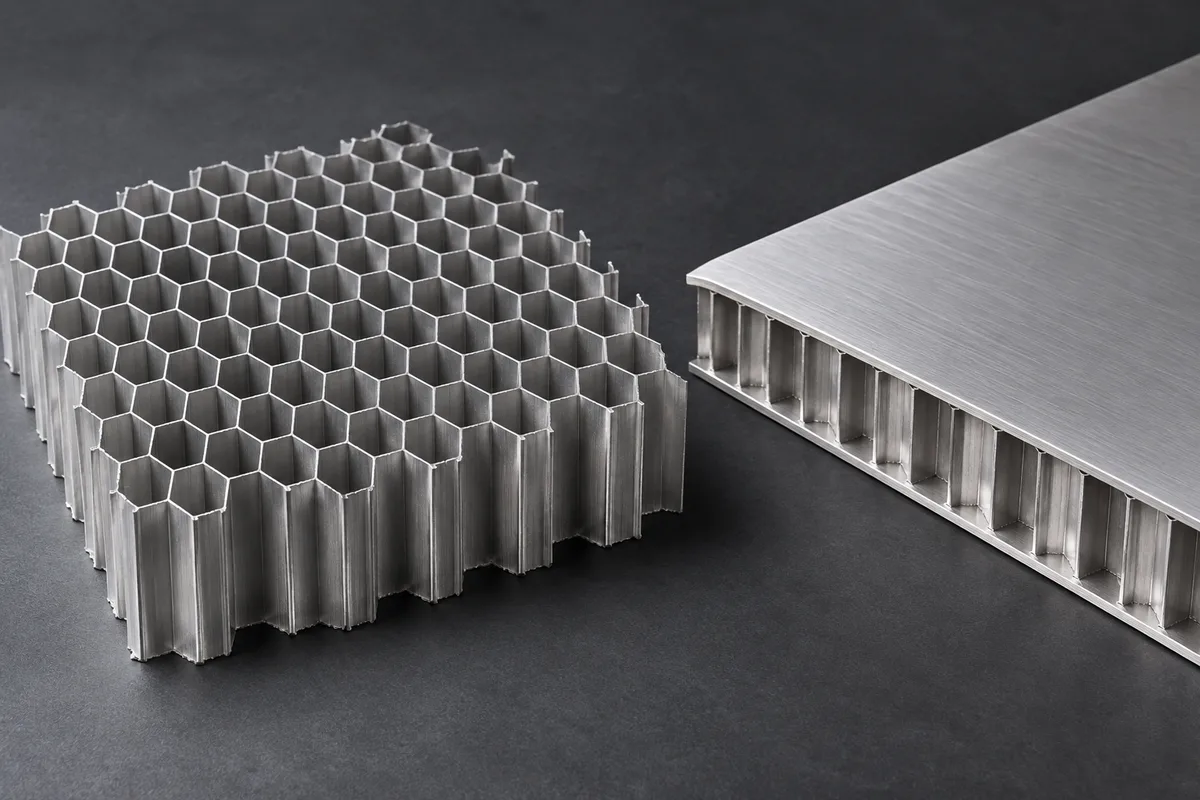
A honeycomb panel works like an I-beam spread over an area. The two aluminium skins carry bending loads in tension and compression, and the honeycomb core holds them apart and carries shear. Doubling the core thickness roughly quadruples bending stiffness while adding very little weight.
The visible sheet, usually 3003, 5005 or 5052 aluminium 0.7 – 1.5 mm thick, coil-coated with PVDF or FEVE paint, anodised, printed with wood or stone patterns, or faced with a thin natural stone veneer.
Expanded aluminium foil in 3003 or 5052, formed into hexagonal cells typically 6 – 19 mm across. Cell size and foil gauge set the core density, compressive strength and shear stiffness. See the aluminium honeycomb core guide.
Usually 0.5 – 1.0 mm aluminium, thicker or reinforced for floors. Ceilings sometimes use FRP or lighter backs to save weight.
Most decorative panels are laminated with a structural adhesive film under heat and pressure. Brazed panels join skin and core metallurgically with no adhesive, for maximum heat resistance; see brazed honeycomb panels.
Panel edges are folded, fitted with extruded aluminium edge profiles or sealed, depending on the fixing system. Back-bolt inserts or fixing cleats are set into the panel for concealed fixing.
Perforated face skins with an acoustic fleece behind them turn the panel into a sound absorber for ceilings and walls.
| Skin alloy | Character | Best for |
|---|---|---|
| 3003-H14 / H24 | Good formability and corrosion resistance at moderate cost | Interior walls and ceilings, painted façades in normal climates |
| 5005-H14 / H34 | Anodises evenly; colour consistent across panels | Anodised panels and metallic finishes |
| 5052-H32 / H34 | Stronger and more resistant to salt air | Coastal façades, high wind loads, floors and transport interiors |
| Finish | Description | Typical location |
|---|---|---|
| PVDF (fluorocarbon) | Two- or three-coat fluoropolymer paint with high UV and chalk resistance | Exterior façades and soffits |
| FEVE | Fluoropolymer coating with high gloss retention and wide colour range | Exterior and high-end interiors |
| Polyester | Economical coil coating | Interior walls and ceilings |
| Anodised | Clear or coloured oxide finish on 5005 skins | Metallic feature walls, lift lobbies |
| Wood and stone grain | Printed or heat-transfer patterns over a base coat | Interior décor, ceilings, warm façade accents |
| Natural stone veneer | Thin marble, granite or slate bonded to the face | Lobbies, feature walls, lightweight stone façades |
| Mirror or brushed | Polished or brushed skin, often with protective lacquer | Interiors and signage |
For exterior work, specify a coating that meets AAMA 2605 or an equivalent coil-coating standard and ask for coating test data. Approve colour on physical samples from the production coating lot. Metline also supplies the colour-coated skin sheet and coil used by panel laminators.
Panel weight is dominated by the skins. The table estimates skin and core weight for common build-ups, using aluminium at 2.70 g/cm³ and a core density of 60 kg/m³; add the adhesive film and any finish or edge profiles. Ask for the manufacturer's datasheet for the exact figure.
| Total thickness (mm) | Face skin (mm) | Back skin (mm) | Core (mm) | Skins (kg/m²) | Core (kg/m²) |
|---|---|---|---|---|---|
| 10 | 1 | 0.5 | 8.5 | 4.1 | 0.51 |
| 15 | 1 | 0.7 | 13.3 | 4.6 | 0.80 |
| 20 | 1 | 0.7 | 18.3 | 4.6 | 1.10 |
| 20 | 1.5 | 1 | 17.5 | 6.8 | 1.05 |
| 25 | 1.5 | 1 | 22.5 | 6.8 | 1.35 |
| 30 | 2 | 1 | 27 | 8.1 | 1.62 |
| Application | Typical build-up | Points to specify |
|---|---|---|
| Ventilated façades and soffits | 20 – 25 mm, 1.0 – 1.5 mm PVDF face, 0.7 – 1.0 mm back, 5052 or 3003 skins | Wind load, fixing system, fire class required by local code, coating standard |
| Interior feature walls | 10 – 20 mm with wood, stone grain, anodised or veneer face | Flatness, joint width, impact resistance at low level |
| Large-format ceilings | 10 – 15 mm, light back skin or FRP, optional perforation | Weight per panel, access, acoustic performance, cut-outs for services |
| Raised and access floors | 20 mm and above, thicker skins and denser core | Concentrated and distributed load, span between supports, surface finish |
| Lift interiors, signage and displays | 6 – 12 mm with mirror, brushed or printed face | Edge finish and fixing |
| Partitions and furniture | 15 – 25 mm with decorative face both sides | Double-sided finish, edge profiles |
For floors and other structural uses, panel thickness, core density and support spacing must be sized for the specific loads and verified by testing or calculation; decorative wall build-ups should not be used as flooring without that check. Honeycomb is also used in aircraft and rail interiors, where different certifications apply; see aircraft honeycomb panels.
| Factor | Honeycomb panel (20 mm) | Aluminium composite panel (4 mm) | Solid aluminium sheet (3 mm) |
|---|---|---|---|
| Structure | Aluminium skins on aluminium honeycomb | Aluminium skins on polymer or mineral-filled core | Single sheet, stiffened by folds or ribs |
| Flatness on large panels | Excellent | Good on moderate sizes | Needs stiffeners to avoid waviness |
| Weight | About 5 – 7 kg/m² | About 5.5 – 8 kg/m², depending on core | About 8.1 kg/m² |
| Fire behaviour | Depends on adhesive; all-metal core | Depends strongly on core (PE, FR or A2 mineral) | Non-combustible metal |
| Stone facing | Yes, common | No | No |
| Curving and folding | Possible, needs care | Easy (routed and folded) | Easy |
| Relative cost | Higher | Lower | Medium |
Choose honeycomb when the panel is large, must stay perfectly flat, carries a stone face, or must meet a strict fire requirement without a polymer core. Choose composite panels for economical routed-and-folded cassettes, and solid sheet for small panels and complex folded shapes. Related: aluminium honeycomb panel supply, stone honeycomb panels and aluminium wall panel materials.
Wall and ceiling panels are usually 10 – 30 mm thick, with 15 – 25 mm common for façades. Floors and other load-bearing uses are thicker and are sized to the load and support spacing.
A typical 20 mm façade panel with a 1.0 mm face and 0.7 mm back weighs roughly 5 – 7 kg/m², most of it in the skins. That is about one tenth of the weight of solid stone of the same thickness.
No building panel is simply "fireproof". Aluminium honeycomb panels have an all-metal core, and with a suitable adhesive they can reach high reaction-to-fire classes such as A2-s1,d0 under EN 13501-1, but the class must be proven by tests on the specific build-up.
Yes. Panels can be rolled to curves and folded into trays or corners with the core relieved at the bend, although minimum radii depend on thickness and skin alloy. Curved panels should be confirmed at the design stage.
Composite panels (ACP) are thin, typically 3 – 6 mm, with a solid polymer or mineral core, and are routed and folded into cassettes. Honeycomb panels are thicker and stiffer for their weight, stay flat in larger sizes and can carry stone facings.
Yes. Metline supplies honeycomb core in 3003 and 5052 and coated or anodising-quality skin sheet and coil separately for panel manufacturers.
Send your panel schedule, build-up, finish and destination. Our team will reply with options, samples and a delivered price.





