Small cells (3 mm)
Support thin skins without dimpling, give the best surface finish and the highest strength at a given foil. Heavier and more costly.



5A12 honeycomb core is a hexagonal cell structure made from foil of 5A12, a high-magnesium (about 9 % Mg) aluminium alloy registered in Chinese standards. Bonded between two thin skins it forms a sandwich panel that is very stiff for its weight, and the high-magnesium foil gives more compressive and shear strength per unit density than ordinary 3003 or 5052 core. This guide explains the alloy, how to choose cell size, foil and density, which standards apply and when 5052 or 5056 is the better choice.
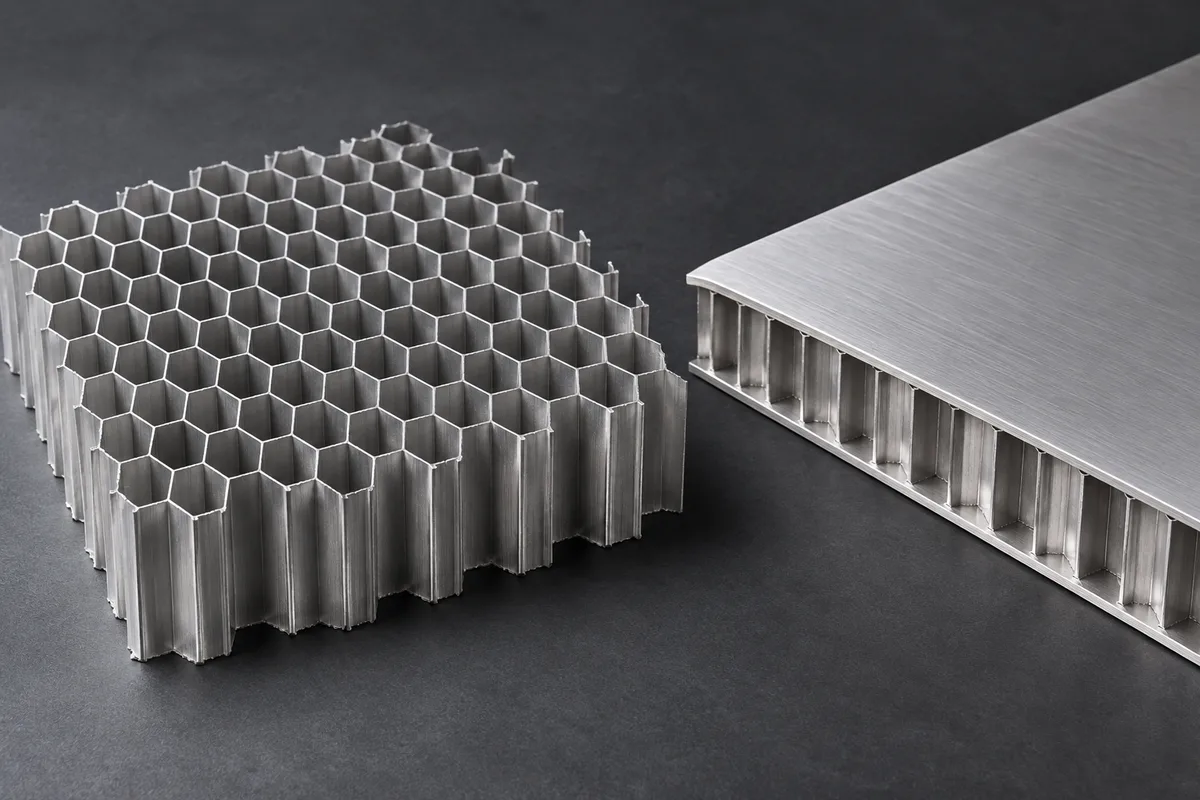
Aluminium honeycomb is made by printing lines of adhesive on stacked sheets of thin foil, curing the stack into a solid block, slicing the block to the required thickness and then pulling the slices open so the bonded and unbonded zones form hexagonal cells. The result is a core that is mostly air, yet when bonded between face sheets it keeps the skins apart and carries shear, much like the web of an I-beam.
The foil alloy sets the strength of every cell wall. 5A12, formerly LF12, is one of the most highly alloyed Al-Mg grades in the GB/T 3190 standard, with roughly twice the magnesium of 5056. In foil form it is strong and springy, so a 5A12 core reaches a given compressive or shear strength at lower density than 5052 core. That is why it is specified on Chinese aerospace and space programmes where weight is critical: satellite structural panels, equipment decks, launch-vehicle fairings and aircraft secondary structure.
Like other high-magnesium alloys, 5A12 is not used where the core will see sustained elevated temperatures in a corrosive setting, because it can sensitise. In practice aerospace sandwich panels are sealed, the foil is given a corrosion-resistant surface treatment and the panel is protected by its skins, but the service temperature should still be part of the selection.
| Element | Limit |
|---|---|
| Magnesium (Mg) | 8.3 – 9.6 |
| Manganese (Mn) | 0.40 – 0.8 |
| Titanium (Ti) | 0.05 – 0.15 |
| Silicon (Si) | ≤ 0.30 |
| Iron (Fe) | ≤ 0.30 |
| Copper (Cu) | ≤ 0.05 |
| Zinc (Zn) | ≤ 0.20 |
| Nickel (Ni) | ≤ 0.10 |
| Beryllium, antimony | Small controlled additions |
| Aluminium (Al) | Remainder |
Main limits per GB/T 3190; the foil certificate states the actual analysis of each lot.
Three numbers describe any honeycomb: the cell size (the distance across flats of a hexagon), the foil thickness and the resulting density. They are linked: for a given cell size, thicker foil means higher density; for a given foil, smaller cells mean higher density. Strength rises faster than density, roughly with density to the power 1.5, so a modest increase in density buys a large increase in strength.
The Chinese specification code reads as cell size, alloy and density. For example, 5-5A12-52 is a 5 mm cell in 5A12 foil at 52 kg/m³. The table shows common combinations with indicative stabilised flatwise compressive strength.
| Code | Cell size | Foil | Density (kg/m³) | Flatwise compression, indicative (MPa) |
|---|---|---|---|---|
| 3-5A12-66 | 3 mm | 0.03 mm | 66 | 2.75 |
| 3-5A12-77 | 3 mm | 0.04 mm | 77 | 3.57 |
| 5-5A12-44 | 5 mm | 0.03 mm | 44 | 1.36 |
| 5-5A12-52 | 5 mm | 0.04 mm | 52 | 1.84 |
| 5-5A12-68 | 5 mm | 0.05 mm | 68 | 2.88 |
| 5-5A12-81 | 5 mm | 0.06 mm | 81 | 3.85 |
| 5-5A12-110 | 5 mm | 0.08 mm | 110 | 6.29 |
| 7-5A12-39 | 7 mm | 0.04 mm | 39 | 1.13 |
| 7-5A12-53 | 7 mm | 0.05 mm | 53 | 1.90 |
| 7-5A12-84 | 7 mm | 0.08 mm | 84 | 4.11 |
| 8-5A12-41 | 8 mm | 0.05 mm | 41 | 1.23 |
| 8-5A12-67 | 8 mm | 0.08 mm | 67 | 2.82 |
Indicative values for comparison only. Design allowables must come from the governing specification and batch test results (for example compression tested to ASTM C365).
Support thin skins without dimpling, give the best surface finish and the highest strength at a given foil. Heavier and more costly.
The general choice for aerospace panels, balancing skin support, strength and weight.
Lowest density for lightly loaded panels and large flat areas; require thicker skins to avoid intra-cell buckling.
Honeycomb is anisotropic. The L direction runs along the ribbon (the direction of the continuous foil), and the W direction is the expansion direction. Because the double-thickness bonded walls run in L, shear strength and modulus in L are typically about 1.5 – 2 times those in W. Panels should be laid out with the L direction aligned to the main shear load.
| Property | Test method | Why it matters |
|---|---|---|
| Density | ASTM C271 | Primary acceptance check; confirms foil and cell geometry |
| Flatwise compression (bare and stabilised) | ASTM C365 | Resistance to crushing under point loads and handling |
| Plate shear, L and W | ASTM C273 | Governs panel bending stiffness and strength |
| Flatwise tension | ASTM C297 | Checks the skin-to-core bond |
| Node bond strength | Purchaser or core specification | Ensures cells do not separate during expansion and machining |
An important practical point: AMS-C-7438 does not list 5A12. If a programme is qualified to AMS-C-7438, the equivalent high-strength choice is 5056 core; 5A12 is ordered to HB 5443 or to a purchaser specification that defines the alloy, geometry and acceptance tests.
| Point | 5052 core | 5056 core | 5A12 core |
|---|---|---|---|
| Foil magnesium | about 2.5 % | about 5 % | about 9 % |
| Strength at equal density | Baseline | Higher | Highest of the three |
| Standards | AMS-C-7438, widely qualified | AMS-C-7438, aerospace | HB 5443, Chinese programmes |
| Availability | Very wide | Wide | More specialised |
| Typical use | Aerospace and industrial panels, marine, rail | Higher-load aerospace panels | Weight-critical space and aircraft panels |
For most commercial sandwich panels 5052 honeycomb core is the default; 5056 core is the step up when an internationally recognised high-strength core is needed. Choose 5A12 when the drawing calls for it or the weight target cannot be met otherwise.
Bonded HOBE block for customers who slice and expand in-house; compact to ship.
Cut to thickness and expanded to sheet size, ready for bonding. Thickness tolerance is agreed per order.
Small vent holes in the cell walls let air escape during autoclave or vacuum cure and equalise pressure in space vacuum.
Foil treated for corrosion resistance and adhesive bonding.
Contoured, chamfered or pocketed core for inserts and edge close-outs.
Sandwich panels with aluminium or composite skins can be arranged to drawing.
Foil of 5A12, a high-magnesium Al-Mg alloy with about 8.3 – 9.6 % magnesium and some manganese, bonded into hexagonal cells.
At equal density, yes: the higher-magnesium foil gives more compressive and shear strength. That lets designers reach a strength target with a lighter core.
No. AMS-C-7438 covers 5052, 5056 and 2024 cores. 5A12 is normally supplied to HB 5443 or a purchaser specification; use 5056 if AMS-C-7438 compliance is required.
The first number is the cell size in millimetres, then the alloy, then the nominal density in kg/m³. 5-5A12-52 is a 5 mm cell in 5A12 foil at about 52 kg/m³.
The L (ribbon) direction, where the double-thickness bonded walls run. Shear strength in L is typically about 1.5 – 2 times that in W.
Yes. Perforated core lets trapped air escape during cure and equalises pressure in vacuum, which is common for space hardware.
Send cell size, density, thickness, sheet size and test requirements. Metline will confirm options, documentation and delivery.





