Standard hexagonal
The default for flat panels. Best balance of weight, flatness and strength, and the cheapest per square metre.



3003 aluminium honeycomb core is a lightweight hexagonal cell structure made from 3003-H18 foil, used as the core of sandwich panels for facades, interiors, doors, transport bodies and equipment. It costs less than 5052 or 5056 core and is easier to bend and shape, with somewhat lower strength. This guide covers cell sizes, densities, typical strength, supply forms and how to specify it.
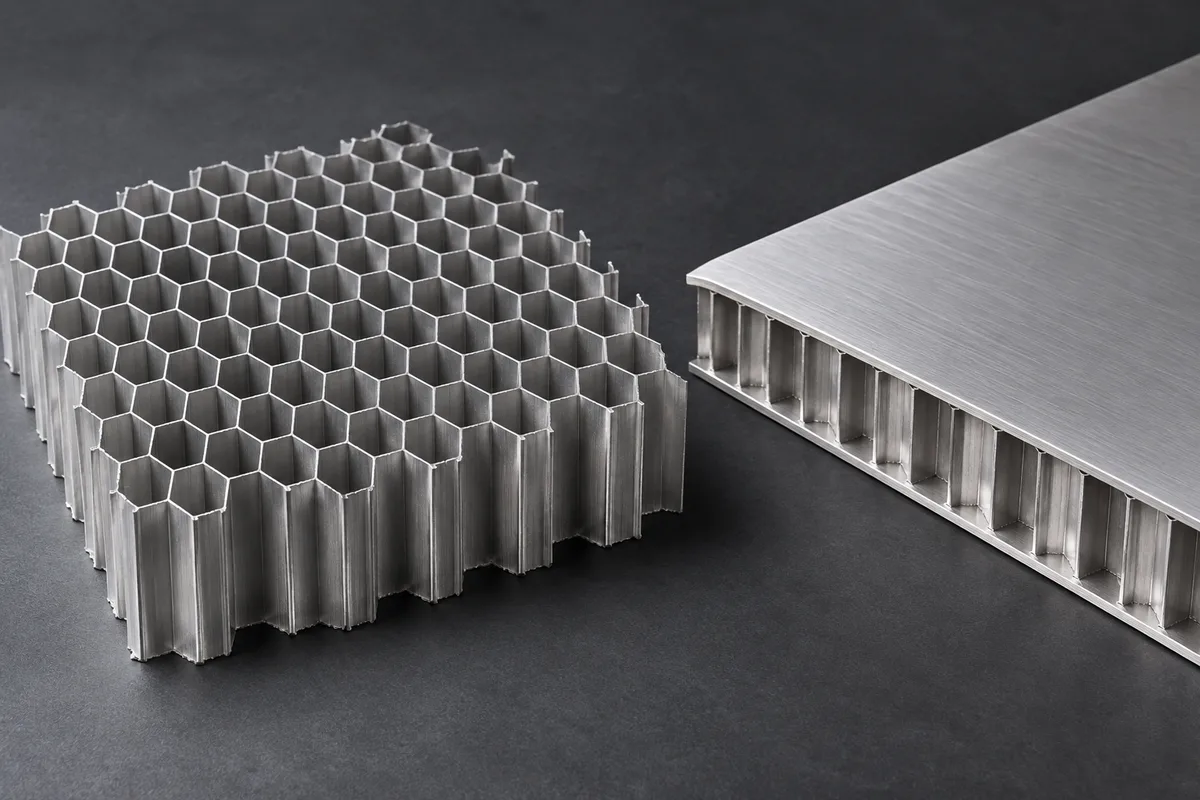
A honeycomb sandwich panel works like an I-beam: two thin skins carry bending as tension and compression, and the core holds them apart and carries shear. The thicker the core, the stiffer the panel, while weight rises very little.
Aluminium honeycomb is made by the expansion process. Thin foil, in this case 3003 in the full-hard H18 temper, is printed with parallel lines of adhesive, stacked into a block and cured. The block (called HOBE, honeycomb before expansion) is sliced to the required core thickness and then pulled apart so the bonded lines become the cell walls. Each hexagon therefore has two double-thickness walls running in the ribbon (L) direction and four single walls at an angle, which is why strength and stiffness are higher in L than in the transverse (W) direction.
3003 is an aluminium-manganese alloy with good formability and corrosion resistance. Compared with 5052 foil it has lower yield strength, so for the same cell size and foil gauge the core is roughly 10 – 30 % weaker in compression and shear. In return it is cheaper, tolerates bending and pre-forming better, and is more than adequate for most architectural, interior and industrial panels where loads are moderate and the skin, not the core, sets the limit.
| Parameter | Typical range for 3003 core | What it controls |
|---|---|---|
| Cell size | 3.2, 4.8, 6.4, 9.5, 12.7, 19 and 25 mm (1/8 – 1 in) | Smaller cells mean more bond area, flatter skins and higher strength |
| Foil thickness | about 0.04 – 0.10 mm | Thicker foil raises density and strength |
| Density | about 20 – 130 kg/m³ (1.2 – 8 lb/ft³) | The single best predictor of compressive and shear strength |
| Core thickness (T) | about 3 mm up to several hundred mm | Panel stiffness rises roughly with the square of core thickness |
| Ribbon direction (L) | Stated on the drawing | The strong shear direction; align with the main span |
| Perforation | Perforated or plain | Perforated foil vents air during curing and in vacuum or altitude changes |
| Condition | Unexpanded block or slice, expanded sheet | Shipping volume and the work left to do on site |
Honeycomb is usually described as density – cell size – foil, for example a 5.2 lb/ft³, 1/4 in cell 3003 core. Give us those three values, the core thickness and the length and width, plus the L direction on your drawing, and the core is fully defined.
Values below are indicative typical figures for 3003 hexagonal core at about 16 mm (0.625 in) thickness, in line with published data from honeycomb producers. Compression is stabilised (with skins bonded); shear is plate shear per ASTM C273. They are not design allowables: use the test certificate for your lot or the producer datasheet for structural calculations.
| Cell size | Nominal density | Compressive strength | Plate shear, L | Plate shear, W |
|---|---|---|---|---|
| 6.4 mm (1/4 in) | 83 kg/m³ (5.2 lb/ft³) | ≈ 4.6 MPa | ≈ 2.3 – 2.4 MPa | ≈ 1.3 – 1.5 MPa |
| 9.5 mm (3/8 in) | 58 kg/m³ (3.6 lb/ft³) | ≈ 2.3 MPa | ≈ 1.5 MPa | ≈ 0.9 MPa |
| 12.7 mm (1/2 in) | 40 kg/m³ (2.5 lb/ft³) | ≈ 1.4 MPa | ≈ 1.0 MPa | ≈ 0.6 MPa |
| 19 mm (3/4 in) | 29 kg/m³ (1.8 lb/ft³) | ≈ 0.9 MPa | ≈ 0.7 MPa | ≈ 0.35 MPa |
Two patterns stand out. First, strength rises faster than density: halving density cuts compressive strength by roughly two-thirds. Second, W-direction shear is typically 55 – 65 % of L-direction shear, so the ribbon must run along the direction of highest shear load. Shear moduli follow the same pattern; for a 1/4 in, 83 kg/m³ core published L-direction shear modulus is in the region of 0.4 – 0.45 GPa.
Compression and shear tests on honeycomb follow ASTM C365 (flatwise compression) and ASTM C273 (core shear). Results depend on specimen thickness and whether the core is stabilised.
The default for flat panels. Best balance of weight, flatness and strength, and the cheapest per square metre.
Cells are stretched in W into a near-rectangular shape. Easier to bend about the L axis for single-curvature panels, at some loss of L shear strength.
A modified cell that can follow compound curves without anticlastic bending. Used for curved facade elements and vehicle parts.
Extra foil layers along the ribbon or locally around inserts raise strength where fasteners or point loads go in.
Tiny holes in each wall let air and moisture escape, useful for autoclave or press curing and for acoustic panels.
Cores of 100 mm or more for energy absorbers, crash pads, test rigs and packaging; can be machined to shape.
| Factor | 3003-H18 core | 5052-H39 core | 5056-H39 core |
|---|---|---|---|
| Relative strength (same cell / density) | Baseline | Higher, roughly 10 – 30 % | Highest of the three |
| Corrosion resistance | Good | Very good | Very good |
| Formability / curving | Best | Good | Fair |
| Relative cost | Lowest | Medium | Highest |
| Typical markets | Architecture, interiors, doors, enclosures, packaging | Transport, marine, industrial, some aerospace | Aerospace and high-performance structures |
Choose 5052 for marine and offshore panels, rail and bus floors, or wherever the core governs strength. 5056 is mostly specified by aerospace programmes. For most cladding, ceilings, partitions and doors, 3003 delivers the required stiffness at lower cost. A fuller discussion is in our 3003 vs 5052 honeycomb comparison.
Exact tolerances are agreed on the order; tell us how the core will be bonded so we can confirm a suitable thickness tolerance.
Unexpanded core is the economical choice for export because a small case of slices becomes a large volume of core. The panel maker expands it on a frame and trims it. Expanded core arrives ready to lay up but takes up far more space in a container.
A common facade example: 1.0 mm coated aluminium skins on 20 mm of 3003 core with 6.4 mm cells gives a flat, rigid panel of roughly 7 – 8 kg/m² including adhesive, far lighter than solid aluminium or stone of similar stiffness.
5052 foil is stronger and slightly more corrosion resistant, so 5052 core gives higher compressive and shear strength for the same cell and density. 3003 is cheaper and bends more easily, and is standard for architectural and interior panels.
6.4 mm (1/4 in) is the most common for facade and interior panels. Use smaller cells under very thin skins to avoid dimpling, and larger 9.5 – 19 mm cells where weight and cost matter more than skin flatness.
It is the direction of the bonded double walls. Shear strength and stiffness are highest in L, so align it with the panel span or the main load path.
Unexpanded core ships in a fraction of the volume and suits panel makers with an expansion frame. Expanded core is ready to bond and suits smaller users or prototypes.
Yes. Standard hex core bends in one direction with care; over-expanded core curves more easily about one axis, and flexible core follows compound curves.
The aluminium core is non-combustible, but the panel rating depends on skins and adhesive. Facade panels must be tested as a complete system to the local fire standard.
Yes. Slices can be cut to thickness and expanded sheets trimmed to length and width; thick blocks can be machined to shape on request.
Send the cell size, density, core thickness, sheet size and supply form. We will reply with a specification check and delivered price.





