Adhesive-bonded core
Light, economical and available in the widest choice of cells and densities. Limit set by the node adhesive, typically 177 °C; strength falls progressively as temperature rises towards that limit.



There is no single "high-temperature honeycomb": the usable temperature of a honeycomb core depends on the cell-wall material and, just as much, on how the cells are joined. Adhesive-bonded aluminium core is normally rated to about 177 °C (350 °F), brazed all-aluminium core removes the adhesive limit, and above the range of aluminium designers move to stainless or nickel-alloy cores. This guide sets out the temperature tiers, what limits each one and how to specify aluminium core for hot service.
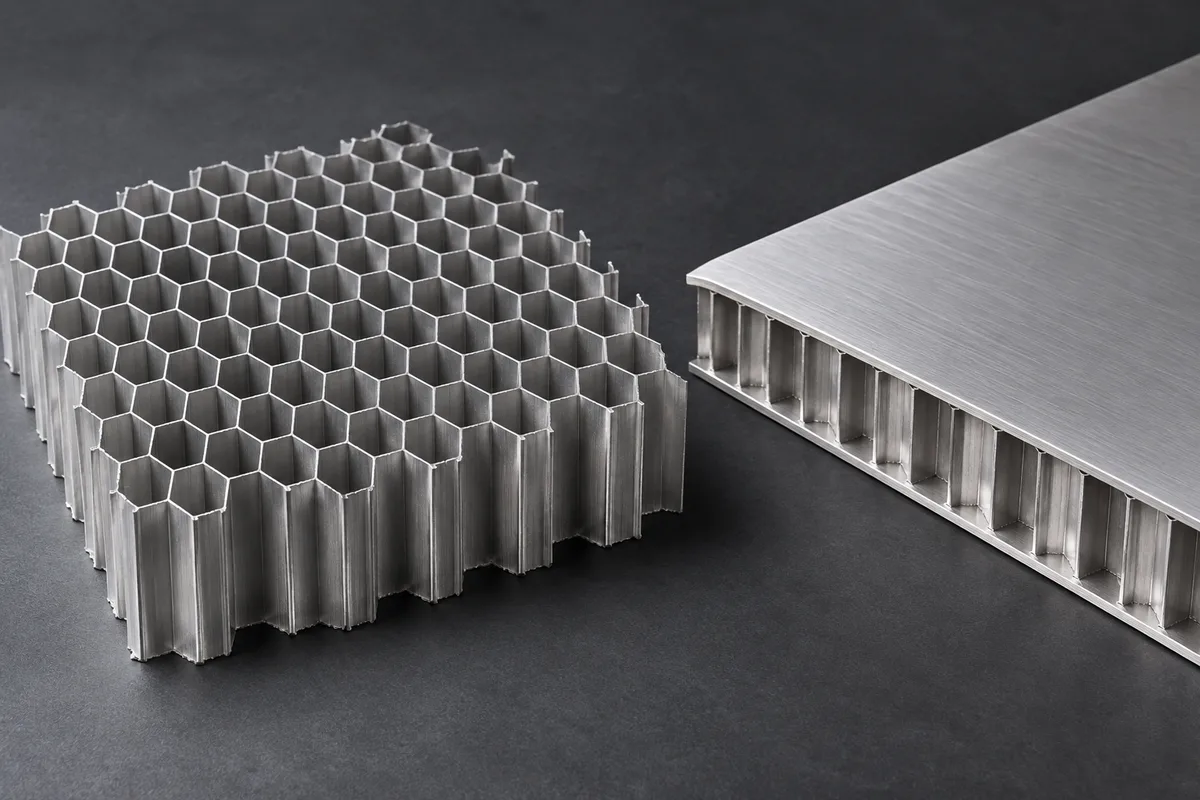
When a buyer asks for "high-temperature honeycomb", the first question is: how hot, for how long, and under what load? A core that survives a short paint-bake at 180 °C may be unsuitable for continuous service at 150 °C under shear load. The table groups common core families by the temperature band in which they are normally used.
| Core family | Joining method | Typical continuous service band | What sets the limit |
|---|---|---|---|
| Aramid (meta-aramid paper) with phenolic resin | Adhesive nodes, resin dip | About −55 to 177 °C | Resin system and paper |
| Glass-fibre / polyimide honeycomb | Polyimide resin | Up to about 260 °C (500 °F) extended service | Polyimide resin |
| Aluminium core, standard node adhesive | Adhesive nodes | Up to about 177 °C (350 °F) | Node adhesive, then alloy softening |
| Aluminium core, high-temperature node adhesive | Adhesive nodes | Somewhat above 177 °C; confirm with datasheet | Node adhesive |
| Brazed all-aluminium core and panels | Al-Si braze, no organic adhesive | Above bonded core; set by alloy strength retention | Softening of the aluminium alloy |
| Stainless steel and nickel-alloy cores | Resistance welding, brazing | Several hundred °C and above | Oxidation and creep of the alloy |
Bands are typical of published producer data and specifications such as AMS 4178 (5052 flexible core, 350 °F). The rating of a finished panel also depends on the facing adhesive and facing material.
Metline supplies aluminium honeycomb in this range: adhesive-bonded 3003, 5052 and 5056 core and brazed aluminium honeycomb panels. Aramid, glass-polyimide, stainless and nickel-alloy cores appear in this guide only as comparisons, so you can see where aluminium stops being the right answer.
Expanded aluminium honeycomb is made by printing lines of adhesive on foil, stacking and curing the block, then pulling it open. The cured adhesive lines become the double-thickness nodes, and every bit of shear that passes through the core passes through those bonds. When the adhesive softens, node strength drops even though the foil itself is still strong.
Most aerospace and industrial node adhesives are epoxy or modified-epoxy systems qualified for service to 177 °C (350 °F). That is why the standard ceiling quoted for bonded aluminium core is 350 °F and why AMS 4178, for example, covers 5052 flexible core for 350 °F service. Producers offer node adhesives for higher temperatures, but the rating must be taken from the datasheet of that exact core product.
Light, economical and available in the widest choice of cells and densities. Limit set by the node adhesive, typically 177 °C; strength falls progressively as temperature rises towards that limit.
Foil and facings coated with an Al-Si braze alloy are joined in a vacuum or controlled-atmosphere furnace at around 600 °C. With no organic adhesive, the panel does not outgas, will not delaminate from adhesive softening and tolerates higher temperatures, limited by the alloy.
Used mostly for metal cores and some special aluminium parts; gives an all-metal path for heat and electrical current.
The facings matter too. A honeycomb panel bonded with a 120 °C-cure epoxy film will be limited by that film, not by a 177 °C core. Always rate the complete construction: core, node bond, facing adhesive and facing material.
Aluminium foils for honeycomb are non-heat-treatable alloys (3003, 5052, 5056) in hard tempers. Their strength comes from cold work, which slowly recovers with time at temperature, and like all aluminium alloys they get weaker as they get hotter. Published producer data for 5052 core show that at 177 °C (350 °F) it keeps roughly two-thirds of its room-temperature compressive and shear strength, which is the figure most designers start from.
| Temperature band | Bonded aluminium core | Brazed aluminium core | Design comment |
|---|---|---|---|
| Cryogenic to 80 °C | Full properties; aluminium gains strength when cold | Full properties | Spacecraft and cryogenic panels use aluminium core routinely |
| 80 – 120 °C | Small reduction; check facing adhesive | Negligible change | Typical engine-bay, electronics and hot-climate exterior service |
| 120 – 177 °C | Progressive loss towards about two-thirds of room-temperature strength | Moderate reduction | Design to elevated-temperature allowables; check creep under sustained load |
| Above 177 °C | Outside standard rating unless a high-temperature node adhesive is specified | Usable, with strength falling as alloy softens | Get test data for the exact construction and exposure time |
| Above about 300 °C | Not suitable | Rarely suitable for load-bearing use | Consider stainless or nickel-alloy cores |
Older marketing figures sometimes quote 300 °C for bonded and 550 °C for brazed aluminium honeycomb. Treat such numbers with caution. Aluminium-silicon braze alloys begin to melt at about 577 °C, and hard-temper aluminium foil anneals and loses much of its strength well below that, so a brazed aluminium panel at 550 °C has little structural capacity left. Brief, low-load exposure is a different case from continuous structural service, and the specification should say which applies.
| Property | Aluminium core (5052) | Aramid paper core | Stainless steel core | Nickel-alloy core |
|---|---|---|---|---|
| Typical maximum service | About 177 °C bonded | About 177 °C | Several hundred °C | Highest; used near combustion zones |
| Density range | Low to high (about 26 – 190 kg/m³) | Low to medium | High | High |
| Thermal conductivity | High | Low (insulating) | Moderate | Low to moderate |
| Electrical behaviour | Conductive, EMI shielding | Dielectric | Conductive | Conductive |
| Behaviour in fire | Non-combustible metal; melts near 600 – 650 °C | Chars; self-extinguishing grades | Retains shape far higher | Retains shape far higher |
| Relative cost | Low to medium | Medium to high | High | Very high |
In practice aluminium covers most sandwich panels that run warm rather than hot: engine-bay closures and nacelle areas away from the core flow, electronics and radar enclosures, hot-climate building facades, oven and dryer doors with an insulating layer, and satellite panels that cycle between deep cold and direct sunlight. Exhaust, turbine-seal and combustor zones belong to stainless or nickel-alloy honeycomb, which Metline does not supply. For a direct comparison with the main non-metallic option, read aluminium vs aramid honeycomb core.
A useful rule of thumb when screening: if the panel runs below about 120 °C, any standard aluminium core will do and the choice is about strength and cost; between 120 and 177 °C, use elevated-temperature allowables and check every adhesive in the build-up; above 177 °C, either specify a high-temperature node adhesive with test data, move to brazed aluminium construction, or add insulation so the aluminium stays in its comfortable range.
Metline supplies aluminium honeycomb core and brazed aluminium panels cut to size, with test reports to the agreed method. For lower-temperature sandwich structures, compare the honeycomb sandwich panel options, and for an overview of every core and panel type see honeycomb core materials and sandwich panels.
Standard adhesive-bonded aluminium core is normally rated to about 177 °C (350 °F), where it keeps roughly two-thirds of its room-temperature strength. Brazed aluminium honeycomb has no adhesive and can run hotter, with the limit set by softening of the alloy; obtain test data for any continuous loaded service above 177 °C.
Stainless steel and nickel-based alloy cores, joined by welding or high-temperature brazing, are used in the hottest zones such as turbine seals and exhaust structures. Metline supplies only aluminium honeycomb; these are listed for comparison.
Not significantly. Typical phenolic-resin aramid core is also used up to about 177 °C. It is chosen for insulation, radar transparency and toughness rather than higher temperature.
No organic adhesive is used, so a brazed panel does not release adhesive volatiles when heated, which suits ovens, clean environments and vacuum equipment.
The lowest-rated element: node adhesive, facing adhesive, facing material, potting around inserts or edge sealant. Rating the core alone can overstate what the panel will tolerate.
Aluminium is non-combustible, but it melts at roughly 600 – 650 °C depending on alloy, so honeycomb does not carry load in a fire. Fire classification of a panel depends on its adhesives and facings and is tested on the complete product.
Share the temperature profile, loads and panel size. We will advise whether bonded core or brazed aluminium panels will work and quote them.





