Stone Honeycomb Panels: Natural Stone on an Aluminium Honeycomb Core
A stone honeycomb panel is a thin natural-stone veneer, typically 3 – 10 mm, bonded to an aluminium honeycomb backing. It keeps the look of solid marble or granite at roughly a quarter to a third of the weight, and the backing gives the thin stone the strength to span large formats and resist impact. This guide explains how the panels are built, what they weigh, how they are fixed and where their limits are, and which aluminium components Metline supplies to stone processors and panel makers.
Solid stone cladding is heavy and brittle. A 30 mm granite slab weighs about 80 kg per square metre, needs a strong substructure and can crack if knocked or flexed. A stone honeycomb panel replaces most of that slab with a stiff, light aluminium sandwich: the stone becomes a thin decorative skin, and the honeycomb carries the bending loads.
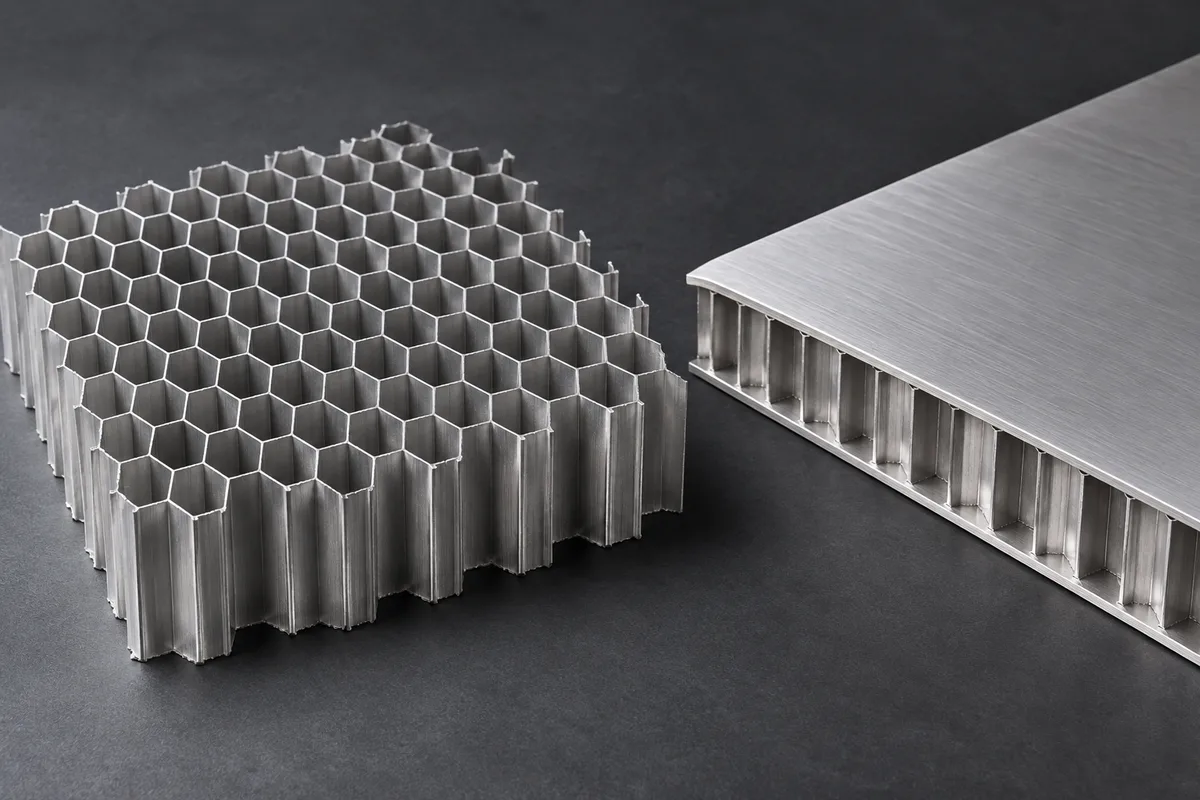
The principle is the same as any honeycomb sandwich panel. Two thin, stiff faces separated by a light core behave like an I-beam: the faces take tension and compression, and the core holds them apart and carries shear. In a stone panel, one face is the stone veneer (usually with a glass-fibre reinforced resin layer on its back), and the other is an aluminium sheet. Because bending stiffness rises with the square of the distance between the faces, a 15 – 20 mm honeycomb turns a fragile 5 mm veneer into a panel that can span a metre or more between fixings.
The result is used wherever designers want real stone but cannot accept the weight: high-rise facades, refurbishment of existing buildings, ceilings, lift cars, ships' interiors, rail and yacht fit-outs, and furniture. The panels can be cut, edge-finished and fitted with hidden fixings in the factory, so site work is closer to installing a metal panel than setting stone.
Holds the thin stone together, spreads stress, limits crack growth
Adhesive
Structural epoxy or polyurethane film or paste
Thin bond line
Bonds stone to the honeycomb or to a front aluminium skin
Front skin (optional)
Aluminium sheet, 3003 or 5052, 0.5 – 1.0 mm
0.5 – 1.0 mm
Some build-ups add a metal face under the stone for flatness and bond area
Honeycomb core
3003 or 5052 aluminium foil honeycomb
10 – 25 mm
Separates the faces, carries shear, adds stiffness at very low weight
Back skin
Aluminium sheet, 3003 or 5052, often pre-treated or coated
0.7 – 1.5 mm
Tension or compression face; carries fixings and seals the back
Panel makers describe their products by the number of layers ("five-layer", "seven-layer"), but what matters to a designer is the stone thickness, the overall thickness, the core height and the back-skin gauge. The reinforcing layer behind the stone is important: without it, a thin veneer that cracks from impact or a hidden flaw can lose fragments. With it, the stone may crack but stays bonded in place.
Honeycomb for stone panels is normally 3003 or 5052 alloy foil, expanded into hexagonal cells and often supplied with a corrosion-protective coating. 5052 is stronger and more corrosion resistant; 3003 is lower cost and adequate for most interior panels. See 3003 vs 5052 honeycomb core for a detailed comparison.
Weights
How much does a stone honeycomb panel weigh?
Almost all the weight is in the stone. The calculated examples below assume stone at 2.70 g/cm³ (typical of marble and granite), honeycomb core at 60 kg/m³, a 1.0 mm aluminium back skin and about 1.5 kg/m² for the glass-fibre layer and adhesives. Lighter stones such as some limestones and travertines weigh less; a front aluminium skin adds about 1.4 – 2.7 kg/m².
Build-up
Stone
Core height
Stone (kg/m²)
Backing system (kg/m²)
Panel total (kg/m²)
Ultra-light interior
3 mm
12 mm
8.1
4.9
13.0
Light interior / ceiling
5 mm
10 mm
13.5
4.8
18.3
General cladding
5 mm
15 mm
13.5
5.1
18.6
Large-format or exterior
5 mm
20 mm
13.5
5.4
18.9
Thick-veneer exterior
10 mm
15 mm
27.0
5.1
32.1
Solid stone for comparison
Thickness
Weight (kg/m²)
Solid marble or granite slab
20 mm
54
Solid marble or granite slab
30 mm
81
Solid marble or granite slab
40 mm
108
A typical 5 mm veneer on 15 – 20 mm honeycomb comes out around 18 – 19 kg/m², roughly a third of a 20 mm solid slab and under a quarter of a 30 mm exterior slab. That difference is what allows stone on lightweight curtain walls, on ceilings and in vehicles and vessels.
Engineering behaviour
Strength, stiffness and thermal movement
Bending
Stiffness comes mainly from core height and the two faces. Increasing core height from 15 to 25 mm raises stiffness far more than increasing stone thickness. Panel strength is usually limited by the stone in tension or by face-to-core bond, so test data on the actual build-up should be used for design.
Impact
The honeycomb absorbs energy by crushing locally, and the reinforcing layer keeps the stone bonded, so panels are much harder to break than thin solid stone. A hard hit can still crack the veneer, which should be considered at ground level.
Thermal movement
Aluminium expands at about 23 µm/m·K, roughly two to four times as much as most granites and marbles. On a 1.2 m panel heated 50 °C, an unrestrained aluminium skin would grow about 1.4 mm. Bond layers, resin systems and balanced build-ups are designed to accommodate this, and fixings must allow movement.
Moisture
Water reaching the core through open edges or holes can corrode foil and degrade bonds over time. Sealed edges, coated cores and correct drainage in the facade system are essential outdoors.
Flatness
The backing gives very flat panels, but an unbalanced build-up (heavy stone one side, thin metal the other) can bow with temperature. Panel makers balance skin gauges to keep panels flat.
Acoustics
Honeycomb panels are light and stiff, so they transmit sound more readily than heavy solid stone. Where acoustic performance matters, add insulation or a mass layer behind the panel.
Installation
How stone honeycomb panels are fixed
Unlike solid stone, the thin veneer cannot be kerfed or dowelled for anchors. Fixings are made into the aluminium backing instead, which is a major advantage: anchors no longer depend on the stone's strength.
Bonded or riveted hanging profiles: aluminium extrusions fixed to the back skin hook onto rails on the substructure, allowing quick hanging and adjustment.
Inserts in the core: threaded inserts potted into the honeycomb with resin give point fixings for bolts or brackets.
Edge-framed panels: an aluminium edge frame or channel bonded around the panel seals the core and provides a fixing flange.
Clip and rail systems: common indoors for walls and ceilings, giving concealed fixings and easy panel removal.
Structural adhesive: used for some interior and vehicle applications, usually in combination with mechanical safety fixings.
For facades, the panel, its fixings and the substructure must be designed together and verified for wind load, self-weight, seismic and thermal movement under the local building code. Anchor strength into the backing should come from tests on the actual panel build-up, using test methods such as ASTM C1354 adapted to composite panels or the panel maker's own type tests. The aluminium substructure is typically extruded 6063-T5/T6 or 6060-T66 rails and brackets; see aluminium facade systems for profile requirements.
Fire and compliance
Fire performance and building regulations
Stone and aluminium are non-combustible, but the resins and adhesives that bond the panel are organic. The fire classification of a stone honeycomb panel therefore depends on the type and quantity of resin, and must come from a test report on the actual product, for example a classification to EN 13501-1 in Europe or the relevant national test in other markets.
Many jurisdictions now restrict combustible materials in the external walls of tall or high-risk buildings, often requiring A1 or A2-s1,d0 classification. Before specifying a stone honeycomb panel for an exterior facade, check the regulation for the building height and use, and ask the panel maker for the classification report covering the exact build-up, adhesive and core.
ASTM C1354 (anchors in dimension stone; adapted for composite backing)
Reaction to fire
EN 13501-1 classification; national facade fire tests where required
Aluminium skin and core alloys
EN 485 / ASTM B209 sheet; EN 573-3 composition
Applications
Where stone honeycomb panels are used
Application
Why honeycomb-backed stone
Typical build-up notes
Building facades and curtain walls
Cuts dead load on the structure and substructure; larger panels per fixing
Sealed edges, coated 5052 core, tested fire classification
Refurbishment and over-cladding
Existing structures often cannot carry solid stone
Thin veneer, hanging profiles on new rails
Interior walls and lobbies
Book-matched large formats with easy concealed fixing
3 – 5 mm veneer, clip systems
Ceilings and soffits
Solid stone overhead is a safety risk; honeycomb panels are light and fragment-retaining
Mechanical safety fixings in addition to clips
Lift cars and escalator cladding
Weight directly affects lift capacity and energy
Thin veneer, edge-framed panels
Yachts, ships and rail interiors
Weight and fire requirements of the vehicle or vessel
Build-up chosen to marine or rail fire rules
Furniture and counters
Large stone tops that are light enough to move and mount
Edge banding to hide the core
What Metline supplies
Aluminium components for stone honeycomb panels
Metline is an aluminium supplier. We do not quarry, cut or sell stone, and we do not install cladding. We supply the aluminium parts of the panel to stone processors, panel laminators and facade contractors who build or specify stone honeycomb panels:
Every delivery includes a mill test certificate for the aluminium. Panel performance tests on the finished stone panel, such as flexural, anchor and fire tests, are the responsibility of the panel maker and should be specified in the panel contract.
Specification checklist
How to specify a stone honeycomb panel
StoneType, quarry or reference sample, finish (polished, honed, flamed, leathered), veneer thickness and veining or book-match requirements.
PanelOverall thickness, length and width, flatness tolerance, edge finish and any corner or return details.
BackingCore alloy, cell size and height, reinforcing layer, front and back skin alloy and gauge.
FixingFixing system, insert or profile positions, and the design loads they must carry, with drawings.
PerformanceRequired test evidence: flexural strength, anchor pull-out, fire classification, freeze-thaw and weathering for exterior use.
LogisticsPanel numbering, protective film, edge protection and crated export packing.
Common mistakes include specifying exterior panels without a fire classification report, leaving cut edges and holes unsealed, using unbalanced build-ups that bow in sun, and treating catalogue values as design data. Ask for test results on the exact build-up you are buying.
Stone honeycomb panels: frequently asked questions
How do stone honeycomb panels compare with solid stone slabs?
They look the same from the front but weigh about 70 – 80 % less, resist breakage better because the backing holds the stone together, and are fixed through the aluminium backing rather than into the stone. Solid stone is simpler and fully non-combustible; honeycomb panels need a fire classification for the bonded build-up.
How thick is the stone on a honeycomb panel?
Usually 3 – 5 mm for interiors and 5 – 10 mm for exteriors, on a 10 – 25 mm aluminium honeycomb core, giving panels about 15 – 30 mm thick overall.
Can stone honeycomb panels be used on exterior facades?
Yes, when the build-up uses a coated core, sealed edges and an exterior-grade adhesive, and when it has a fire classification that meets the building regulation for the project. Check local rules for tall buildings carefully.
Which aluminium alloy is used for the honeycomb?
Mostly 3003 or 5052 aluminium (aluminum) foil. 5052 is stronger and more corrosion resistant and is preferred outdoors; 3003 is common for interior panels.
Does Metline supply the stone?
No. Metline supplies the aluminium components: honeycomb core, laminated aluminium honeycomb backing panels, skin sheet and coil, and extrusions. The stone veneer and its lamination come from the stone processor.
How are the panels fixed?
Through the aluminium backing, using bonded or riveted hanging profiles, potted threaded inserts, edge frames or clip-and-rail systems. Anchor capacity should be confirmed by tests on the actual panel.
Building stone honeycomb panels?
Tell us the core height, cell size, alloy, skin gauge and panel sizes. Metline will reply with aluminium honeycomb and skin supply options, delivered worldwide.