Perforated panels
Micro-perforated face skin over the core with an acoustic fleece gives sound absorption for ceilings and transport interiors.



A honeycomb sandwich panel is two thin facing sheets bonded or brazed to a honeycomb core, a build-up that gives the stiffness of a much thicker solid plate at a fraction of the weight. The facing material decides appearance, durability and impact resistance; the core decides shear strength and weight. Metline supplies aluminium-faced honeycomb panels and aluminium honeycomb core for panels with other facings, cut to size, worldwide.
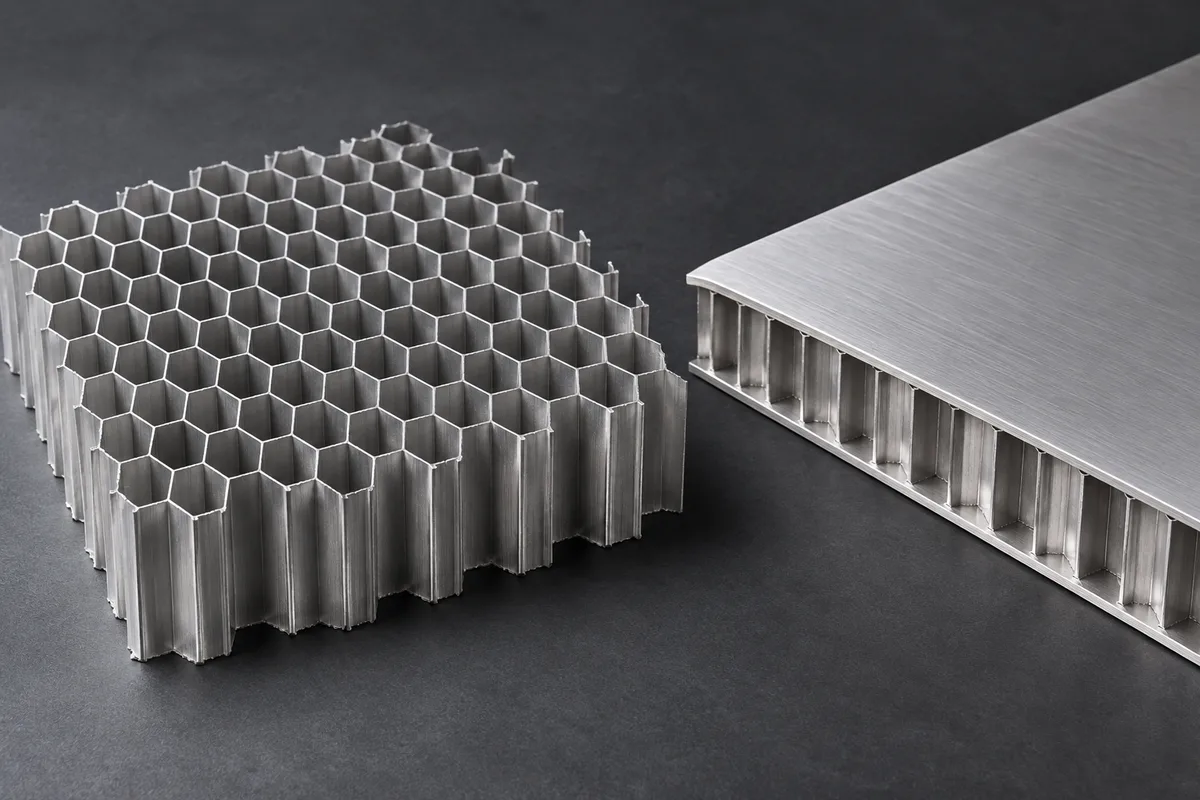
Every honeycomb sandwich panel has the same three layers: a facing on each side and a honeycomb core between them, joined by adhesive or by brazing. Change any one layer and the panel changes character, which is why the same word covers a 6 mm interior ceiling panel and a 50 mm aircraft floor.
| Layer | Common choices | What it controls |
|---|---|---|
| Facings (skins) | Aluminium 3003, 5052, 5005, 6061; coated or anodised. Also CFRP, GFRP, stone veneer, laminates | Bending strength, surface finish, impact and scratch resistance |
| Core | Aluminium honeycomb (3003, 5052, 5056); aramid, thermoplastic or paper in other markets | Shear strength, compression, weight, temperature limit |
| Joining | Epoxy film, two-part epoxy or polyurethane adhesive; vacuum brazing for all-aluminium panels | Bond durability, fire behaviour, maximum temperature |
| Edges and inserts | Extruded aluminium edge profiles, folded skins, potted inserts | Sealing, fixing and load introduction |
Bending stiffness of a sandwich comes mainly from the facings and the distance between them. For two equal facings of thickness tf and modulus E, separated by a distance d between their centre lines, the bending stiffness per unit width is approximately D = E × tf × d² / 2. Doubling the core thickness therefore roughly quadruples stiffness, while the weight hardly changes.
| Facing | Strengths | Limitations | Typical uses |
|---|---|---|---|
| Aluminium sheet (mill, anodised, PVDF or polyester coated) | Durable, flat, recyclable, non-combustible metal; wide colour range | Dents under hard impact | Facades, ceilings, partitions, vehicle bodies, cleanrooms, platforms |
| Brazed aluminium | No adhesive, no outgassing, higher temperature tolerance | Higher cost, size limited by furnace | Cleanrooms, ovens, vacuum and semiconductor equipment |
| Carbon-fibre (CFRP) | Highest stiffness per weight | Cost; needs insulating ply against aluminium core | Aerospace, motorsport, optical and robotic structures |
| Glass-fibre (GFRP) | Electrically insulating, corrosion-proof, economical composite | Lower stiffness than CFRP or aluminium | Truck bodies, marine interiors, chemical environments |
| Stone veneer | Natural stone appearance at a fraction of the weight | Brittle surface; edge detailing critical | Cladding, lift interiors, furniture |
Metline supplies the aluminium in all of these: aluminium-faced panels complete, and aluminium honeycomb core plus aluminium sheet or coil to fabricators who bond their own composite or stone facings. See carbon fibre honeycomb panels, fibreglass honeycomb panels and stone honeycomb panels for those build-ups.
Panel weight is the two skins (2.70 kg/m² per millimetre of aluminium) plus the core (core density × core thickness). The table assumes a 50 kg/m³ aluminium core, a common density for architectural and interior panels; heavier structural cores add proportionally more, and adhesive adds roughly 0.3 – 0.6 kg/m² depending on system.
| Skin thickness (mm) | Total thickness (mm) | Core thickness (mm) | Panel weight (kg/m², excl. adhesive) | 1220 × 2440 mm panel (kg) |
|---|---|---|---|---|
| 0.5 | 6 | 5 | 3.0 | 8.8 |
| 0.7 | 10 | 8.6 | 4.2 | 12.5 |
| 0.8 | 15 | 13.4 | 5.0 | 14.9 |
| 1 | 20 | 18 | 6.3 | 18.8 |
| 1 | 25 | 23 | 6.6 | 19.5 |
| 1.5 | 25 | 22 | 9.2 | 27.4 |
| 1 | 50 | 48 | 7.8 | 23.2 |
Calculated values for guidance. Solid aluminium plate of equal bending stiffness would be several times heavier.
Worked comparison. A 20 mm panel with 1 mm aluminium skins has facing centre lines 19 mm apart, so D ≈ 69 GPa × 1 mm × (19 mm)² / 2 ≈ 12.5 kN·m per metre width. A solid aluminium plate needs to be about 13 mm thick to match that stiffness, and it would weigh about 35 kg/m² against roughly 6.3 kg/m² for the sandwich: more than five times heavier. That ratio, not the absolute weight, is why sandwich panels dominate large flat surfaces in buildings and vehicles.
The same arithmetic shows what the core must do. The skins only work together if the core carries the shear between them without excessive deflection and supports them against local buckling. On short, heavily loaded spans, check core shear strength and shear deflection; a low-density core that is fine for a ceiling can be the weak link in a floor.
Micro-perforated face skin over the core with an acoustic fleece gives sound absorption for ceilings and transport interiors.
Patterned skins hide minor dents and fingerprints in public interiors.
Roll-bent or formed over over-expanded core for columns, canopies and curved facades.
Back-grooved and folded edges create trays with hidden fixings for facades and ceilings.
For each sector, the fire and durability rules differ: EN 13501-1 for buildings, EN 45545-2 for rail, IMO requirements for passenger ships and FAR 25.853 for aircraft interiors. Those requirements are met by the complete panel, so state them on the enquiry.
A 20 mm panel with 1 mm aluminium skins and a 50 kg/m³ core weighs about 6.3 kg/m² before adhesive, or roughly 19 kg for a 1220 × 2440 mm sheet. A solid aluminium plate of equal stiffness would weigh many times more.
0.5 – 0.8 mm for ceilings and light interior panels, 1.0 mm for facades and partitions, and 1.5 mm or more for floors, platforms and panels exposed to impact.
Yes. Asymmetric build-ups, for example a coated face skin and a mill-finish back skin, are common. Very different skins can cause bowing, so keep thickness and material similar when flatness matters.
Yes, with PVDF-coated aluminium skins, a durable adhesive, sealed edges and a fire classification that meets local building rules.
We supply the aluminium honeycomb core and aluminium sheet for those panels; the composite facings are sourced and bonded by the panel fabricator.
Send thickness, skins, finish, size and quantity. We will confirm the build-up and quote delivered to your site or port.





