Hexagonal core
The standard geometry with the most predictable properties. Suits flat or gently curved panels such as floors, bulkheads and equipment decks.



5056 aluminium honeycomb core is the highest-strength standard aluminium core: expanded from 5% magnesium foil, it carries roughly 15 – 25 % more compression and shear than 5052 core of the same density and resists salt spray better. It is the usual choice for aerospace sandwich panels, naval interiors and energy-absorbing parts. Metline supplies 5056 core in a wide range of cell sizes, densities and forms, unexpanded, expanded or cut to drawing, to customers worldwide.
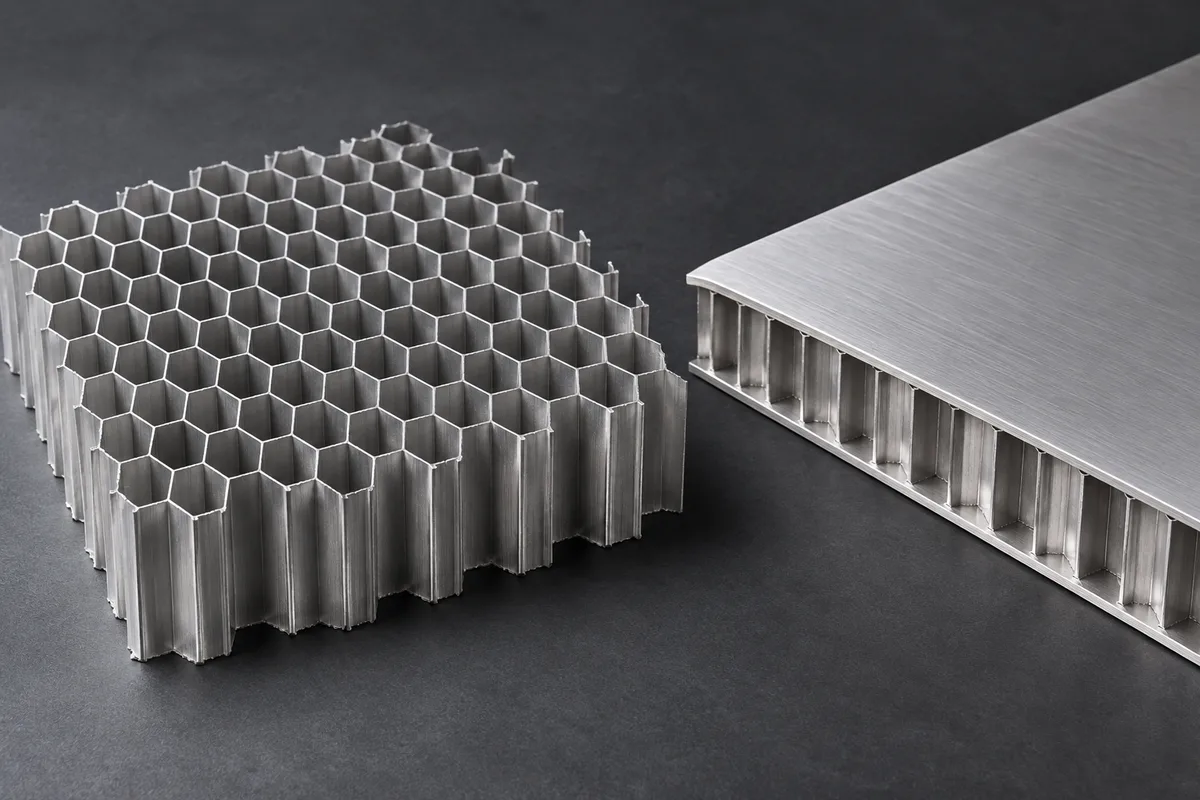
Honeycomb core is the lightweight middle layer of a sandwich panel. Two thin skins carry bending loads as tension and compression, while the core keeps them apart and carries shear between them. Doubling core thickness roughly quadruples stiffness for a very small weight increase, which is why honeycomb panels are found wherever stiffness per kilogram matters.
5056 core is made from 5056 aluminium foil, an alloy with 4.5 – 5.6 % magnesium. The foil is supplied in a fully hard condition, typically 5056-H39, to give the cell walls maximum strength. Compared with core made from 5052 foil (2.5 % Mg) or 3003 foil, 5056 core offers the highest compression and shear strength of the commercial aluminium cores and noticeably better resistance to salt spray and humid tropical air.
The trade-off is cost and formability. 5056 foil is harder to roll thin and the finished core is slightly less forgiving to form over tight curves, so designers use it where the extra strength or corrosion margin is needed, and choose 5052 or 3003 core for less demanding panels.
High-density cores made from thick foil can also be produced by corrugating each sheet before bonding, which avoids the very high force needed to expand thick foil. Either way, the result has three principal directions: L (the ribbon direction, along the continuous foil), W (the expansion direction) and T (the thickness). Shear strength in L is typically about 1.5 – 1.8 times that in W, so panels should be laid out with the L direction along the main shear load.
Core strength rises steeply with density, which depends on foil gauge and cell size. The ranges below are indicative typical values compiled from published manufacturers' data for 5056 hexagonal core at room temperature. Specification minimums, for example those in AMS-C-7438, can be up to about 25 % lower, so design allowables must come from the specification or the certified lot data.
| Cell size | Density | Stabilised compression | Plate shear, L | Plate shear, W |
|---|---|---|---|---|
| 1/8 in (3.2 mm) | 3.1 lb/ft³ (50 kg/m³) | 2.0 – 2.4 MPa (290 – 350 psi) | 1.4 – 1.8 MPa | 0.9 – 1.0 MPa |
| 1/8 in (3.2 mm) | 4.5 – 4.8 lb/ft³ (72 – 77 kg/m³) | 4.3 – 4.8 MPa (620 – 700 psi) | 2.6 – 3.1 MPa | 1.6 – 2.2 MPa |
| 1/8 in (3.2 mm) | 6.1 lb/ft³ (98 kg/m³) | 6.7 – 7.3 MPa (970 – 1060 psi) | 3.6 – 4.1 MPa | 2.1 – 2.4 MPa |
| 3/16 in (4.8 mm) | 3.1 lb/ft³ (50 kg/m³) | 2.0 – 2.8 MPa | 1.5 – 2.1 MPa | 0.9 – 1.1 MPa |
| 3/16 in (4.8 mm) | 5.7 lb/ft³ (91 kg/m³) | 5.5 – 6.0 MPa | 3.4 – 3.8 MPa | 2.0 – 2.2 MPa |
Stabilised compression is measured with skins bonded to the core (ASTM C365); bare compression is lower. Shear is measured by the plate shear method (ASTM C273). Values vary between manufacturers and lots.
Beyond plain hexagonal core, 5056 foil can be formed into several cell geometries and part forms. Match the type to the panel shape and load direction.
The standard geometry with the most predictable properties. Suits flat or gently curved panels such as floors, bulkheads and equipment decks.
Cells pulled into an elongated, near-rectangular shape. Curves easily in the W direction, with higher W shear and lower L shear than hexagonal core.
A special cell shape that bends to tight radii and compound curves without anticlastic distortion, for fairings, ducts and leading edges.
Extra foil bonded along the ribbons (double-wall or bonded strips) to raise local strength for hard points, insert zones and heavy loads.
Very small cells (1/16 in class) support thin skins and prevent dimpling, giving a smooth surface for precision panels and mirrors.
Small holes in the cell walls let air escape during bonding and allow venting or pressure equalisation in service.
Core compressed slightly in the T direction to remove the initial strength peak, giving a flat crush curve for energy absorbers.
Thick expanded blocks milled to contour, chamfered or pocketed to drawing, ready for bonding.
Core heat-formed or shaped to a specific curvature before lay-up, used for cabin walls, radomes and shells.
Honeycomb panels fail far more often from corrosion at the bond line than from overload, so foil treatment matters. 5056 already resists corrosion better than 5052, but aerospace and marine panels normally add one of these treatments:
Creates a porous oxide that adhesives key into strongly and that resists moisture. The usual treatment for structural aerospace core, often followed by a corrosion-inhibiting primer.
Chromate or chromium-free conversion coatings give good corrosion protection and paint adhesion at lower cost for industrial and marine panels.
Corrosion-inhibiting primer applied over anodised or converted foil, for panels in wet or salt-laden service.
Also design out moisture paths: seal panel edges, use potted inserts, and add a glass-fibre isolation ply between aluminium core and carbon-fibre skins to prevent galvanic corrosion.
| Parameter | Typical standard | Maximum / option | Tolerance |
|---|---|---|---|
| Ribbon length (L) | 1220 mm (48 in) | up to about 2540 mm (100 in) | +50 / −0 mm |
| Width (W, expanded) | 2440 mm (96 in) | up to about 3660 mm (144 in) | +100 / −0 mm |
| Common sheet sizes | 1220 × 2440, 1220 × 3050, 1220 × 3660, 1524 × 3050 mm | cut to size | — |
| Thickness (T) | any slice thickness | blocks to several hundred mm | ±0.13 mm up to 102 mm; about ±1.6 mm above |
| Density | per specification | — | ±10 % |
| Cell size | per specification | — | ±10 % |
Orders follow the industry naming convention cell size – alloy – foil gauge – density, for example 1/8-5056-.001 (3.1 pcf), plus the treatment, perforation and whether the core is expanded. Giving all of these avoids ambiguity between suppliers.
| Sector | Typical parts | Why 5056 core |
|---|---|---|
| Aerospace | Flooring, flap and spoiler cores, fairings, equipment shelves, satellite panels | Highest strength-to-weight of aluminium cores; anodised and qualified to AMS-C-7438 |
| Marine and offshore | Bulkheads, interior partitions, deck equipment platforms, enclosures | Better salt-spray resistance than 5052 or 3003 core |
| Defence | Shelters, transit cases, blast and impact layers, missile structures | High crush strength and energy absorption |
| Rail and transport | Floors, ceilings, doors and equipment boxes | Stiff, light and dimensionally stable |
| Energy absorption | Crash pads, impact attenuators, test barriers | Predictable crush plateau, especially when pre-crushed |
| Industrial | Machine tables, clean-room panels, air-flow straighteners | Flat, rigid and easy to machine |
| Property | 5056 core | 5052 core | 3003 core |
|---|---|---|---|
| Foil magnesium | 4.5 – 5.6 % | 2.2 – 2.8 % | none (Mn alloy) |
| Relative strength at equal density | Highest (about 15 – 25 % above 5052) | Baseline | Lowest |
| Salt-spray resistance | Very good | Good | Fair |
| Formability over curves | Good | Very good | Very good |
| Typical market | Aerospace, marine, defence | Aerospace, transport, general | Architecture, signage, industrial |
| Relative cost | Highest | Medium | Lowest |
If weight is critical and loads are moderate, 5052 core of slightly higher density may match a lighter 5056 core at lower cost; compare on strength per kilogram, not grade alone. Non-metallic aramid core is the alternative where electrical insulation, low thermal conductivity or very tight curvature matter more than strength.
At the same cell size and density, 5056 core is typically about 15 – 25 % stronger in compression and shear, because its foil contains roughly twice the magnesium. It also resists salt spray better.
L is the ribbon direction along the continuous foil, W is the direction in which the block was expanded, and T is the core thickness. Shear strength is highest in L, roughly 1.5 – 1.8 times that in W.
Hexagonal core bends in one direction but forms a saddle shape over compound curves. For curved panels, order over-expanded (OX) core, flexible core or preformed core.
Aluminium, titanium, stainless steel, glass-fibre and carbon-fibre skins are all used. With carbon-fibre skins add a glass-fibre isolation ply to avoid galvanic corrosion of the aluminium core.
Unexpanded blocks or slices take up a small fraction of the volume of expanded core, which cuts freight cost for large orders. You then expand the core in your own facility.
Density, cell size and thickness reports, plus compression and shear test results to ASTM C365 and C273 where specified, with lot traceability. Tell us the specification, for example AMS-C-7438, when you enquire.
Send the cell size, density, thickness, sheet size and quantity, or your panel drawing. We will reply with options, test documents and a delivered price.





