Conductive or welded core
Nodes joined by resistance welding or with conductive adhesive so every cell is a closed metal tube. Preferred for high-performance shielding.



A honeycomb vent panel lets cooling air through a shielded enclosure while blocking electromagnetic interference: each cell acts as a small waveguide that strongly attenuates frequencies below its cutoff. Cell size sets the cutoff frequency, cell depth sets how much attenuation you get, and the electrical bond between core, frame and enclosure decides whether the theory holds in practice. Metline supplies the aluminium honeycomb core, frame extrusions and sheet that vent makers and enclosure builders use, cut to drawing.
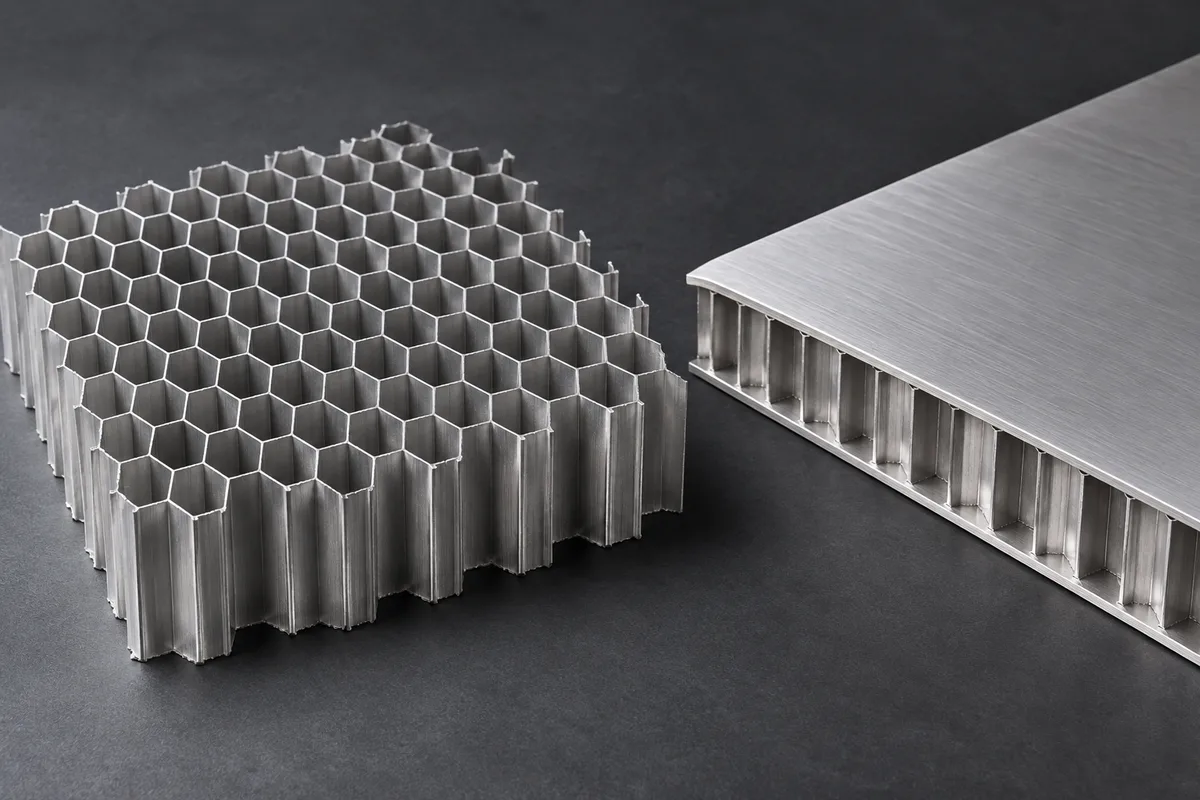
Any opening in a shielded enclosure leaks electromagnetic energy. A plain hole leaks badly once its largest dimension approaches half a wavelength. Honeycomb solves this by dividing a large opening into many small, deep metal tubes. A metal tube will not propagate waves below a cutoff frequency set by its width; below that frequency the field decays exponentially along the tube length, so a deep enough cell attenuates the signal by a large amount while air flows straight through.
A hexagonal cell behaves between the rectangular and circular cases. The practical rule that follows is a depth-to-cell ratio of at least about 4:1 for high attenuation, and a cell small enough that its cutoff sits well above the highest frequency you need to stop. Theory gives the upper limit; real panels achieve less because of seams, node bonds and the joint between vent and enclosure.
The table applies the rectangular-cell approximations to common honeycomb cell sizes. Attenuation figures are theoretical waveguide values for frequencies well below cutoff; measured shielding effectiveness of a finished vent is normally lower and must be confirmed by test.
| Cell size (mm) | Approx. cutoff (GHz) | Theoretical attenuation, 6.35 mm deep (dB) | Theoretical attenuation, 12.7 mm deep (dB) |
|---|---|---|---|
| 1.6 | 94 | 108 | 217 |
| 3.2 | 47 | 54 | 108 |
| 4.8 | 31 | 36 | 72 |
| 6.4 | 23 | 27 | 54 |
Calculated from fc ≈ 150 / w and 27.3 × t / w. Hexagonal cells and real assemblies differ; use these values to compare options, not as guaranteed performance.
| Choice | Effect on shielding | Effect on airflow |
|---|---|---|
| Smaller cell | Higher cutoff, more attenuation per mm of depth | More wall area, slightly higher pressure drop |
| Deeper core | Attenuation rises in proportion to depth | Higher pressure drop, heavier panel |
| Thinner foil | No real change to cutoff | More open area, lower pressure drop |
| Slanted cells (30°, 45°, 60°) | Blocks line of sight, adds path length | Higher pressure drop; useful for security and light-tightness |
| Two layers crossed at 90° | Much better performance where the core cells are not fully electrically joined | About double the pressure drop of one layer |
Thin-foil honeycomb has a very high open area, typically well above 95 % for common cell sizes, which is why honeycomb vents pass far more air than perforated plate or mesh of comparable shielding. The cells also straighten the airflow, which helps fan performance.
Standard expanded honeycomb is held together by adhesive lines at the nodes. Most structural adhesives are electrical insulators, so in a bonded core the cell walls may not form electrically continuous tubes. The core still attenuates, but less than the waveguide theory suggests, and performance can depend on polarisation. Three approaches deal with this:
Nodes joined by resistance welding or with conductive adhesive so every cell is a closed metal tube. Preferred for high-performance shielding.
Two bonded cores stacked with ribbon directions at 90°, so a weakness in one orientation is covered by the other.
Simply using a deeper core raises attenuation and compensates for imperfect node contact in less critical vents.
Aluminium is the usual core material: 3003 and 5052 foil are light, highly conductive, easy to cut and take conversion coatings well. Stainless steel or plated cores are used where corrosion or very high power levels demand them; Metline supplies the aluminium options. Bonded aluminium core used in vents is often specified with a flame-retardant adhesive film for equipment safety approvals.
| Frame type | Typical material | Notes |
|---|---|---|
| Extruded frame (C, U or flanged section) | 6063-T5 or T6 extrusion to ASTM B221 | Rigid, straight edges, integral flange or gasket groove; the core is crimped or bonded into the channel |
| Formed sheet frame | 5052-H32 sheet to ASTM B209 or AMS-QQ-A-250/8 | Bent, stamped or welded; suits small batches and custom shapes |
| Frameless / direct mount | Core edge compressed or bonded into a machined enclosure opening | Lowest profile; enclosure must provide the conductive seat |
The frame-to-enclosure joint usually limits real shielding more than the core does. A conductive gasket between the vent flange and the enclosure, closely spaced fasteners and unpainted, conversion-coated mating faces keep the joint low-impedance. For aluminium, chromate conversion coating to MIL-DTL-5541 Class 3 (or a trivalent equivalent) is the normal finish where low electrical resistance is needed; painted or powder-coated frames should have the gasket land masked.
Metline supplies aluminium honeycomb core cut to size and depth, 6063 frame extrusions and 5052 sheet with certificates, ready for vent fabrication. For an overview of other honeycomb products, see honeycomb core materials and sandwich panels.
Each cell is a small metal waveguide. Below its cutoff frequency the field decays rapidly along the cell, so a cell several times deeper than it is wide attenuates strongly, while air passes straight through the open cells.
3.2 mm (1/8 in) is the most common general-purpose choice. Use 1.6 mm for higher frequencies or thinner panels, and 4.8 – 6.4 mm where airflow matters more and the frequencies of concern are lower.
Aim for a depth at least about four times the cell size for high attenuation; 6.35 mm and 12.7 mm deep cores are common with 3.2 mm cells.
In adhesive-bonded core the nodes may not be electrically joined, so shielding can depend on polarisation. Crossing two layers at 90° evens this out and raises attenuation, at the cost of more pressure drop.
Chromate or trivalent conversion coating to MIL-DTL-5541 Class 3 keeps electrical resistance low at the mating faces. Paint or anodising should be kept off the gasket land.
We supply the aluminium materials: honeycomb core cut to size and depth, frame extrusions and sheet, with certificates. Vent assembly and gasketing are carried out by the vent or enclosure fabricator.
Send cell size, depth, vent sizes and frame details. We will quote the aluminium honeycomb core, extrusions and sheet cut to drawing.





