Unexpanded blocks
Full cured blocks for buyers who slice and expand in-house. Blocks give the most flexibility to cut different core thicknesses from one stock.



Unexpanded aluminium honeycomb is the bonded stack of foil, supplied as blocks or thin slices before it is pulled open into hexagonal cells. It takes a small fraction of the volume of expanded core, so it ships and stores far more cheaply, and panel makers expand it on their own lines to the exact size they need. This guide covers alloys, specifications, the expansion step and when unexpanded supply makes sense.
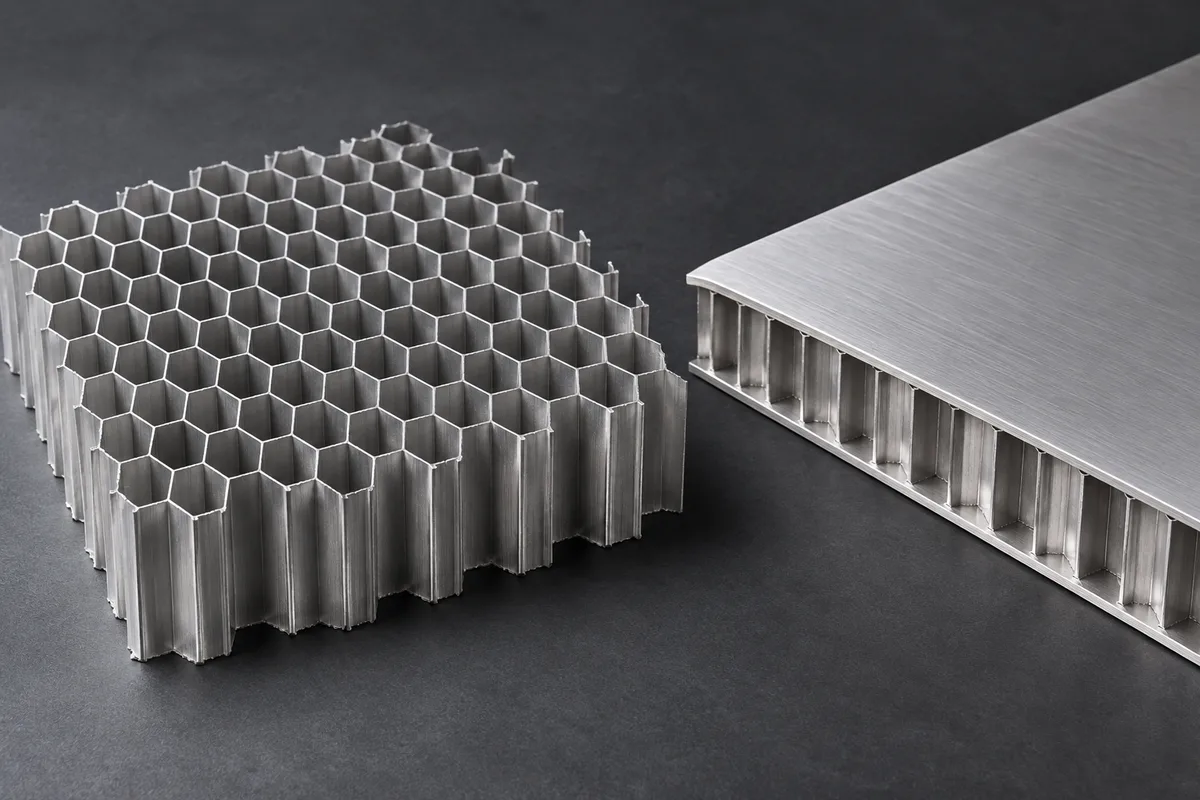
Most aluminium honeycomb is made by the expansion process. Sheets of foil are printed with parallel lines of adhesive, called node lines, offset by half a pitch on alternate sheets. The sheets are stacked and cured under heat and pressure into a solid-looking block. When the block is later pulled apart at right angles to the sheets, the unbonded sections open up and form hexagonal cells.
The block in its bonded but unopened state is called unexpanded core, sometimes abbreviated HOBE (honeycomb before expansion). It can be supplied as a full block or sliced across the node lines into thin pieces whose thickness equals the final core thickness of the panel. Because the cells are still closed, an unexpanded slice is a compact, flat stack of foil that occupies only a small part of the volume of the same core once expanded.
Unexpanded core suits manufacturers who have their own expansion and panel lines: sandwich-panel producers, rail and vehicle interior makers, aerospace subcontractors and companies that make filters, air-flow straighteners and energy absorbers.
Full cured blocks for buyers who slice and expand in-house. Blocks give the most flexibility to cut different core thicknesses from one stock.
Blocks pre-cut to the core thickness required, ready to expand. This is the most common form for panel producers, since no slicing equipment is needed.
Slices cut to agreed length, width and thickness, in a chosen alloy, foil gauge and cell size, with perforated foil where venting is required.
Perforated foil is specified when the core will be used in vacuum bagging, aerospace or space structures, or bonded panels that must vent trapped air and moisture during curing and in service. Non-perforated core is standard for most building and transport panels.
| Parameter | Typical range | Effect |
|---|---|---|
| Cell size (after expansion) | About 3 – 25 mm | Smaller cells give higher density, better face support and smoother panel faces |
| Foil thickness | 0.03 – 0.1 mm | Thicker foil raises density, compressive and shear strength |
| Expanded density | About 20 – 130 kg/m³ | Set by foil thickness and cell size together; the main driver of strength |
| Core thickness (slice) | About 5 – 200 mm | Matches the panel core thickness; thicker core gives much higher panel stiffness |
| Alloy | 3003, 5052, 5056 | Strength and corrosion resistance rise from 3003 to 5056 |
| Foil treatment | Plain or corrosion-resistant conversion coating | Treated foil improves durability and adhesive bonding |
| Perforation | Perforated or plain | Venting during cure and in service |
Core is usually identified by alloy, cell size, foil thickness and density, for example "5052, 6.35 mm cell, 0.05 mm foil". Mechanical properties such as flatwise compressive strength and plate shear strength in the L (ribbon) and W directions are tested on expanded core to ASTM C365 and C273, density to ASTM C271 and node bond strength to ASTM C363.
| Alloy | Strength | Corrosion resistance | Typical use |
|---|---|---|---|
| 3003 | Lowest of the three | Good | Building panels, partitions, signage, furniture and general sandwich panels |
| 5052 | Medium to high | Very good, including humid and marine air | Transport, rail, marine interiors, clean rooms and many aerospace parts |
| 5056 | Highest | Very good | Aerospace and high-load structural panels, energy absorbers |
For most commercial sandwich panels, 3003 or 5052 is sufficient. 5056 is chosen when the core must carry higher shear or compression at the same density, typically in aerospace structures where AMS-C-7438 or a customer specification applies. Our 3003 vs 5052 comparison gives more detail.
Even cell geometry is the main quality target, because distorted cells change the shear and compressive properties of the core. The expansion ratio and final cell shape should match the design values the panel was engineered for.
| Criterion | Unexpanded core | Expanded core |
|---|---|---|
| Supply form | Compact cured blocks or slices | Open hexagonal sheets ready to bond |
| Freight and storage | Small volume, low cost | Bulky, costly to ship long distances |
| Transit damage | Low | Cells can be crushed at edges |
| Buyer processing | Needs expansion and trimming | Ready to use after trimming |
| Best for | Panel makers with expansion lines and long supply routes | Small users and prototypes without expansion equipment |
If you do not have expansion equipment, buy expanded core or finished panels from a panel fabricator. If you produce panels in volume, unexpanded supply usually gives the lowest delivered cost per square metre of core.
It is a cured block or slice of foil sheets bonded along offset node lines, supplied before being pulled open into hexagonal cells. The buyer expands it to the required size.
Unexpanded core is compact and cheap to ship but must be expanded before use; expanded core is ready to bond but bulky and more easily damaged in transit.
Yes. You need an expansion frame or table that grips the slice evenly and pulls it to the correct cell shape. Without one, buy expanded core instead.
Cell sizes of about 3 – 25 mm, foil of 0.03 – 0.1 mm, expanded densities of about 20 – 130 kg/m³ and slice thicknesses of about 5 – 200 mm, in 3003, 5052 or 5056 alloy.
Yes. Alloy, foil gauge, cell size, perforation and slice dimensions can be specified to match your panel design and expansion line.
3003 for general building and decorative panels, 5052 for transport, marine and most structural uses, and 5056 where the highest core strength is needed, such as aerospace.
Send alloy, cell size, foil gauge, slice thickness and quantity. Our team will quote unexpanded blocks or slices for delivery worldwide.





