Machining
Good in T6/T651: short chips and a bright finish. Use carbide tools, high speeds and coolant. Annealed material is gummy and machines poorly.



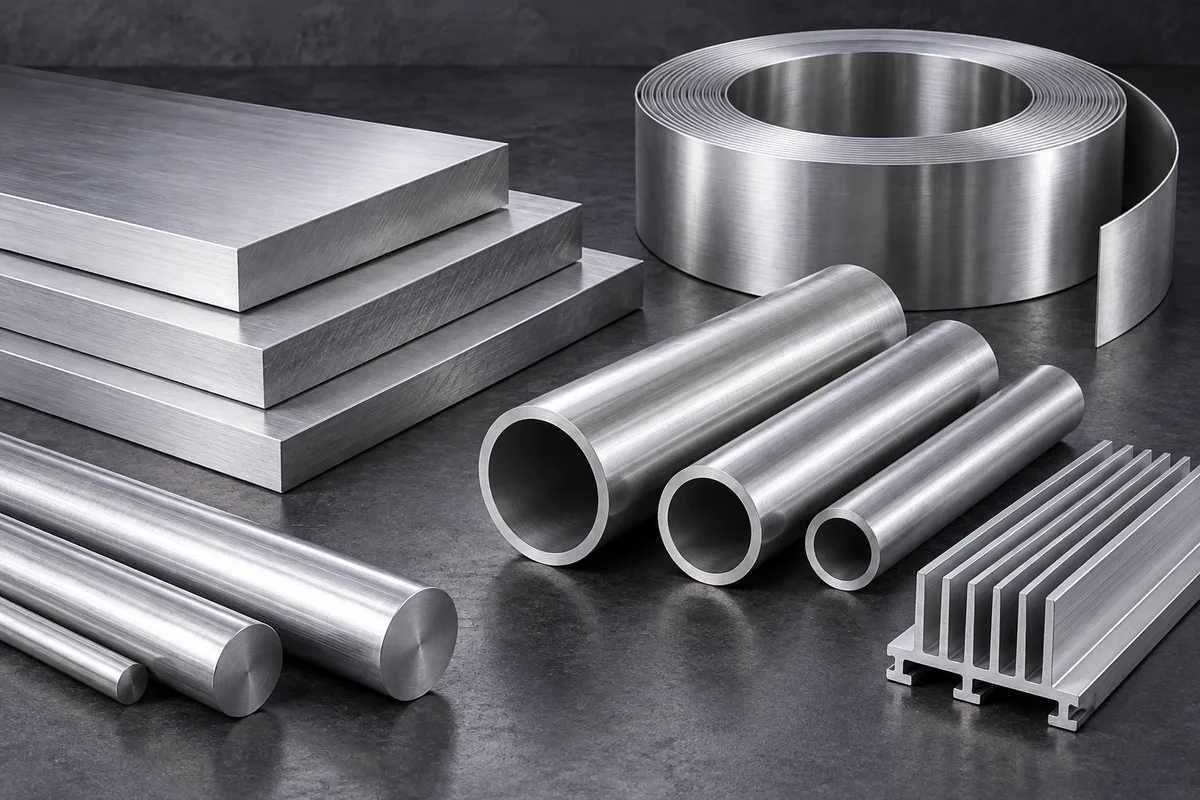
6061 is the most widely used heat-treatable aluminium alloy, supplied as plate, sheet, bar, tube, extrusions, forgings, coil and wire. Most buyers order it in T6 or one of its stress-relieved variants (T651 for plate and rolled bar, T6511 for extrusions), with a typical tensile strength of 310 MPa and yield of 276 MPa. This guide maps each product form to its standards and tempers, summarises the properties, and explains when 6061 is the right choice and when another alloy will do better.
6061 is an aluminium-magnesium-silicon alloy with small additions of copper and chromium. Heat treatment dissolves magnesium and silicon and then precipitates them as fine Mg2Si particles, which gives the alloy its strength. It was introduced in the mid-1930s and has been the general-engineering aluminium ever since.
Its popularity comes from balance rather than any single property. It is strong enough for structures and machine parts, machines well, welds with ordinary MIG and TIG procedures, resists atmospheric corrosion, anodises evenly and is produced in every major product form by mills around the world. That availability matters: a designer who specifies 6061 can buy plate, bar, tube and extrusion in the same alloy and temper family from many sources, with consistent certification.
Its limits are just as clear. It is not as strong as 2xxx or 7xxx aerospace alloys, it loses a large part of its T6 strength in the heat-affected zone of a weld, and for permanent seawater immersion the 5xxx marine grades corrode less. Knowing those limits is the key to choosing it well.
| Element | Limit | Role |
|---|---|---|
| Magnesium (Mg) | 0.8 – 1.2 | Forms Mg2Si with silicon |
| Silicon (Si) | 0.40 – 0.8 | Forms Mg2Si with magnesium |
| Copper (Cu) | 0.15 – 0.40 | Adds strength |
| Chromium (Cr) | 0.04 – 0.35 | Grain control; stress-corrosion resistance |
| Iron (Fe) | ≤ 0.7 | Impurity |
| Manganese (Mn) | ≤ 0.15 | |
| Zinc (Zn) | ≤ 0.25 | |
| Titanium (Ti) | ≤ 0.15 | Grain refiner |
| Others each / total | ≤ 0.05 / 0.15 | |
| Aluminium (Al) | Remainder |
Aluminum Association limits, identical in ASTM specifications and EN 573-3.
| Temper | Tensile strength (typical) | Yield strength (typical) | Elongation | Hardness |
|---|---|---|---|---|
| O | 125 MPa / 18 ksi | 55 MPa / 8 ksi | 25 – 30 % | 30 HB |
| T4 / T451 | 241 MPa / 35 ksi | 145 MPa / 21 ksi | 22 % | 65 HB |
| T6 / T651 / T6511 | 310 MPa / 45 ksi | 276 MPa / 40 ksi | 12 – 17 % | 95 HB |
| T6 specified minimum (sheet/plate, most thicknesses) | 290 MPa / 42 ksi | 240 MPa / 35 ksi | 8 – 10 % | — |
| T6 extrusions, specified minimum (ASTM B221) | 260 MPa / 38 ksi | 240 MPa / 35 ksi | 8 – 10 % | — |
Typical values from Aluminum Association and ASM data; minimums vary with form and size and are what designs should use.
| Temper | Process | When to use it |
|---|---|---|
| O | Annealed | Severe forming, spinning and drawing; heat treat afterwards for strength |
| T4 | Solution treated, naturally aged | Forming followed by artificial ageing; moderate strength |
| T6 | Solution treated, artificially aged | Full strength in sheet, drawn tube and wire |
| T651 | T6 plus stretching 1.5 – 3 % | Plate and rolled bar that will be machined; minimal distortion |
| T6511 | T6 plus stretching and minor straightening | Extruded bar and profiles for machining |
| T652 | T6 plus compression stress relief | Forgings and hand forgings |
| T62 | Solution treated and aged by the user | Parts heat-treated after forming from O or F material |
If a part will be machined heavily, order a stress-relieved temper (T651, T6511 or T652). Ordinary T6 bar or plate can move as internal quench stresses are released when material is removed.
| Form | Common tempers | ASTM | AMS (aerospace) | EN |
|---|---|---|---|---|
| Sheet and plate | O, T4, T6, T651 | B209 | 4025, 4026, 4027 | EN 485 |
| Rolled or cold-finished bar and rod | T6, T651 | B211 | 4115, 4116, 4117 | EN 754 |
| Extruded bar, rod and profiles | T6, T6511 | B221, B308 (structural shapes) | 4150, 4160, 4161 | EN 755 |
| Drawn seamless tube | O, T4, T6 | B210, B483 | 4079, 4080, 4082, 4083 | EN 754 |
| Seamless pipe and extruded tube | T6 | B241, B429 | 4150 (extruded) | EN 755 |
| Forgings | T6, T652 | B247 | 4127 | EN 586 |
| Wire and rivet wire | O, H13, T6 | B211, B316 | — | EN 1301 |
Standard numbers are the commonly used ones; always confirm the exact specification and revision on the drawing or purchase order.
Metline supplies 6061 in each of these forms, cut to size where required, with EN 10204 3.1 certificates. Detailed product pages:
Good in T6/T651: short chips and a bright finish. Use carbide tools, high speeds and coolant. Annealed material is gummy and machines poorly.
MIG/TIG with ER4043 (crack resistance, post-weld heat treatment) or ER5356 (higher fillet strength, better anodised colour match). Design codes take welded 6061-T6 at about 165 MPa tensile in the heat-affected zone.
Bend T6 to about 1.5 – 3 × thickness; form tighter in O or T4 and then age.
Clear, dyed and hard anodising all work well, giving an even appearance.
Good in atmospheric and fresh-water service; anodise or paint for marine exposure, or use 5083 for immersed parts.
Useful strength to about 100 – 150 °C; long exposure above that over-ages the alloy. Good toughness at cryogenic temperatures.
| Alloy | Typical yield (temper) | Weldability | Corrosion | Choose it when… |
|---|---|---|---|---|
| 6061 | 276 MPa (T6) | Good | Good | You need a balanced, widely available structural alloy |
| 6063 | 214 MPa (T6) | Good | Good | Surface finish and complex thin extrusions matter more than strength |
| 6082 | 260 – 310 MPa (T6) | Good | Good | Working to European standards; thick sections |
| 5052 | 193 MPa (H32) | Excellent | Excellent | Sheet forming and marine exposure without heat treatment |
| 5083 | 145 MPa (H111) – 215 MPa (H116) | Excellent | Excellent in seawater | Welded marine and cryogenic structures |
| 2024 | 345 MPa (T4/T351) | Poor | Fair | Fatigue-critical aerospace structure |
| 7075 | 503 MPa (T6) | Poor | Fair | Maximum strength for machined parts |
Further reading: 6063 guide, 7075 guide, 2024 guide and the 6061-T6 temper guide.
Machine parts, frames and fixtures, vehicle and trailer components, marine fittings, structural shapes, bicycle frames, electronics housings and aerospace fittings. It is the general-purpose structural aluminium.
All three have the same strength. T651 (plate and rolled bar) and T6511 (extrusions) are stretched after quenching to relieve internal stress, so they stay stable when machined.
Yes. 6061-T6 has a typical yield of 276 MPa against 214 MPa for 6063-T6. 6063 extrudes more easily and gives a better surface finish.
Yes, by MIG or TIG with ER4043 or ER5356 filler. The weld zone loses part of its T6 strength, which design codes account for, unless the assembly is re-heat-treated.
EN AW-6061 (AlMg1SiCu, 3.3211). Many European designs use 6082, which has similar properties and wider local availability.
Aluminium does not rust. 6061 forms a protective oxide and resists atmospheric corrosion well; anodising or painting is recommended for marine or industrial atmospheres.
Send your list with tempers, sizes and standards. Metline will confirm availability, certification and delivered pricing worldwide.





