Low alloy content
Little copper, chromium and iron means few intermetallic particles in the surface, so the oxide film grows evenly and stays clear.



6063 is the architectural extrusion alloy: a lean aluminium-magnesium-silicon grade that flows easily through complex dies, leaves a smooth surface and anodises to a bright, even colour. In the common T5 and T6 tempers it offers 150 – 240 MPa tensile strength, enough for frames, trims, tube and light structures. This guide covers its chemistry, tempers, guaranteed properties, standards and where it beats 6061.
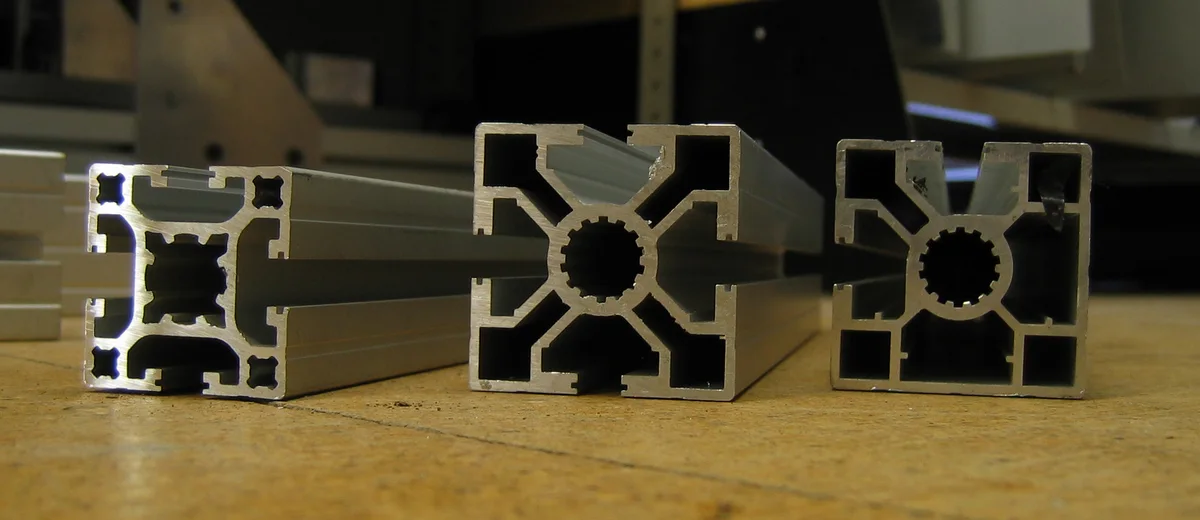
6063 belongs to the heat-treatable 6xxx family, like 6061 and 6082, but carries less magnesium and silicon and almost no copper, chromium or manganese. That lean chemistry is deliberate. It lowers the force needed to push hot billet through a die, allows very thin walls and fine detail, and gives a clean surface with few die lines.
The trade-off is strength. 6063-T6 reaches roughly three quarters of the strength of 6061-T6, which is ample for windows, curtain-wall mullions, shopfronts, railings, furniture, LED channels, heat sinks and irrigation tube, but not for heavily loaded machine parts. Because so much of the world's extruded aluminium goes into building products, 6063 is the single most extruded alloy and is often simply called "architectural alloy".
Another reason 6063 dominates extrusion is its low quench sensitivity. It reaches T5 properties when cooled by fans or a light water mist at the press exit, so a separate solution-treatment furnace is not needed. That keeps processing cost down and makes thin, wide or asymmetric sections practical without distortion from a hard water quench.
The limits below are the registered Aluminum Association values used by ASTM and EN 573-3 (EN AW-6063). Many extruders run tighter internal targets within this window: lower magnesium and silicon for maximum extrusion speed and finish, or higher levels when T6 or T66 strength is required.
| Element | Min % | Max % | Why it matters |
|---|---|---|---|
| Silicon (Si) | 0.20 | 0.60 | Combines with Mg to form Mg2Si |
| Iron (Fe) | — | 0.35 | Held low for a bright anodised finish |
| Copper (Cu) | — | 0.10 | Kept very low for corrosion resistance and finish |
| Manganese (Mn) | — | 0.10 | |
| Magnesium (Mg) | 0.45 | 0.90 | Main strengthening element with Si |
| Chromium (Cr) | — | 0.10 | Low, to avoid yellowish anodised tones |
| Zinc (Zn) | — | 0.10 | |
| Titanium (Ti) | — | 0.10 | |
| Others, each / total | — | 0.05 / 0.15 | |
| Aluminium (Al) | Remainder |
Compared with 6061, 6063 has roughly half the magnesium and copper and a quarter of the chromium. Fewer second-phase particles means fewer sites that disturb the anodic film, which is the metallurgical reason 6063 gives a more uniform anodised appearance.
| Temper | How it is made | Typical use |
|---|---|---|
| O | Fully annealed | Severe bending and forming; rarely stocked |
| T1 | Cooled from extrusion and naturally aged | Low-stress trims and irrigation tube where strength is unimportant |
| T4 | Solution heat-treated and naturally aged | Parts bent or stretched before final ageing |
| T5 | Cooled from extrusion and artificially aged | The standard temper for window, door, curtain-wall and general profiles |
| T52 | Cooled from extrusion and aged to a controlled strength window (ASTM gives both minimum and maximum values) | Architectural shapes that are bent, crimped or roll-formed, such as glazing beads and trim |
| T6 | Solution heat-treated (or press-quenched to the same effect) and artificially aged | Higher-strength frames, railings, tube and structural members |
| T66 | Like T6 but with tighter process control to reach higher minimums (EN 755-2) | Curtain-wall mullions and load-bearing profiles under EN specifications |
| T83, T831, T832 | Solution treated, cold drawn a controlled amount, then aged | Drawn tube with closer tolerances and higher strength |
On drawings, T5 and T6 are the two tempers to know. T5 is cheaper and perfectly adequate for most building profiles; T6 adds about 25 – 30 % yield strength and is worth specifying where wind load, span or impact governs the section size.
The first table gives typical values for comparison; the second gives specified minimums for extrusions, which are the values to design to. EN 755-2 sets slightly higher minimums for T5 and T6 than ASTM B221 for thin walls, and adds the T66 temper.
| Temper | Tensile strength | Yield strength (0.2 %) | Elongation | Brinell hardness |
|---|---|---|---|---|
| O | 90 MPa / 13 ksi | 48 MPa / 7 ksi | 18 – 25 % | 25 HB |
| T1 | 152 MPa / 22 ksi | 90 MPa / 13 ksi | 20 % | 42 HB |
| T4 | 172 MPa / 25 ksi | 90 MPa / 13 ksi | 22 % | — |
| T5 | 186 MPa / 27 ksi | 145 MPa / 21 ksi | 12 % | 60 HB |
| T6 | 241 MPa / 35 ksi | 214 MPa / 31 ksi | 12 % | 73 HB |
Typical values from Aluminum Association and ASM data; not guaranteed.
| Temper and size band | ASTM B221 tensile, min | ASTM B221 yield, min | ASTM elongation, min | EN 755-2 Rm / Rp0.2, min |
|---|---|---|---|---|
| T1, up to 12.7 mm (0.500 in) | 117 MPa / 17 ksi | 62 MPa / 9 ksi | 12 % | — |
| T5, up to 12.7 mm (0.500 in) | 152 MPa / 22 ksi | 110 MPa / 16 ksi | 8 % | — |
| T5, wall up to 10 mm | — | — | — | 175 MPa / 130 MPa, A 8 % |
| T52, up to 25 mm (1.000 in) | 152 – 205 MPa / 22 – 30 ksi | 110 – 170 MPa / 16 – 25 ksi | 8 % | — |
| T6, up to 25 mm (1.000 in) | 207 MPa / 30 ksi | 172 MPa / 25 ksi | 8 – 10 % | — |
| T6, wall up to 10 mm | — | — | — | 215 MPa / 170 MPa, A 8 % |
| T66, wall up to 10 mm | — | — | — | 245 MPa / 200 MPa, A 8 % |
ASTM values summarised from ASTM B221; EN values from EN 755-2:2016 for walls up to 10 mm (thicker walls have lower minimums). The governing standard and size band are stated on the mill certificate.
| System | Designation |
|---|---|
| Aluminum Association / ASTM | 6063 |
| UNS | A96063 |
| European (EN) | EN AW-6063 / EN AW-AlMg0.7Si |
| German (former DIN) | AlMgSi0.5, Werkstoff 3.3206 |
| ISO | AlMg0.7Si |
| Japan (JIS) | A6063 |
| China (GB/T) | 6063 |
| United Kingdom (former BS) | HE9 (extrusions) |
| India (IS 733 / IS 1285) | 63400 |
| Specification | Scope for 6063 |
|---|---|
| ASTM B221 / ASME SB-221 | Extruded bar, rod, wire, profiles and tube; the main 6063 specification |
| ASTM B241 / ASME SB-241 | Seamless pipe and seamless extruded tube, including 6063-T6 schedule pipe |
| ASTM B429 | Extruded structural pipe and tube |
| ASTM B483 and B210 | Drawn tube for general purposes and drawn seamless tube |
| AMS-QQ-A-200/9 and AMS 4156 | Aerospace and defence extrusions in 6063 |
| EN 755-2 / EN 755-9 / EN 12020-2 | European extrusion properties, general tolerances and precision-profile tolerances |
| IS 733 / IS 1285 (India), JIS H4100 (Japan), GB/T 6892 (China) | National extrusion and tube standards |
Little copper, chromium and iron means few intermetallic particles in the surface, so the oxide film grows evenly and stays clear.
Well-controlled extrusion gives a consistent grain structure, so etching and anodising produce the same tone along the length.
Lower extrusion pressure means fewer die lines and pick-up marks, reducing the polishing or etching needed before anodising.
The porous anodic film absorbs dyes and electrolytic colours uniformly: silver, champagne, bronze, black and gold are routine.
Clear anodising to AA 15 – AA 25 (15 – 25 µm) is common for exterior work under the Qualanod and AAMA 611 schemes.
6063 profiles are also the standard substrate for polyester powder coating to Qualicoat and AAMA 2603/2604/2605 classes.
Colour consistency depends on chemistry and process control as much as alloy. For a large façade, order all profiles from one source and one alloy window, ask for colour limit samples, and avoid mixing 6063 with 6061 or 6082 parts that will sit side by side, since they anodise to visibly different tones. See our guide to aluminium anodising for more.
Fair. 6063 is softer than 6061 and tends to form long, stringy chips. Use sharp, polished high-rake tools, high speeds and good lubrication. T6 machines noticeably better than T4 or T5.
Readily welded by TIG and MIG with ER4043 or ER5356 filler. Strength in the heat-affected zone drops to about the O to T4 level, so welded frames are sized for the reduced value.
Good in T4 and T52, acceptable in T5, limited in T6. Use mandrels for tube, and bend before anodising: anodic films crack on tight bends.
Most window and façade frames are mechanically joined with corner cleats, crimping and screw ports designed into the profile, which avoids weld softening and finish damage.
| Property | 6063-T6 | 6061-T6 |
|---|---|---|
| Tensile strength, typical | 241 MPa | 310 MPa |
| Yield strength, typical | 214 MPa | 276 MPa |
| Yield strength, min (extrusions) | 172 MPa (ASTM) | 241 MPa (ASTM) |
| Extrudability | Excellent; thin walls and complex hollows | Good; simpler, thicker sections |
| Anodised appearance | Bright and uniform | Good, slightly duller |
| Machinability | Fair | Very good |
| Electrical conductivity | About 53 – 55 % IACS | About 43 % IACS |
| Relative cost as extrusion | Lower | Higher |
Choose 6063 when appearance, section complexity and cost lead the decision and loads are moderate. Choose 6061 (or 6082 in Europe) when the part carries significant load, will be machined heavily, or needs the higher fatigue strength. For a deeper comparison read 6061 vs 6063.
Mainly extruded building products: window, door and curtain-wall profiles, railings and trims. It is also used for furniture, LED and heat-sink profiles, irrigation and handrail tube, and substation bus pipe.
No. 6063-T6 is typically 241 MPa tensile against 310 MPa for 6061-T6. 6063 trades strength for easier extrusion and a better anodised finish.
T5 is cooled at the press and artificially aged; T6 is solution heat-treated (or effectively press-quenched) and then aged. T6 is roughly 25 – 30 % stronger in yield, while T5 is cheaper and sufficient for most building profiles.
Yes, by TIG or MIG with 4043 or 5356 filler. The heat-affected zone loses much of its temper strength, so welded structures must be designed for the lower value.
Yes. Its corrosion resistance is very good, and anodising or powder coating extends service life further, which is why it is the standard alloy for façades and windows.
EN AW-6063 (AlMg0.7Si), formerly DIN AlMgSi0.5 / Werkstoff 3.3206. The old British designation was HE9.
Tell us the section, temper, finish and quantity. We will reply with availability, certification and a delivered price.





