Machining
T6 is hard enough to break chips cleanly and give a bright finish. Use sharp carbide tools with high positive rake, high spindle speeds and flood coolant. Softer tempers (O, T4) are gummy and tend to build up on the tool edge.



6061-T6 is 6061 alloy that has been solution heat-treated, quenched and artificially aged to its peak routine strength: typically 310 MPa tensile and 276 MPa yield. It is the default temper for machined parts, structural extrusions and general engineering sheet worldwide. This guide explains how T6 is produced, what each product standard guarantees, how T6 behaves in welding and machining, and when another temper is the better buy.
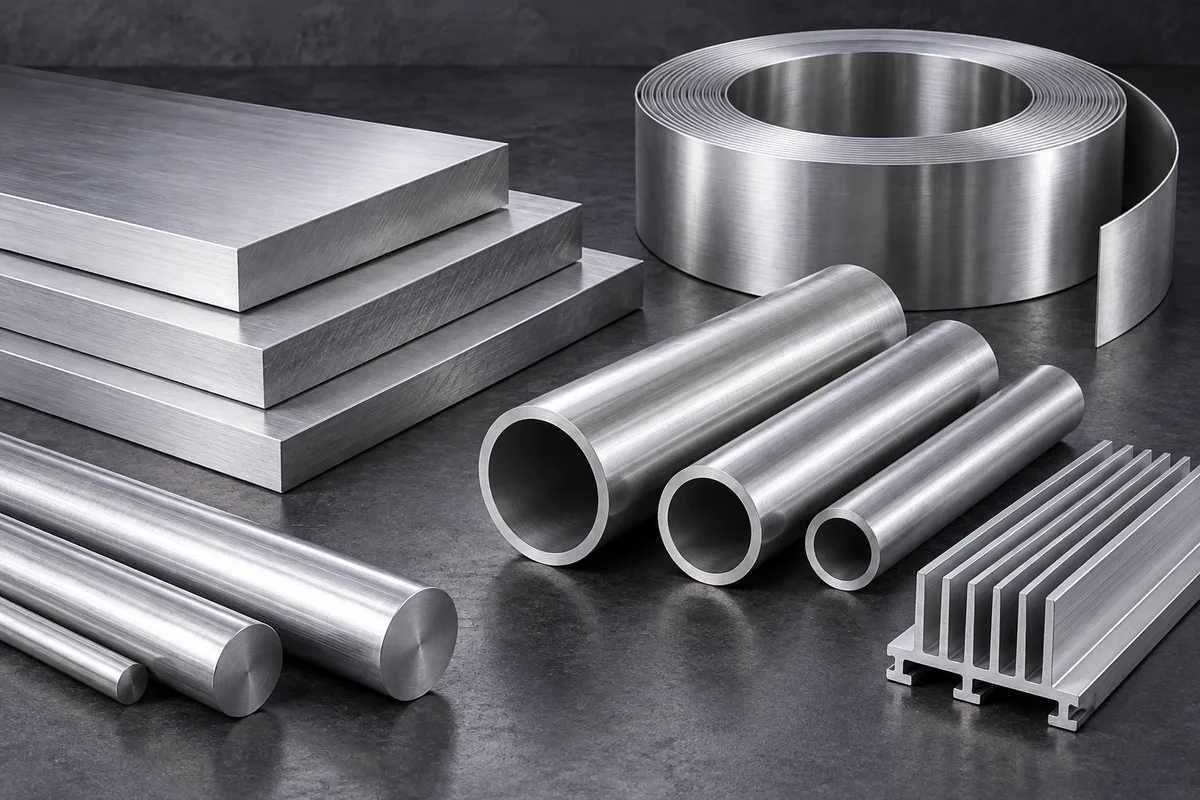
The designation has two parts. "6061" identifies the alloy: a 6xxx-series aluminium strengthened by magnesium and silicon, with a little copper and chromium. "T6" is the temper code defined in ANSI H35.1 and EN 515: solution heat-treated, then artificially aged, with no deliberate cold work in between.
The 6061 chemistry on its own gives only modest strength. The alloy becomes useful once heat treatment turns its dissolved magnesium and silicon into billions of nanometre-scale Mg2Si precipitates that block dislocation movement. The T6 cycle is tuned to stop at the point where those precipitates give the highest strength, which is why T6 is sometimes described as "peak-aged".
Because the same temper code applies across product forms, 6061-T6 sheet, bar, extrusion and forging look identical on a drawing. They are not identical on the certificate: each form is covered by its own specification with its own guaranteed minimums, and those minimums differ by up to 30 MPa. That difference is the most common source of confusion for buyers and is covered in the specified-minimums section below.
Times and temperatures above are typical industrial practice summarised from AMS 2770 and ASM handbook data; mills adjust them for furnace loading and section size.
If 6061 is cooled from extrusion and aged without a separate solution treatment, the result is designated T5. If it is solution-treated but left to age at room temperature, it is T4. Both are weaker than T6, and T4 slowly gains strength for several days after quenching before stabilising.
All 6061 product forms share the registered composition limits of the Aluminum Association, which ASTM, AMS and EN 573-3 (EN AW-6061) follow. The heat treatment does not change the chemistry; it changes how the alloying elements are distributed.
| Element | Min % | Max % | Why it matters |
|---|---|---|---|
| Silicon (Si) | 0.40 | 0.80 | Forms Mg2Si with magnesium |
| Iron (Fe) | — | 0.70 | Impurity; held low for toughness |
| Copper (Cu) | 0.15 | 0.40 | Adds strength in the T6 condition |
| Manganese (Mn) | — | 0.15 | |
| Magnesium (Mg) | 0.80 | 1.20 | Main strengthening element |
| Chromium (Cr) | 0.04 | 0.35 | Grain control and stress-corrosion resistance |
| Zinc (Zn) | — | 0.25 | |
| Titanium (Ti) | — | 0.15 | Grain refinement in the cast billet or slab |
| Others, each / total | — | 0.05 / 0.15 | |
| Aluminium (Al) | Remainder |
Typical values describe what correctly heat-treated material usually achieves. They are useful for comparison and for estimating performance, but they are not guaranteed: design to the specified minimum of the standard you order to.
| Property | Metric | Imperial | Note |
|---|---|---|---|
| Ultimate tensile strength | 310 MPa | 45 ksi | Typical |
| Tensile yield strength (0.2 %) | 276 MPa | 40 ksi | Typical |
| Elongation | 12 – 17 % | 12 – 17 % | Depends on specimen size |
| Shear strength | 207 MPa | 30 ksi | Typical |
| Fatigue strength | 96.5 MPa | 14 ksi | 5 × 10⁸ cycles, R. R. Moore test |
| Brinell hardness | 95 HB | 95 HB | 500 kg load, 10 mm ball |
| Rockwell / Vickers (converted) | About 60 HRB / 107 HV | Converted from Brinell | |
| Modulus of elasticity | 68.9 GPa | 10,000 ksi | Average of tension and compression |
| Poisson's ratio | 0.33 | 0.33 | |
| Fracture toughness KIC | About 29 MPa√m | About 26 ksi√in | Varies with orientation |
The table below summarises the guaranteed minimums for the most common forms. Values are for the thinner or smaller size bands; thick plate and large-diameter bar have slightly lower minimums because their centres cool more slowly during the quench.
| Product form | Standard | Tensile, min | Yield, min | Elongation, min |
|---|---|---|---|---|
| Sheet and plate (T6 / T651) | ASTM B209, AMS 4025/4027 | 290 MPa / 42 ksi | 241 MPa / 35 ksi | 8 – 10 % |
| Sheet and plate (T6 / T651) | EN 485-2 | 290 MPa | 240 MPa | 6 – 10 % (by thickness) |
| Rolled or cold-finished bar and rod (T6 / T651) | ASTM B211, AMS 4117 | 290 MPa / 42 ksi | 241 MPa / 35 ksi | 10 % |
| Extruded bar, profiles and tube (T6 / T6511) | ASTM B221, AMS 4150 | 262 MPa / 38 ksi | 241 MPa / 35 ksi | 8 – 10 % |
| Extruded profiles (T6) | EN 755-2 | 260 MPa | 240 MPa | 8 % |
| Drawn seamless tube (T6) | ASTM B210, B483 | 290 MPa / 42 ksi | 241 MPa / 35 ksi | 8 – 10 % |
| Die forgings (T6) | ASTM B247, AMS 4127 | 262 MPa / 38 ksi | 241 MPa / 35 ksi | 7 % |
Summary only; the exact value depends on the edition of the standard and the thickness or diameter band, and is printed on the mill certificate.
The practical consequence: a part machined from extruded 6061-T6511 bar is guaranteed about 28 MPa less tensile strength than the same part machined from rolled T651 bar or plate, even though both are "6061-T6". If your stress calculation relies on 290 MPa, say so on the drawing by naming the product standard, not just the alloy and temper.
| Form | Typical size range | Usual temper | Common uses |
|---|---|---|---|
| Sheet | 0.5 – 6 mm; 1000 – 1500 mm wide (48 × 96 / 48 × 144 in) | T6 | Enclosures, panels, brackets |
| Plate | 6 – 200 mm thick; up to about 2500 mm wide | T651 | Base plates, fixtures, machined parts |
| Round, square and hex bar | About 5 – 500 mm diameter or across flats | T6, T651, T6511 | Turned parts, shafts, fittings |
| Flat bar | About 2 – 100 mm thick, 10 – 400 mm wide | T6, T6511 | Frames, bus links, machined blanks |
| Extruded profiles | Angle, channel, tee, I-beam and custom sections | T6, T6511 | Structures, frames, rails |
| Tube and pipe | Seamless or structural, round, square and rectangular | T6 | Frames, bicycle tubing, hydraulic lines |
| Forgings | Open-die blocks, discs, rings; closed-die parts | T6, T652 | Wheels, flanges, valve bodies |
| Block | Saw-cut from thick plate or forging | T651, T652 | Moulds, tooling, prototypes |
Sizes outside these ranges can often be sourced; send the dimensions with your enquiry. Each form has its own page on this site with detailed size tables (see the related links below).
| Temper | Condition | Typical tensile / yield | When to choose it |
|---|---|---|---|
| 6061-O | Annealed (softest) | 125 / 55 MPa | Deep drawing, spinning and tight bends; heat-treat to T6 after forming |
| 6061-T4 | Solution treated, naturally aged | 241 / 145 MPa | Moderate forming, then artificial ageing to T6 (giving T62 properties) |
| 6061-T6 | Solution treated, artificially aged | 310 / 276 MPa | Sheet, extrusions and general parts where residual stress is not a concern |
| 6061-T651 | T6 plus stretching (plate, rolled bar) | 310 / 276 MPa | Plate and bar that will be heavily machined |
| 6061-T6511 | T6 plus stretching and minor straightening (extrusions) | 310 / 276 MPa | Extruded bar and profiles that will be machined |
| 6061-T652 | T6 plus compressive stress relief (forgings) | 310 / 276 MPa | Forged blocks and rings for machining |
Choosing T6 when a part will be machined deeply on one side is a classic mistake: the unrelieved quench stress is released as metal is removed and the part bows. The material cost of T651 or T6511 is little different, so specify the stress-relieved version for any machined component.
T6 is hard enough to break chips cleanly and give a bright finish. Use sharp carbide tools with high positive rake, high spindle speeds and flood coolant. Softer tempers (O, T4) are gummy and tend to build up on the tool edge.
MIG and TIG weld well with ER4043 or ER5356 filler. Heat softens a band about 25 mm either side of the weld; design codes typically take the welded tensile strength as about 165 MPa (24 ksi). Re-solution treating and ageing after welding restores T6 strength but can distort the assembly.
T6 has limited ductility. Allow bend radii of roughly 1.5 – 3 × thickness for sheet and bend across the rolling direction. For tighter forming use O or freshly quenched T4.
Prolonged exposure above about 150 °C over-ages the precipitates and permanently lowers strength. Short exposures, such as powder-coat curing at about 180 – 200 °C for 10 – 20 minutes, cause only a small loss.
Takes clear, coloured and hard (Type III) anodising well; the finish is slightly less bright than 6063 because of the higher alloy content. Powder coating and painting are routine.
Good resistance in air and fresh water. In seawater 6061-T6 performs acceptably when anodised or painted; for permanent immersion, 5083 or 5086 is the safer choice.
| Sector | Typical 6061-T6 parts | Usual form |
|---|---|---|
| Machinery and automation | Base plates, gantries, fixtures, linear-motion carriages, robot tooling | Plate T651, bar T6511 |
| Transport and EV | Battery trays, suspension brackets, trailer frames, crash-management parts | Extrusions, plate, forgings |
| Construction | Handrails, stair stringers, platforms, structural connections, bridge decking parts | Structural profiles, tube |
| Marine | Deck fittings, ladders, gangways, superstructure framing | Extrusions, tube, plate (protected) |
| Electronics | Chassis, heat spreaders, instrument housings, server frames | Plate, sheet, extrusions |
| Sport and leisure | Bicycle frames and parts, climbing hardware, archery and camera equipment | Drawn tube, bar, forgings |
| Aerospace (secondary) | Fittings, ground-support equipment, fluid lines | Plate to AMS 4027, tube, bar |
| Tooling and moulds | Prototype and short-run moulds, vacuum-forming tools, jigs | Block and plate T651 |
Use these as starting points only. For any load-bearing design, check the specified minimum of the actual product standard, the welded strength if joints are welded, the operating temperature and the corrosion environment.
| Need | Consider | Why |
|---|---|---|
| Higher strength | 7075-T6 / T651 | About 570 MPa tensile, but poor weldability and lower corrosion resistance |
| Best finish on extrusions | 6063-T5 / T6 | Brighter anodised finish, easier to extrude in thin sections, lower strength |
| European structural standard | 6082-T6 | Similar or slightly higher strength; the usual choice under EN specifications |
| Seawater immersion and welding | 5083-H111 / H321 | Non-heat-treatable, so welds keep most of their strength; excellent in seawater |
| Higher conductivity | 6101-T6 or 1350 | About 55 – 61 % IACS for busbar and conductors |
| Very flat tooling plate | Cast tooling plate | Stress-free and precision-milled, but lower strength |
In most general-engineering situations 6061-T6 remains the right answer: it is widely available in every form, certified under every major standards system and forgiving to fabricate.
Typically about 276 MPa (40 ksi). The guaranteed minimum is 240 – 241 MPa (35 ksi) for sheet, plate, bar and extrusions under ASTM and EN standards. Design to the minimum.
They have the same strength. T651 has also been stretched after quenching to relieve internal stress, so it stays flat or straight when machined. Order T651 for plate and bar that will be machined.
About 95 Brinell, roughly 60 HRB or 107 HV. That is hard enough to machine cleanly but much softer than steel, so wear surfaces are often hard-anodised.
No. Welding softens the heat-affected zone to around 165 MPa tensile. Either size the joint for the welded strength, place welds in low-stress areas, or re-heat-treat the welded assembly to T6.
Moderately. Use generous radii (about 1.5 – 3 × thickness for sheet) and bend across the grain. For tight bends, form in O or T4 and age afterwards.
It keeps most of its strength up to about 100 °C. Long-term exposure above roughly 150 °C over-ages the alloy and the strength loss is permanent.
Yes. Metline supplies 6061-T6 in all common forms from Mumbai to customers worldwide, with mill test certificates and export packing.
Tell us the form, temper, size, standard and quantity. We will reply with availability, certification and a delivered price.





