Machining
Among the best-machining aluminium alloys in T6 and T651: short chips, low built-up edge and fine finishes. Use carbide tools, high speeds and coolant. Choose T651 or T7351 for heavy material removal to limit distortion.



7075 is a zinc-based, heat-treatable aluminium alloy with one of the highest strengths of any commercial aluminium grade: about 572 MPa typical tensile strength in the T6 temper. It machines superbly but cannot be fusion-welded and needs protection against corrosion. This guide gives the data, explains the tempers and helps you decide when 7075 is the right choice and when another grade is better.
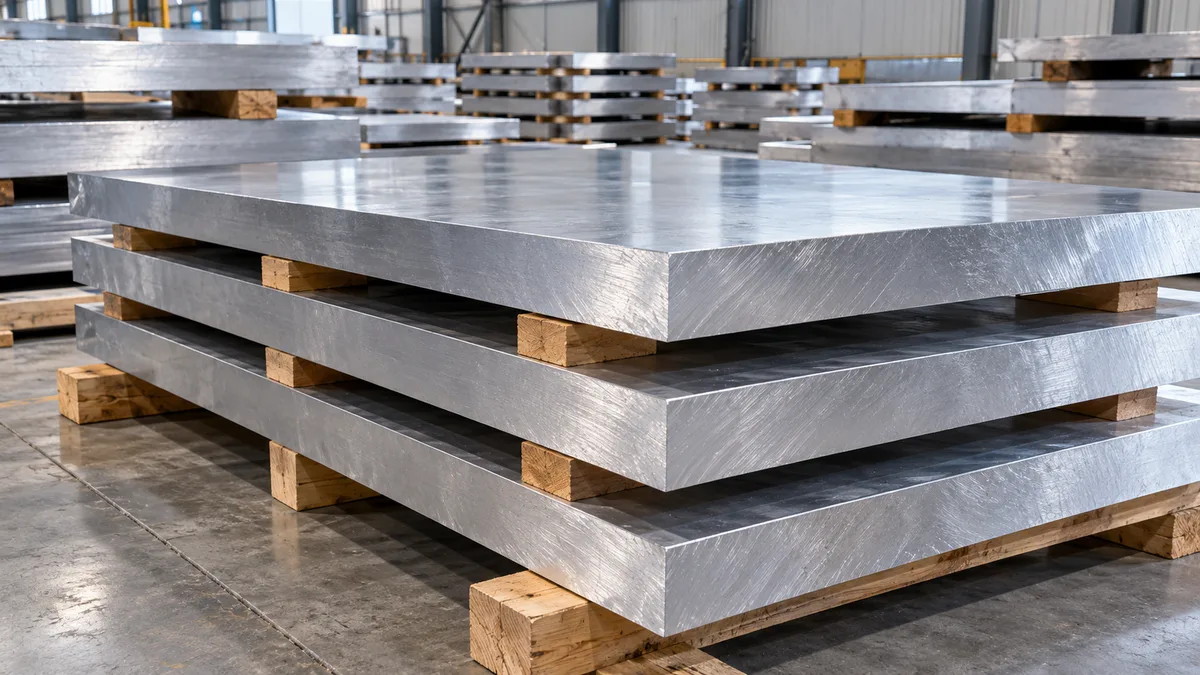
7075 belongs to the 7xxx series, where zinc is the main alloying element. With roughly 5.6 % zinc, 2.5 % magnesium and 1.6 % copper, it forms fine MgZn2-type precipitates during ageing that block dislocation movement and give the alloy its high strength. In the T6 temper its yield strength is about 503 MPa, close to twice that of 6061-T6.
That strength comes with trade-offs that every designer should know. 7075 has lower general corrosion resistance than 5xxx and 6xxx alloys because of its copper content, and in the peak-aged T6 temper it is susceptible to stress-corrosion cracking. It is not suitable for arc welding. It also costs more than the general-purpose grades. Where those limitations are acceptable, it offers a strength-to-weight ratio that few metals can match at its price.
| Element | Minimum | Maximum | Role |
|---|---|---|---|
| Zinc (Zn) | 5.1 | 6.1 | Main strengthening element |
| Magnesium (Mg) | 2.1 | 2.9 | Combines with Zn to form hardening precipitates |
| Copper (Cu) | 1.2 | 2.0 | Adds strength and improves SCC behaviour in over-aged tempers |
| Chromium (Cr) | 0.18 | 0.28 | Controls grain structure, improves SCC resistance |
| Iron (Fe) | — | 0.50 | Impurity |
| Silicon (Si) | — | 0.40 | Impurity |
| Manganese (Mn) | — | 0.30 | |
| Titanium (Ti) | — | 0.20 | Grain refiner |
| Others each / total | — | 0.05 / 0.15 | |
| Aluminium | Remainder |
Aluminum Association limits; identical to EN AW-7075 (AlZn5.5MgCu), UNS A97075 and Werkstoff 3.4365.
| Temper | What it means | Typical tensile | Typical yield | Elongation | Brinell |
|---|---|---|---|---|---|
| O | Annealed, softest | About 228 MPa | About 103 MPa | About 17 % | 60 HB |
| T6 | Solution treated and artificially aged to peak strength | About 572 MPa | About 503 MPa | About 11 % | 150 HB |
| T651 | T6 plus stretching to relieve quench stress (plate, rolled bar) | About 572 MPa | About 503 MPa | About 11 % | 150 HB |
| T6511 | T6 stretched with minor straightening (extrusions) | About 572 MPa | About 503 MPa | About 11 % | 150 HB |
| T73 / T7351 | Over-aged for maximum SCC resistance (T7351 stretched) | About 505 MPa | About 435 MPa | About 13 % | — |
| T76 / T7651 | Over-aged for exfoliation resistance | Between T6 and T73 | Between T6 and T73 | — | — |
Typical values (ASM) describe average material. For design and acceptance use the specified minimums, which fall as thickness increases because thick sections cool more slowly during quenching. The table below shows how ASTM B209 minimums for 7075-T651 plate change with thickness:
| Plate thickness | Min. tensile | Min. yield |
|---|---|---|
| 6.35 – 12.67 mm (0.250 – 0.499 in) | 538 MPa (78 ksi) | 462 MPa (67 ksi) |
| 12.70 – 25.40 mm (0.500 – 1.000 in) | 538 MPa (78 ksi) | 469 MPa (68 ksi) |
| 25.43 – 50.80 mm (1.001 – 2.000 in) | 531 MPa (77 ksi) | 462 MPa (67 ksi) |
| 50.83 – 63.50 mm (2.001 – 2.500 in) | 524 MPa (76 ksi) | 441 MPa (64 ksi) |
| 63.53 – 76.20 mm (2.501 – 3.000 in) | 496 MPa (72 ksi) | 421 MPa (61 ksi) |
| 76.23 – 101.60 mm (3.001 – 4.000 in) | 462 MPa (67 ksi) | 372 MPa (54 ksi) |
Summarised from ASTM B209; check the current edition and your order specification for exact limits and elongation requirements.
| Form | Common tempers | Commercial standards | Aerospace examples |
|---|---|---|---|
| Sheet | O, T6, T73, T76 (bare or Alclad) | ASTM B209, EN 485 | AMS-QQ-A-250/12, /13; AMS 4045, 4049 |
| Plate and block | T651, T7351, T7651 | ASTM B209, EN 485 | AMS 4045, AMS 4078 |
| Rolled / cold-finished bar | T6, T651, T73, T7351 | ASTM B211, EN 754 | AMS-QQ-A-225/9 |
| Extruded bar, profiles, angle | T6, T6511, T73511, T76511 | ASTM B221, EN 755 | AMS-QQ-A-200/11, AMS 4154, AMS 4167 |
| Tube | O, T6, T73 | ASTM B210, B241, EN 754 / 755 | AMS-WW-T-700/7 |
| Forgings | T6, T652, T73, T7352 | ASTM B247, EN 586 | AMS 4126, AMS 4141 |
| Wire | O, H13, T6, T73 | ASTM B211, B316 | By specification |
Metline supplies 7075 in all of these forms, cut to size on request and certified with EN 10204 3.1 mill certificates. Product pages for each form give sizes and weights; see the links at the end of this guide.
Among the best-machining aluminium alloys in T6 and T651: short chips, low built-up edge and fine finishes. Use carbide tools, high speeds and coolant. Choose T651 or T7351 for heavy material removal to limit distortion.
Not recommended for MIG or TIG welding: hot cracking and a weak heat-affected zone result. Use mechanical fastening, adhesive bonding or, with qualification, friction stir welding.
Poor cold formability in T6; minimum bend radii are large. Form in the O temper or freshly quenched, then heat-treat. Small bends in T6 need generous radii and testing.
Anodises well for protection and hard coatings. Clear anodising gives a slightly yellow-grey tone because of copper; colour matching with 6xxx parts is difficult.
Anodise, conversion-coat or paint parts used outdoors or near the sea. Avoid direct contact with carbon fibre or steel without insulation.
Prolonged service above about 120 °C over-ages the alloy and reduces strength. Strength and toughness are retained well at low temperatures.
| Property | 6061-T6 | 2024-T3 | 7075-T6 | 7050-T7451 |
|---|---|---|---|---|
| Typical tensile strength | 310 MPa | 483 MPa | 572 MPa | 524 MPa |
| Typical yield strength | 276 MPa | 345 MPa | 503 MPa | 469 MPa |
| Weldability (arc) | Good | Poor | Poor | Poor |
| General corrosion resistance | Good | Fair | Fair | Fair to good |
| SCC resistance | Very good | Moderate | Low in T6 | Good |
| Machinability | Very good | Good | Excellent | Very good |
| Relative cost | Low | Medium | Medium to high | High |
Choose 6061 when you need welding, corrosion resistance and low cost more than strength. Choose 2024 for fatigue-critical sheet structures where crack growth resistance matters. Choose 7075 for the highest strength in machined parts, moulds and sports equipment. Choose 7050 for thick aerospace parts where 7075 would lose strength in the centre or risk stress corrosion. More detail: 6061 vs 7075 and 2024 vs 7075.
In the T6 temper, typical tensile strength is about 572 MPa (83 ksi) and yield about 503 MPa (73 ksi). Guaranteed minimums for T651 plate range from 538 MPa down to about 462 MPa as thickness increases to 100 mm.
Yes. 7075-T6 has roughly 1.8 times the yield strength of 6061-T6, but 6061 is weldable, more corrosion resistant and cheaper.
Not reliably with MIG or TIG; it is prone to hot cracking and loses much of its strength near the weld. Use mechanical fasteners, bonding or qualified friction stir welding.
Strength is the same. T651 is stretched 1.5 – 3 % after quenching to relieve residual stress, so it stays flat during machining. Plate is normally supplied as T651.
Moderately. It is less resistant than 5xxx and 6xxx alloys and should be anodised or painted for outdoor or marine use. The T73 temper greatly improves resistance to stress-corrosion cracking.
EN AW-7075 (AlZn5.5MgCu), Werkstoff 3.4365. In Japan it is A7075 (JIS H4000 for sheet and plate), and China uses the designation 7075 in GB/T 3190.
Send the form, temper, size and quantity. Our team will reply with availability, certification and a delivered price.





