Rolled plate, T651
Rolled, solution treated, quenched, stretched 1.5 – 3 % and aged. Low residual stress and good flatness. Thickness typically 6 – 200 mm, widths to about 2500 mm.



For jigs, fixtures, mould plates and machined structures, 6061 is supplied as rolled T651 plate, forged T652 block or precision-milled blanks cut to size. Each route trades strength, flatness, internal soundness and cost differently. This guide explains how to choose between them, what surface and tolerance to ask for, and when cast tooling plate or another alloy is the better buy.
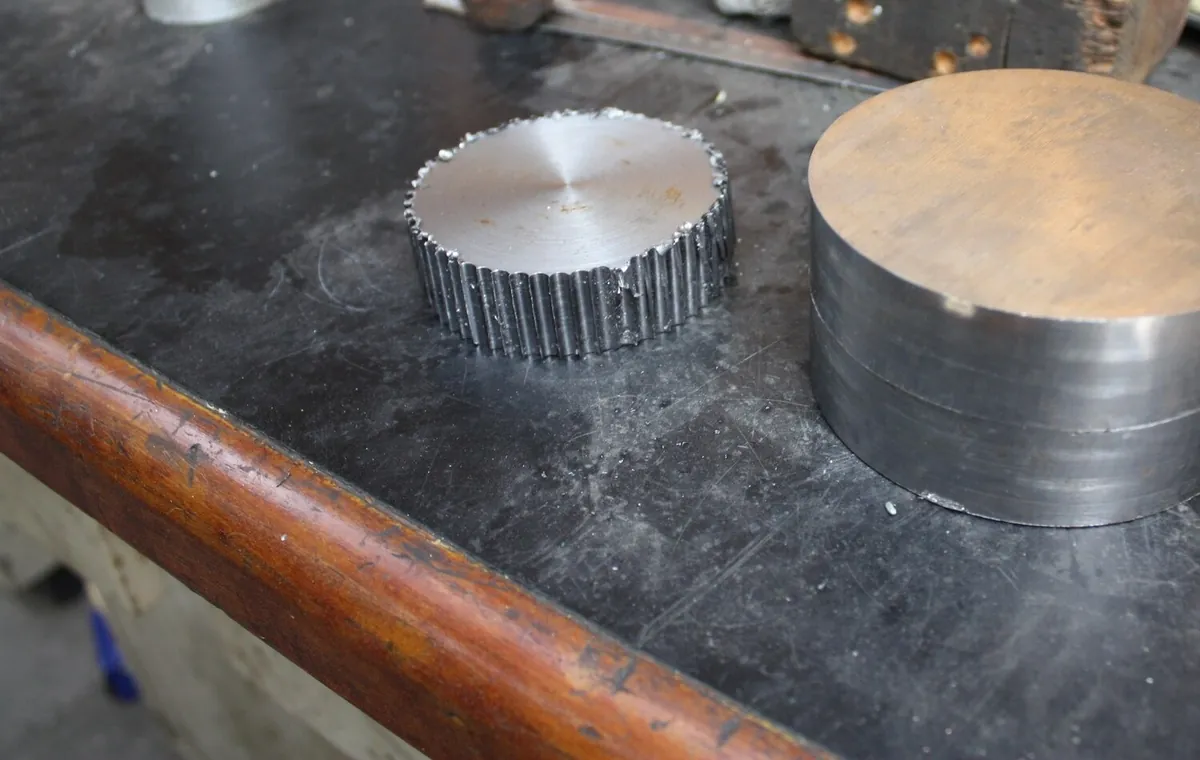
A good tooling material must cut quickly, hold size when material is removed, take a durable surface finish and be available in large sections at a sensible price. 6061-T651 meets all four: it machines at high spindle speeds with short chips, has low residual stress after stretching, anodises well and is rolled by mills worldwide.
It is not the hardest or most stable option. 7075-T651 is roughly twice as strong and is preferred for high-load mould inserts, while cast tooling plates are flatter and more stable but weaker. 6061 sits in the middle: strong enough for most fixtures and mould bases, stable enough for precision work, and economical in large sizes.
Rolled, solution treated, quenched, stretched 1.5 – 3 % and aged. Low residual stress and good flatness. Thickness typically 6 – 200 mm, widths to about 2500 mm.
Forged from ingot or billet, solution treated, compressed about 1 – 5 % to relieve stress, then aged. Dense, with a refined grain through the section; used for large mould blocks and highly stressed parts.
Cut from thick plate to your dimensions with a small allowance. The economical route for most fixture and mould work.
One or both faces milled flat and parallel to a stated thickness, often with protective film. Goes straight onto the machine table.
Surface-ground for gauges, inspection bases and assembly plates that need very fine finish and flatness.
Squared on all faces to close tolerances, so the first operation can start from a known datum.
| Property | 6061-T651 rolled plate | 6061-T652 forged block | Cast tooling plate |
|---|---|---|---|
| Typical yield strength | About 275 MPa | About 255 – 275 MPa | About 100 – 150 MPa |
| Residual stress | Low | Low | Very low |
| Flatness as supplied | Good; better when milled | Machined to size | Excellent, precision-milled |
| Internal soundness | Good; UT on request | Very good | Good, fine porosity possible |
| Anodising | Excellent | Excellent | Fair, often uneven |
| Weldability | Good | Good | Limited |
| Relative cost | Low | High | Medium |
| Best for | Fixtures, mould plates, frames | Large moulds, loaded parts | Vacuum tables, gauges, bases |
Values are typical and depend on section size and supplier. Forged block properties fall slightly with section thickness; confirm against the order specification (for example ASTM B247 / AMS 4127 for forgings).
| Element | Min % | Max % |
|---|---|---|
| Silicon (Si) | 0.40 | 0.80 |
| Iron (Fe) | — | 0.70 |
| Copper (Cu) | 0.15 | 0.40 |
| Manganese (Mn) | — | 0.15 |
| Magnesium (Mg) | 0.80 | 1.20 |
| Chromium (Cr) | 0.04 | 0.35 |
| Zinc (Zn) | — | 0.25 |
| Titanium (Ti) | — | 0.15 |
| Others, each / total | — | 0.05 / 0.15 |
| Aluminium (Al) | Remainder |
| Property (T651 / T652) | Typical value | Why it matters for tooling |
|---|---|---|
| Tensile strength | 310 MPa | Resists clamping and moulding loads |
| Yield strength | 276 MPa | Sets the load before permanent deformation |
| Hardness | About 95 HB | Resists dents and thread wear better than cast plate |
| Modulus | 68.9 GPa | Stiffness is a third of steel: allow thicker sections |
| Thermal conductivity | 167 W/m·K | Fast, even cooling of moulds and heat-sinking fixtures |
| Thermal expansion | 23.6 µm/m·°C | Measure parts at a controlled temperature |
For design, use the specified minimums of the order standard (for example 290 MPa tensile and 240 MPa yield for T651 plate up to 100 mm under ASTM B209), not the typical values above.
Block weight is length × width × thickness × 2.70 g/cm³. The table gives quick figures for popular fixture and mould sizes; a 10 % allowance for saw kerf and clean-up is sensible when budgeting material from full plate.
| Block size (mm) | Volume (dm³) | Mass (kg) |
|---|---|---|
| 300 × 300 × 25 | 2.25 | 6.1 |
| 400 × 400 × 30 | 4.80 | 13.0 |
| 500 × 300 × 40 | 6.00 | 16.2 |
| 500 × 500 × 50 | 12.50 | 33.8 |
| 600 × 400 × 60 | 14.40 | 38.9 |
| 800 × 500 × 80 | 32.00 | 86.4 |
| 1000 × 500 × 100 | 50.00 | 135.0 |
| 1000 × 600 × 150 | 90.00 | 243.0 |
| 1200 × 800 × 200 | 192.00 | 518.4 |
Standard squares such as 300 × 300 mm and 400 × 400 mm are popular for automation and measuring fixtures. Larger blocks are cut from plate up to about 2500 mm wide, or forged when the section is thicker than rolled plate allows.
No. 6061 is a wrought alloy supplied as rolled plate or forged block. Cast tooling plates are made from different casting alloys, are flatter and more stable, but have roughly half the strength and do not anodise as evenly.
Both are solution treated and aged. T651 is stress-relieved by stretching and applies to rolled plate; T652 is stress-relieved by compression and applies mainly to forgings and blocks.
6061 is cheaper, anodises better and suits prototype and short-run moulds. 7075 is harder and stronger, giving longer life and better edge retention for production moulds.
Yes. Plate and blocks can be supplied saw-cut, milled on one or both faces, ground, or six-side milled to your tolerances.
For moulds and critical tooling it is strongly recommended. Ask for testing to ASTM B594 or AMS-STD-2154 at the class your part requires.
Send sizes, surface condition, quantity and destination. We will reply with the best supply route and a delivered price.






