Cutting and drilling
Saw with a fine-pitch carbide blade and lubricant. T6 drills and taps cleanly; for thin walls use rivet nuts or threaded inserts instead of tapping directly into the wall.



6061-T6 square tube is the standard choice when a frame, chassis or support needs real structural strength from a light, weldable and corrosion-resistant hollow section. Metline supplies 6061 square tubing (6061 aluminum square tubing in the US) from 10 mm to over 200 mm across, in sharp or radiused corners, cut to length and certified to ASTM or EN standards, to buyers worldwide.
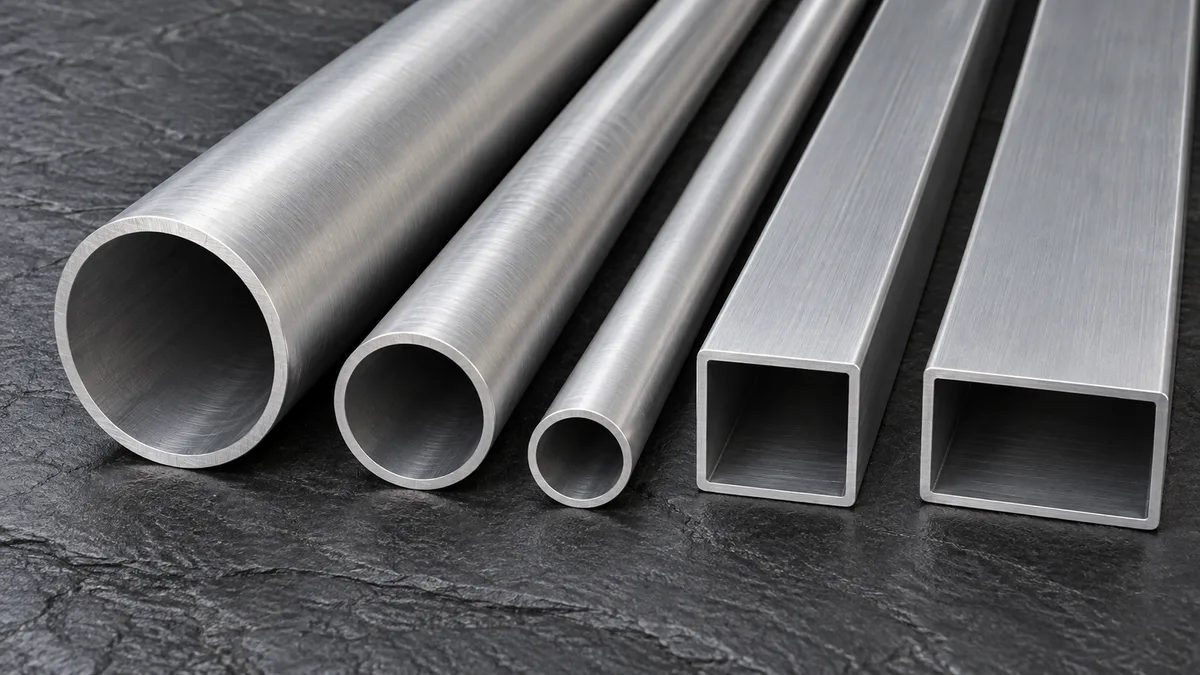
6061 square tube is an extruded hollow section with four equal sides, made from the heat-treatable 6061 alloy and normally supplied in the T6 temper. It carries roughly 50 % more load than the same section in 6063-T6, which is why it is used for structures rather than trim.
Square tube is extruded either over a mandrel (seamless) or through a porthole die, where the metal splits around a bridge and re-joins under pressure inside the die. Porthole tube has longitudinal seam welds that are metallurgically sound for structural work and is how most square sections are made. Seamless square tube is specified when the part must hold internal pressure or pass a flattening or expansion test.
After extrusion the tube is solution heat-treated (usually on the press with a water or air quench), stretched to straighten it and relieve stresses, and artificially aged to T6. The result is a section with a flat-to-flat torsional stiffness close to a round tube of the same weight, but with flat faces that make bolting, welding gussets, mounting panels and clamping in a vice simple.
Composition limits are the registered Aluminum Association values, followed by ASTM B221 and EN 573-3 for EN AW-6061. The mill certificate with each lot shows the measured analysis.
| Element | Min | Max | Why it matters |
|---|---|---|---|
| Silicon (Si) | 0.40 | 0.80 | Forms Mg2Si with magnesium, the strengthening phase |
| Iron (Fe) | — | 0.70 | Impurity; kept low for toughness |
| Copper (Cu) | 0.15 | 0.40 | Raises strength above 6063 |
| Manganese (Mn) | — | 0.15 | Grain control |
| Magnesium (Mg) | 0.80 | 1.20 | Main strengthening element |
| Chromium (Cr) | 0.04 | 0.35 | Controls grain growth; aids stress-corrosion resistance |
| Zinc (Zn) | — | 0.25 | Impurity |
| Titanium (Ti) | — | 0.15 | Grain refiner |
| Others each / total | — | 0.05 / 0.15 | |
| Aluminium | Remainder |
Design to the specified minimums of the standard on your order; the typical figures show what extruded T6 tube usually achieves in testing. Wall thickness matters: minimums in ASTM B221 and EN 755-2 apply to defined wall ranges.
| Temper / basis | Tensile strength | Yield strength (0.2 %) | Elongation | Hardness |
|---|---|---|---|---|
| O, typical | 125 MPa / 18 ksi | 55 MPa / 8 ksi | 25 % | 30 HB |
| T4, typical | 240 MPa / 35 ksi | 145 MPa / 21 ksi | 22 % | 65 HB |
| T6 / T6511, typical | 310 MPa / 45 ksi | 276 MPa / 40 ksi | 12 % | 95 HB |
| T6 extruded, ASTM B221 minimum | 260 MPa / 38 ksi | 240 MPa / 35 ksi | 8 – 10 % | — |
| T6 extruded, EN 755-2 minimum (thin walls) | 260 MPa | 240 MPa | 8 – 10 % | — |
| T6 after welding (ADM design value) | 165 MPa / 24 ksi | — | — | — |
| System | Designation | Typical tube standard |
|---|---|---|
| ASTM / Aluminum Association | 6061-T6 | ASTM B221 (extruded), B429 (structural pipe and tube), B241 (seamless) |
| Aerospace | 6061-T6 / T6511 | AMS 4150, AMS-QQ-A-200/8 (extrusions) |
| UNS | A96061 | — |
| Europe | EN AW-6061 (AlMg1SiCu) | EN 755-2 properties; EN 755-8 porthole and EN 755-7 seamless tolerances |
| Germany | 3.3211 | DIN EN 755 |
| Japan | A6061S / A6061TE | JIS H4100, JIS H4080 |
| India | 65032 | IS 733 |
Seamless and porthole tube are both accepted under ASTM B221; specify "seamless" on the order if your application requires it.
Weights below assume sharp corners and a density of 2.70 g/cm³; radiused corners reduce the weight slightly. Section modulus (Z) is about either principal axis and is what you use for bending stress (σ = M / Z).
| Size (mm) | Wall (mm) | kg/m | I (cm⁴) | Z (cm³) |
|---|---|---|---|---|
| 20 × 20 | 2 | 0.39 | 0.8 | 0.79 |
| 25 × 25 | 2 | 0.50 | 1.6 | 1.31 |
| 25 × 25 | 3 | 0.71 | 2.2 | 1.74 |
| 30 × 30 | 3 | 0.87 | 4.0 | 2.66 |
| 40 × 40 | 3 | 1.20 | 10.2 | 5.10 |
| 40 × 40 | 4 | 1.56 | 12.6 | 6.30 |
| 50 × 50 | 3 | 1.52 | 20.8 | 8.34 |
| 50 × 50 | 5 | 2.43 | 30.8 | 12.30 |
| 60 × 60 | 4 | 2.42 | 47.1 | 15.69 |
| 75 × 75 | 5 | 3.78 | 114.9 | 30.64 |
| 80 × 80 | 5 | 4.05 | 141.2 | 35.31 |
| 100 × 100 | 6 | 6.09 | 333.6 | 66.72 |
| 120 × 120 | 6 | 7.39 | 594.3 | 99.04 |
| 150 × 150 | 8 | 12.27 | 1531.9 | 204.26 |
Square tube is checked for outside size, wall thickness, corner radius, squareness of the corners, twist and straightness. For ASTM orders the tolerance tables of ANSI H35.2 apply; for EN orders, EN 755-8 (porthole tube) or EN 755-7 (seamless). Twist is the parameter most often overlooked on long frame members: if your assembly is jig-welded, state a twist limit per metre on the drawing.
Saw with a fine-pitch carbide blade and lubricant. T6 drills and taps cleanly; for thin walls use rivet nuts or threaded inserts instead of tapping directly into the wall.
TIG and MIG weld well with ER4043 or ER5356 filler. Strength near the weld drops to about T4 level, so place welds away from peak bending moment or design to welded allowables.
Square tube tends to buckle on the inside face and bow on the outside. Use a mandrel or filler, generous radii (at least 3 – 4 × the outside size in T6), or bend in T4 and age afterwards.
Machines with short chips and a good finish. Clamp thin walls with soft jaws or internal plugs to avoid crushing.
Takes clear and coloured anodising; the finish is slightly less uniform than 6063, so choose 6063 if appearance is the priority.
Good in atmosphere and fresh water. In marine splash zones anodise or paint, and isolate steel fasteners to prevent galvanic corrosion.
| Property | 6061-T6 | 6063-T6 | 6082-T6 | 7075-T6 |
|---|---|---|---|---|
| Typical tensile | 310 MPa | 241 MPa | 310 – 340 MPa | 570 MPa |
| Typical yield | 276 MPa | 214 MPa | 260 – 310 MPa | 505 MPa |
| Surface finish / anodising | Good | Excellent | Good | Fair |
| Weldability | Good | Good | Good | Poor |
| Range of square sizes | Wide | Widest | Wide (Europe) | Limited |
| Typical use | Structural frames | Architectural, trim | Structural (EN projects) | High-stress parts |
Choose 6063 square tube when appearance matters more than load, 6082 when your project is designed to EN 1999 and European stock sizes, and 7075 only for unwelded, highly stressed parts.
For sharp corners, weight in kg/m = 2 × (2 × side − 2 × wall) × wall × 2.70 / 1000. A 50 × 50 × 3 mm tube weighs about 1.52 kg/m and a 100 × 100 × 6 mm tube about 6.09 kg/m. Radiused corners make it slightly lighter.
Yes. Typical yield strength in T6 is about 276 MPa for 6061 against 214 MPa for 6063, so 6061 carries roughly 30 % more load in the same section. 6063 has the better surface finish.
Most square tube is porthole-extruded and contains seam welds formed inside the die, which are sound for structural use. Seamless square tube can be supplied when pressure duty or a specification requires it; state this on the order.
Welding reduces strength near the joint to about 165 MPa tensile. Most welded frames are designed to this reduced value; full T6 strength returns only if the assembly is solution treated and aged again.
Both have the same strength. T6511 has been stretched to relieve stresses and may receive minor straightening, which keeps machined parts more stable. For most tube orders T6 is specified.
Yes. Metline ships from Mumbai to customers worldwide with mill certificates, export packing and EXW, FOB, CIF or DAP terms.
Send size, wall, length, quantity and destination port, and we will reply with availability, certification and a delivered price.





