Plain gauge
Constant wall thickness along the length. Cheapest and most robust; used on entry-level and utility bikes.



6061 is the most widely used aluminium alloy for bicycle frames because it can be drawn thin, butted, hydroformed and welded, then heat-treated back to full T6 strength as a complete frame. This guide covers the tube types and sizes frame builders use, the properties and standards that matter, the full production route from extrusion to post-weld ageing, and how 6061 compares with 7005, steel and carbon.
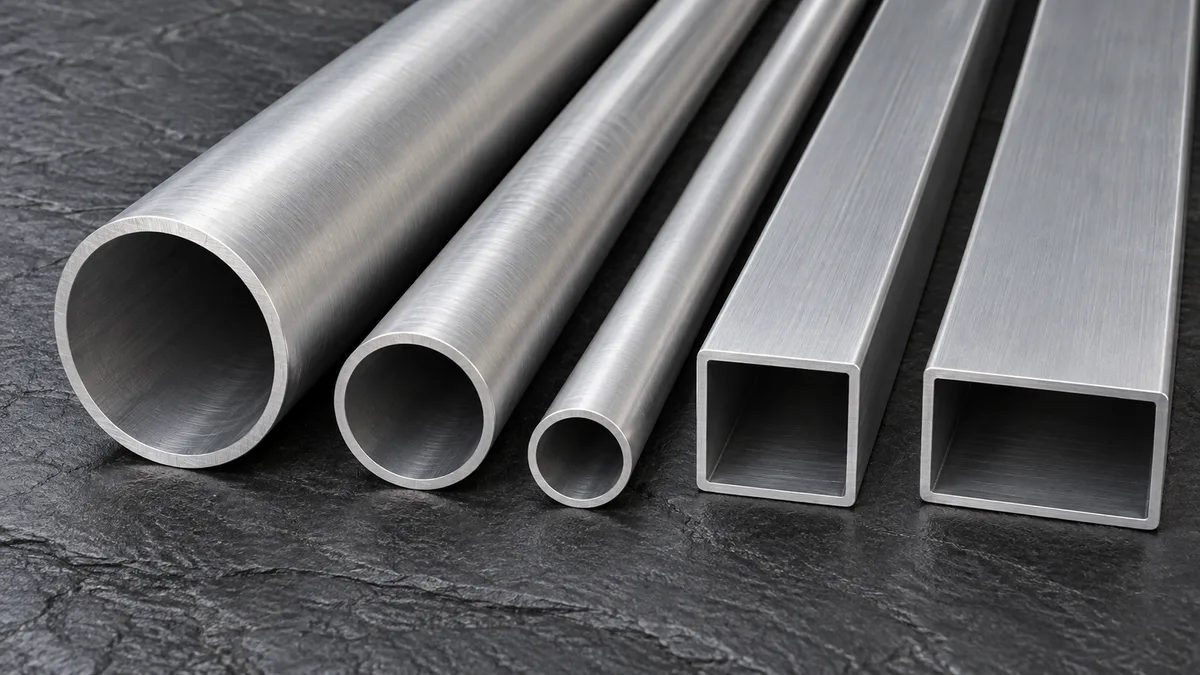
A frame has to be light, stiff, fatigue resistant and affordable to build in volume. Aluminium has one third the density of steel and one third the stiffness, so aluminium frames use larger-diameter, thinner-wall tubes. Bending stiffness grows with roughly the cube of diameter, so an oversized aluminium tube can be stiffer than a slim steel tube at lower weight.
Among aluminium alloys, 6061 offers the right mix for that approach. In the annealed (O) condition it is ductile enough to be butted, tapered, ovalised, bent and hydroformed into complex shapes. After welding, the whole frame can be solution treated, quenched and aged, restoring T6 strength right through the welded joints. It also has good resistance to corrosion and stress-corrosion cracking, anodises well and is produced by tube mills all over the world.
The main alternative, 7005, avoids the full post-weld solution treatment because it recovers much of its strength by natural ageing after welding. That made it popular with smaller frame builders. Large factories, which run heat-treatment furnaces anyway, mostly build in 6061 and its higher-strength derivatives.
Each tube in a frame does a different job, so diameters, walls and shapes vary. The ranges below are typical of current mountain, road, gravel and city frames; every frame designer sets final sizes from load cases and testing.
| Tube | Typical OD or section | Typical wall (butted) | Notes |
|---|---|---|---|
| Top tube | 31.8 – 42 mm round, or ovals around 42 × 27 mm | 0.8 – 1.6 mm | Often shaped; butted thin in the middle |
| Down tube | 35 – 50 mm round, or aero / hydroformed shapes | 1.0 – 2.0 mm | Carries the highest pedalling and braking loads |
| Seat tube | 31.8 – 35 mm | 1.5 – 2.2 mm at the top | Inner diameter matched to 27.2, 30.9 or 31.6 mm seatposts |
| Head tube | Straight or tapered, about 44 – 64 mm | Machined from thick tube | Bored for 1-1/8 in and 1.5 in headset standards |
| Seat stays | 14 – 22 mm, round or tapered | 0.8 – 1.2 mm | Often curved or S-bent for comfort and clearance |
| Chain stays | 18 – 25 mm, round or oval | 1.2 – 1.8 mm | Shaped for tyre, chainring and crank clearance |
Tube lengths are usually supplied cut close to frame length, around 400 – 820 mm, with butting zones positioned for the frame size. Straight-gauge tube is sold in longer lengths for builders who mitre and butt in-house.
Constant wall thickness along the length. Cheapest and most robust; used on entry-level and utility bikes.
Thicker wall at one end, where the tube joins the highest-stressed junction (for example the bottom bracket), thinner elsewhere.
Thick at both ends for welding and stress, thin in the middle where bending stress is lower. The common choice for mid- and high-range frames.
Three wall thicknesses: a thick weld zone, a transition and a thin centre, for example 1.3 / 0.9 / 1.3 mm. Saves further weight on performance frames.
The outside diameter changes along the length, or the tube is ovalised, flattened or hydroformed to put stiffness where it is needed.
Tube is expanded into a die by internal fluid pressure, producing complex sections and integrated junctions. Needs O-temper material with high elongation.
Butting thicknesses are written from end to end, so "1.6 / 1.2 / 1.6" means 1.6 mm at each end and 1.2 mm in the middle. Weld zones are kept thicker because welding softens the material locally until the frame is heat-treated.
| Element | Min % | Max % |
|---|---|---|
| Silicon (Si) | 0.40 | 0.80 |
| Iron (Fe) | — | 0.70 |
| Copper (Cu) | 0.15 | 0.40 |
| Manganese (Mn) | — | 0.15 |
| Magnesium (Mg) | 0.80 | 1.20 |
| Chromium (Cr) | 0.04 | 0.35 |
| Zinc (Zn) | — | 0.25 |
| Titanium (Ti) | — | 0.15 |
| Others, each / total | — | 0.05 / 0.15 |
| Aluminium (Al) | Remainder |
| Temper | Tensile, min | Yield, min | Elongation, min | Role in frame production |
|---|---|---|---|---|
| O (annealed) | ≤ 150 MPa (max) | — | 16 % or more | Butting, bending, hydroforming |
| T4 | 180 MPa | 110 MPa | 16 % | Intermediate forming |
| T6, wall ≤ 6.3 mm | 260 MPa / 38 ksi | 240 MPa / 35 ksi | 8 % | Finished frame after ageing |
| T6 typical | 310 MPa / 45 ksi | 276 MPa / 40 ksi | 10 – 12 % |
Extruded tube minimums from ASTM B221 and EN 755-2. Drawn tube to ASTM B483 or EN 754-2 has similar T6 minimums; check the governing standard for the exact wall band.
Fatigue matters more than static strength on a bicycle. 6061-T6 has no true endurance limit, so frames are sized so that stresses under repeated pedalling and road loads stay well within the fatigue strength of the alloy and especially of the welds. ISO 4210-6 sets the frame and fork fatigue and impact tests that a finished bicycle must pass.
| Material | Density | Typical yield | Post-weld treatment | Notes |
|---|---|---|---|---|
| 6061-T6 aluminium | 2.70 g/cm³ | 276 MPa | Full solution treat + age | Most formable; standard for volume frames |
| 7005-T6 aluminium | 2.78 g/cm³ | About 290 MPa | Natural plus artificial age | Less forming capability; no full solution treatment |
| 4130 Cr-Mo steel | 7.85 g/cm³ | About 435 MPa (normalised) | None | Slim tubes, durable, heavier |
| Carbon fibre composite | About 1.5 – 1.6 g/cm³ | Laminate dependent | Not welded | Lightest; higher cost; different failure modes |
In practice, frame quality depends more on tube design, weld quality, heat treatment and testing than on small differences in alloy strength. A well-designed 6061 frame is lighter than most steel frames and much less expensive than carbon.
6061 anodises to a clear or coloured finish (black, silver, red, blue, gold and others) that is hard-wearing and resists corrosion. Because anodising is a conversion of the surface, any scratches, die lines or weld discoloration show through, so tubes for anodised frames need a clean, consistent surface and careful polishing of welds. Powder coat and wet paint hide surface variation and are common on city and mountain bikes.
Welding heats the tube ends above the ageing temperature and softens them to roughly T4-level strength. Solution treating, quenching and ageing the whole frame restores T6 strength in the welded zones.
Both make good frames. 6061 is more formable and is preferred for butted and hydroformed tubes in factories with heat-treatment furnaces. 7005 recovers strength after welding without full solution treatment, which suits smaller builders.
The tube wall is thicker at both ends and thinner in the middle, for example 1.6 / 1.2 / 1.6 mm, putting material where stress is highest and saving weight elsewhere.
The seat tube inner diameter must match the post, so a 27.2 mm post typically needs a tube of about 31.6 – 31.8 mm OD with a wall around 2.2 mm at the top. Check the reamed bore size after welding.
Yes. 6061 anodises well in clear and many colours. Order tube with an anodising-quality surface and finish welds carefully, because anodising shows surface marks.
The ISO 4210 series, with frame and fork fatigue and impact tests in ISO 4210-6. Many markets also accept EN or national standards based on it.
Send tube drawings, butting profiles, tempers, quantities and destination. We will reply with supply options and a delivered price.





