CNC machining
Use sharp carbide with high positive rake and high spindle speeds. T651 plate stays flat when frames are pocketed from one side.



6061 is the default aluminium for machined electronics parts: CNC-milled phone mid-frames, tablet and laptop shells, camera bodies, SIM trays and the fixtures used to make them. In T6 it gives a reliable 276 MPa typical yield strength, machines cleanly and takes a uniform anodised finish, and it is available everywhere. This guide explains which temper to buy, what finish quality to expect and where 6061 stops being the best choice.
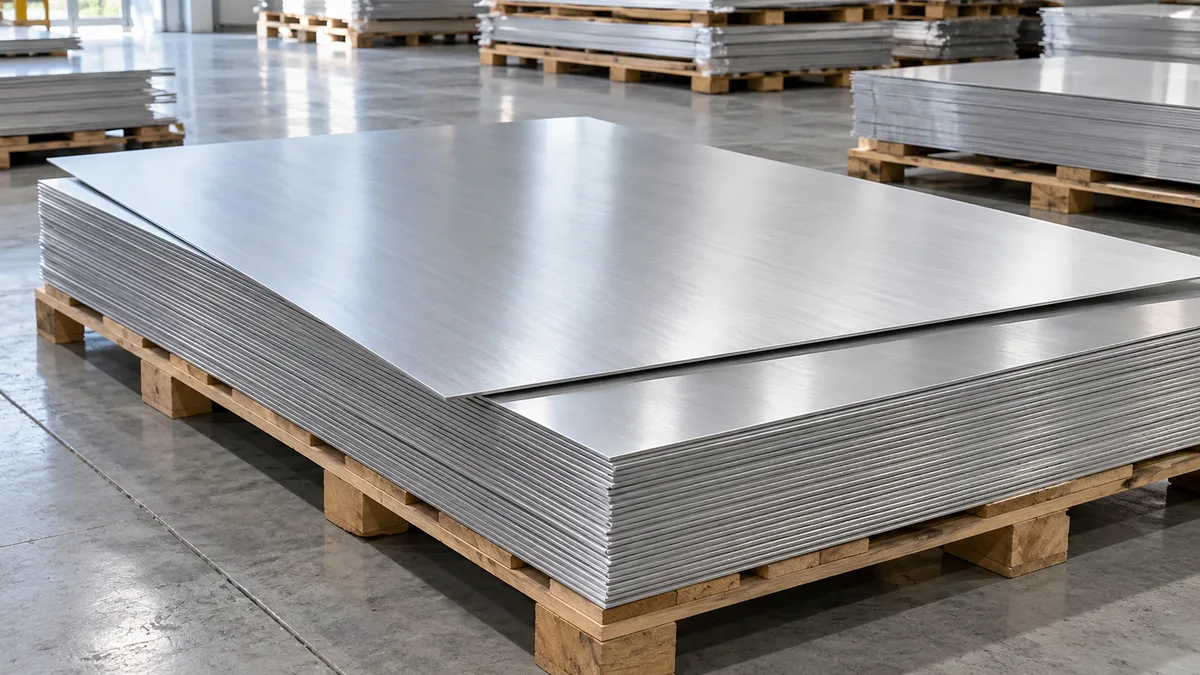
3C stands for computers, communications and consumer electronics. Aluminium parts in these products have to be light, stiff, precise and good-looking, and most are produced by CNC machining, stamping or a combination of the two followed by anodising.
6061 meets that brief at a low cost. Its magnesium and silicon give a heat-treatable strength that is about twice that of 5052, a small copper addition raises strength further, and chromium keeps the grain structure fine. In T6 or T651 it cuts with short chips and a bright surface, holds tolerance during heavy machining, and anodises to a hard, even film suitable for dyed colours.
For thin, drawn or bent housings, 6061 can be formed in O or T4 and then aged; for milled unibody parts, T6 or stress-relieved T651 plate is machined directly. Where higher dent resistance is wanted, designers move up to 6013 or 7xxx alloys; where the finest cosmetic finish matters more than strength, 6063 is an option.
| Element | Limit |
|---|---|
| Silicon (Si) | 0.40 – 0.8 |
| Iron (Fe) | ≤ 0.7 |
| Copper (Cu) | 0.15 – 0.40 |
| Manganese (Mn) | ≤ 0.15 |
| Magnesium (Mg) | 0.8 – 1.2 |
| Chromium (Cr) | 0.04 – 0.35 |
| Zinc (Zn) | ≤ 0.25 |
| Titanium (Ti) | ≤ 0.15 |
| Others each / total | ≤ 0.05 / 0.15 |
| Aluminium (Al) | Remainder |
Aluminum Association / EN 573-3 limits. For cosmetic anodising, tighter internal limits on iron and silicon help produce a cleaner, more uniform appearance; agree them with the supplier if colour consistency is critical.
| Temper | Tensile strength | Yield strength | Elongation | Use in 3C |
|---|---|---|---|---|
| O, specified (ASTM B209) | ≤ 152 MPa | ≤ 83 MPa | ≥ 14 – 18 % | Deep forming, then heat treatment |
| T4, specified | ≥ 207 MPa | ≥ 110 MPa | ≥ 14 – 16 % | Bending and drawing, then ageing |
| T6, specified | ≥ 290 MPa | ≥ 240 MPa | ≥ 8 – 10 % | Design minimum for finished parts |
| T6, typical | 310 MPa | 276 MPa | 12 % | Finished parts |
Specified ranges depend on thickness band; the certificate gives the actual values.
Use sharp carbide with high positive rake and high spindle speeds. T651 plate stays flat when frames are pocketed from one side.
Form in T4 with radii of about 1 × thickness, then age. T6 needs roughly 1.5 – 3 × thickness for bends.
Bead blasting, brushing or diamond cutting create the texture before anodising. Even grain gives a uniform look.
Sulphuric (Type II) films of about 10 – 25 µm, dyed in black, grey, blue and other colours, then sealed.
Type III films of about 25 – 50 µm for wear-prone parts such as buttons and trays.
Coarse grains, iron-rich particles and rolling streaks show after anodising; specify a cosmetic or anodising-quality surface.
| Alloy | Typical T6 / H yield | Anodised appearance | Notes |
|---|---|---|---|
| 5052-H32 | 193 MPa | Good, slightly yellow | Formable, not heat-treatable |
| 6063-T6 | 214 MPa | Excellent | Best finish, lower strength |
| 6061-T6 | 276 MPa | Very good | Balanced default |
| 6013-T6 | about 340 – 350 MPa | Good, warmer tone | Stronger 6xxx option |
| 7075-T6 | 503 MPa | Fair – good | Highest strength, harder to finish |
Yes. It is strong enough for most frames, machines well and anodises evenly. For thinner, more dent-resistant housings, 6013 or 7xxx alloys are used.
T6 for thin sheet and T651 for plate. T651 is stress-relieved by stretching, so parts stay flat when pockets are milled.
Yes. Bend in T4 and age to T6 afterwards, or bend T6 using generous radii of about 1.5 – 3 × thickness.
Clear, black, grey, blue, red, gold and most dyed colours. Production trials on the supplied sheet are recommended for colour matching.
Yes, as coil or slit strip, as well as cut sheet and plate.
Send temper, thickness, size and quantity. Metline will reply with availability, certification and delivery terms.





