30 – 50 mm
Fixture plates, CNC sub-plates, jig bodies, robot end-effector bases and automation frames.



6061-T6 and 6061-T651 plate have the same chemistry and essentially the same strength; the difference is that T651 is stretched after quenching to remove residual stress. For thick plate that will be machined, that stretch decides whether a part stays flat or bows when pockets are cut. This guide explains the two tempers, how properties change with thickness, and how to specify thick 6061 plate for moulds, fixtures and machined structures.
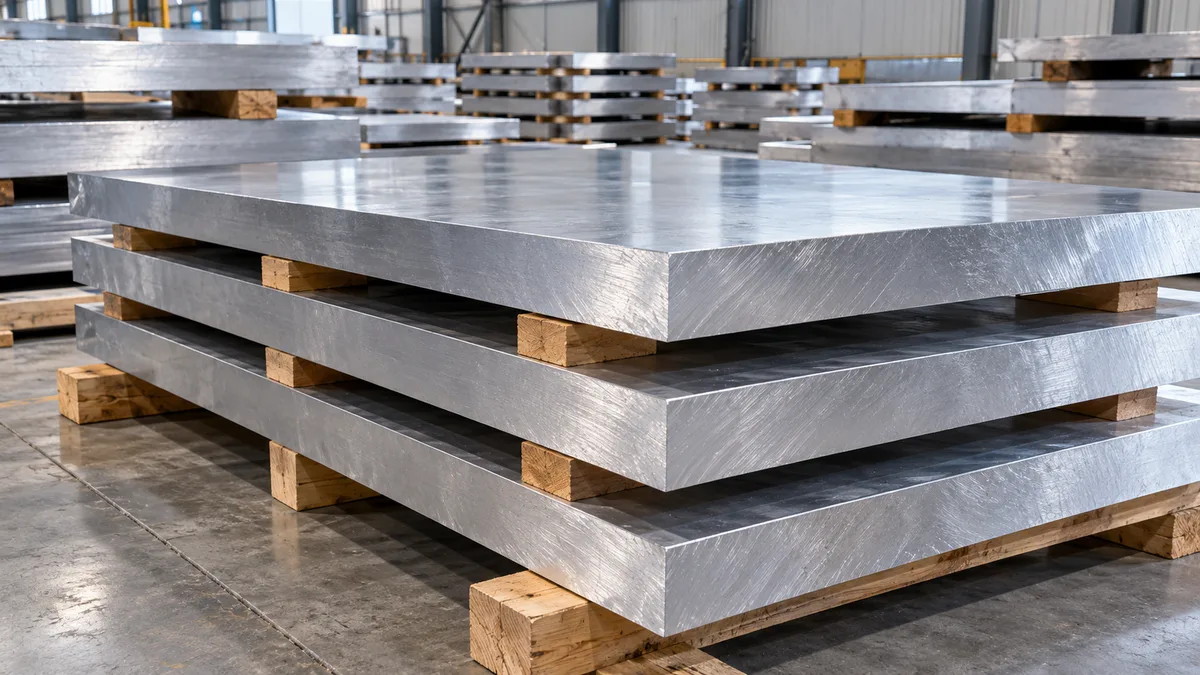
Both tempers start the same way: the rolled plate is solution heat-treated at about 530 °C, quenched in water and then artificially aged at about 160 – 175 °C to precipitate Mg2Si. Quenching a thick plate cools the surface much faster than the core, which locks in compressive stress at the surfaces and tensile stress in the middle.
In T651, the plate is stretched permanently by 1.5 – 3 % between quenching and ageing (the "51" suffix). Stretching yields the whole cross-section and evens out those internal stresses, typically reducing them by around 80 – 90 %. In T6, the stretch is omitted, so the quench stresses stay in the plate.
Strength is not the reason to choose one over the other. Standards set the same minimums for both, and typical values are the same. What changes is machining behaviour: remove material from one face of a T6 plate and the remaining stresses rebalance, so the part bows, twists or springs when unclamped. A T651 plate machined the same way moves far less.
| Aspect | 6061-T6 plate | 6061-T651 plate |
|---|---|---|
| Process | Solution treat, quench, age | Solution treat, quench, stretch 1.5 – 3 %, age |
| Residual stress | High in thick sections | Low |
| Strength | Same minimums | Same minimums |
| Distortion when machined | Likely with deep pockets or one-sided removal | Minimal |
| Thickness limit | Not limited by stretching; very thick plate is usually T6 | Limited by the stretcher capacity of the mill |
| Typical use | Thin sheet, blanks for welding, very thick sections | Machined parts, tooling, moulds, fixtures |
Thick plate cools more slowly at mid-thickness during the quench, so less magnesium silicide stays in solution and the core reaches slightly lower strength after ageing. Standards account for this by lowering minimum elongation and, in the heaviest bands, tensile strength.
| Thickness (ASTM B209, T651) | Tensile, min | Yield, min | Elongation, min |
|---|---|---|---|
| 6.3 – 12.5 mm (0.250 – 0.499 in) | 290 MPa (42 ksi) | 240 MPa (35 ksi) | about 10 % |
| 12.7 – 25 mm (0.500 – 1.000 in) | 290 MPa (42 ksi) | 240 MPa (35 ksi) | about 9 % |
| 25 – 50 mm (1.001 – 2.000 in) | 290 MPa (42 ksi) | 240 MPa (35 ksi) | about 8 % |
| 50 – 100 mm (2.001 – 4.000 in) | 290 MPa (42 ksi) | 240 MPa (35 ksi) | about 6 % |
| 100 – 150 mm (4.001 – 6.000 in) | 275 MPa (40 ksi) | 240 MPa (35 ksi) | about 6 % |
| Over 150 mm | By agreement | By agreement | By agreement |
Summarised from ASTM B209 / AMS 4027; elongation limits vary slightly between editions. EN 485-2 follows a similar pattern and reduces minimums above 100 mm. The actual results are always on the mill certificate.
Typical properties of 6061-T6/T651 are about 310 MPa tensile, 276 MPa yield, 12 % elongation and 95 HB. Some suppliers list "T6 ≥ 290 MPa, T651 ≥ 310 MPa" as if T651 were stronger; that mixes specified minimums with typical values. Design to the minimums for your thickness band, whichever temper you buy.
Thick plate uses the same registered chemistry as all other 6061 products. Chromium matters more in thick plate than in sheet, because it limits recrystallisation and helps retain strength and toughness at mid-thickness.
| Element | Min % | Max % |
|---|---|---|
| Silicon (Si) | 0.40 | 0.80 |
| Iron (Fe) | — | 0.70 |
| Copper (Cu) | 0.15 | 0.40 |
| Manganese (Mn) | — | 0.15 |
| Magnesium (Mg) | 0.80 | 1.20 |
| Chromium (Cr) | 0.04 | 0.35 |
| Zinc (Zn) | — | 0.25 |
| Titanium (Ti) | — | 0.15 |
| Others, each / total | — | 0.05 / 0.15 |
| Aluminium (Al) | Remainder |
For the very heaviest sections, alternatives include forged and compressed 6061 block (temper T652, stress-relieved by compression) and cast tooling plate, which has no rolling or quench stresses at all but lower strength.
Thick 6061 plate is rolled in widths of 1000 – 2500 mm and lengths of 2000 – 6000 mm, and is usually sold either as full plates or saw-cut blocks. Common thicknesses are 30, 40, 50, 60, 80, 100, 120, 150 and 200 mm. Weight is 2.70 kg per m² per mm of thickness.
| Thickness (mm) | Approx. (in) | kg per m² | 1250 × 2500 plate (kg) | 1500 × 3000 plate (kg) |
|---|---|---|---|---|
| 30 | 1.18 | 81.0 | 253 | 364 |
| 40 | 1.57 | 108.0 | 338 | 486 |
| 50 | 1.97 | 135.0 | 422 | 608 |
| 60 | 2.36 | 162.0 | 506 | 729 |
| 80 | 3.15 | 216.0 | 675 | 972 |
| 100 | 3.94 | 270.0 | 844 | 1215 |
| 120 | 4.72 | 324.0 | 1013 | 1458 |
| 150 | 5.91 | 405.0 | 1266 | 1823 |
| 180 | 7.09 | 486.0 | 1519 | 2187 |
| 200 | 7.87 | 540.0 | 1688 | 2430 |
| 250 | 9.84 | 675.0 | 2109 | 3038 |
| 300 | 11.81 | 810.0 | 2531 | 3645 |
Plates above about 200 mm and stretched T651 above roughly 150 – 200 mm depend on individual mill capability; confirm availability with each enquiry.
Thick plate can hide porosity, inclusions or centreline defects that only appear when a deep pocket is cut. For moulds, aerospace tooling and pressure-retaining parts, specify ultrasonic inspection up front.
6061-T651 produces short, broken chips and a bright finish at high spindle speeds. It takes clear, coloured and hard anodising well, which makes it a common choice for fixtures and machine components.
Fixture plates, CNC sub-plates, jig bodies, robot end-effector bases and automation frames.
Injection and blow mould plates, vacuum-forming tools, machine beds and semiconductor chamber bodies.
Large mould blocks, heavy machine structures, aerospace assembly tooling and test rigs.
Alternative grades for thick plate: 6082-T651 (the European equivalent, slightly stronger), 7075-T651 (about twice the strength, for high-load tooling), 5083 (best for welded and marine parts) and cast tooling plate (best flatness).
No. Both have the same minimum and typical properties. T651 is stretched to relieve residual stress, which improves stability during machining, not strength.
Under ANSI H35.1, "51" means the product was stress-relieved by stretching a controlled amount after solution treatment: 1.5 – 3 % for plate. "52" means stress relief by compression, used for forgings and some blocks.
It is limited by the stretching capacity of the mill. Plate to about 150 – 200 mm is widely available, and some mills stretch thicker. Beyond that, plate is usually supplied as T6, or forged block in T652 is used.
Quench stresses in un-stretched plate rebalance when material is removed. Use T651, machine symmetrically and finish after a rest pass to avoid it.
For moulds, aerospace tooling and parts with deep pockets, yes. ASTM B594 or AMS-STD-2154 class A is a common requirement and catches internal defects before machining starts.
Not practically. Stretching must happen between quenching and ageing. A T6 plate can be thermally stress-relieved, but this lowers strength.
Send temper, thickness, sizes, testing needs and destination. We will reply with availability, certification and a delivered price.





