Sheet and plate
Bare or Alclad sheet from about 0.3 mm; plate in T351 up to heavy thicknesses for machined parts.



2024 is the classic high-strength aluminium-copper-magnesium alloy of aircraft structures, valued for its fatigue resistance and damage tolerance. In the common T3 and T351 tempers it reaches about 470 – 485 MPa tensile strength, roughly 50 % more than 6061-T6, but it corrodes more easily and is not fusion welded. This guide covers its composition, tempers, standards, forms and how to work with it.
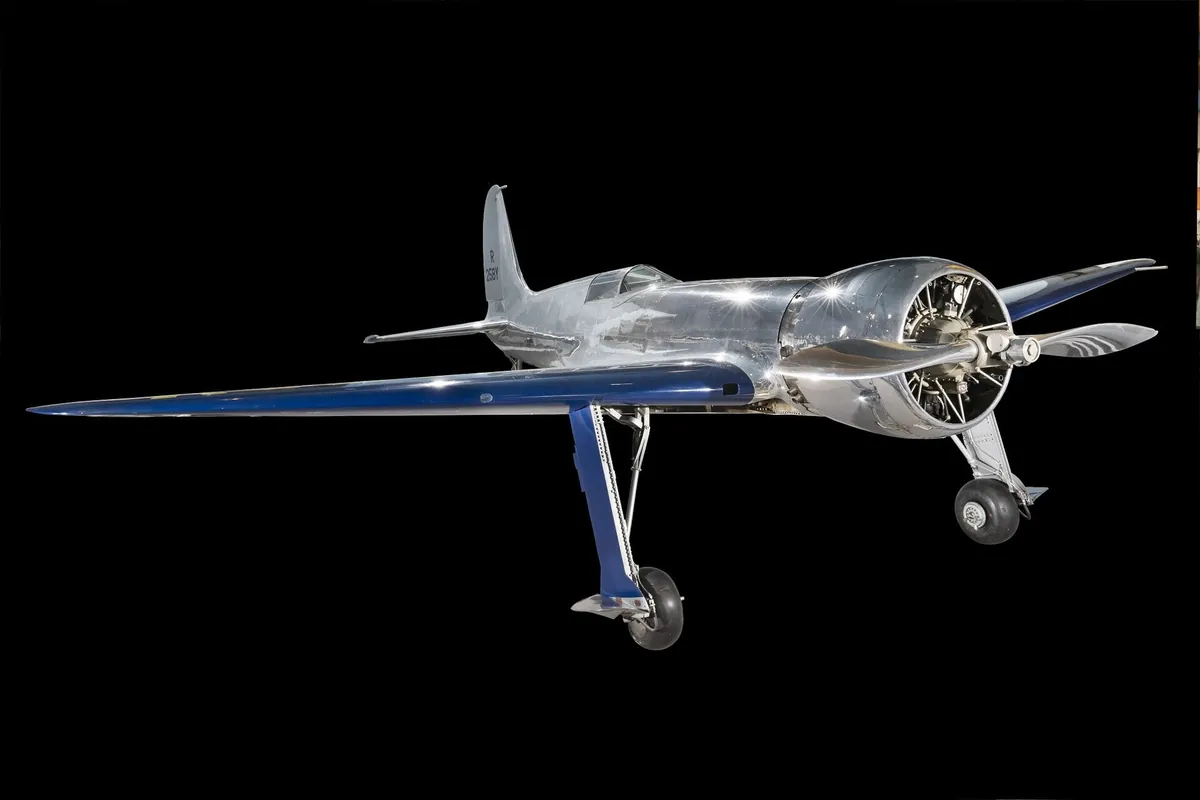
2024 was introduced in the early 1930s as a stronger successor to 2017 duralumin, with more magnesium. It became the standard material for aircraft fuselage skins, wing lower surfaces and other tension-loaded structure, and it is still one of the most widely specified aerospace aluminium alloys.
Its strength comes from copper and magnesium, which form fine precipitates during natural or artificial ageing. In the naturally aged T3 and T4 tempers the alloy combines high strength with excellent resistance to fatigue crack growth, which is why it is preferred for parts that see repeated loading, such as pressurised fuselage skins.
The copper that gives 2024 its strength also lowers its corrosion resistance. Sheet is therefore often supplied as Alclad, with a thin layer of pure aluminium bonded to each face, and bare parts are anodised, conversion coated and painted. Fusion welding causes hot cracking, so 2024 structures are riveted, bolted, bonded or friction stir welded.
| Element | Limit | Role |
|---|---|---|
| Copper (Cu) | 3.8 – 4.9 | Main strengthening element |
| Magnesium (Mg) | 1.2 – 1.8 | Adds strength with Cu (Al2CuMg phase) |
| Manganese (Mn) | 0.30 – 0.9 | Grain control, toughness |
| Silicon (Si) | ≤ 0.50 | Impurity |
| Iron (Fe) | ≤ 0.50 | Impurity; low Fe improves toughness |
| Chromium (Cr) | ≤ 0.10 | |
| Zinc (Zn) | ≤ 0.25 | |
| Titanium (Ti) | ≤ 0.15 | Grain refiner |
| Others each / total | ≤ 0.05 / 0.15 | |
| Aluminium | Remainder | About 90.7 – 94.7 % |
Aluminum Association limits, matched by EN AW-2024 (AlCu4Mg1). Higher-purity variants such as 2124 and 2524 lower Fe and Si for better fracture toughness.
| Temper | Processing | Typical use |
|---|---|---|
| O | Annealed | Severe forming before heat treatment |
| T3 | Solution treated, cold worked, naturally aged | Sheet: fuselage skins, structural panels |
| T351 | Solution treated, stretched 1.5 – 3 %, naturally aged | Plate and bar for machined parts |
| T3510 / T3511 | Stretched extrusions (T3511 allows minor straightening) | Extruded bar, angles and profiles |
| T4 | Solution treated, naturally aged | Bar, wire, rivets; parts to be formed |
| T42 | Solution treated and naturally aged by the user | Parts heat treated from O temper |
| T62 | Solution treated and artificially aged by the user | Better stress-corrosion resistance, lower ductility |
| T81 / T851 | T3 / T351 then artificially aged | Higher yield, better stress-corrosion and exfoliation resistance |
| T8511 | Stretched extrusion, artificially aged | Profiles for elevated-temperature service |
| Temper | Tensile | Yield (0.2 %) | Elongation | Shear | Hardness |
|---|---|---|---|---|---|
| O | 186 MPa (27 ksi) | 76 MPa (11 ksi) | 20 % | 125 MPa | 47 HB |
| T3 (bare sheet) | 483 MPa (70 ksi) | 345 MPa (50 ksi) | 18 % | 283 MPa | 120 HB |
| T4 / T351 | 469 MPa (68 ksi) | 324 MPa (47 ksi) | 19 – 20 % | 283 MPa | 120 HB |
| T851 | 483 MPa (70 ksi) | 448 MPa (65 ksi) | 6 % | 296 MPa | 128 HB |
These are typical values (ASM data). Specified minimums are lower and vary with product form and thickness; Alclad sheet is a few percent weaker because the cladding carries little load. Fatigue strength is about 138 MPa (20 ksi) at 5 × 10⁸ cycles in T3/T4.
| Product | Common specifications |
|---|---|
| Sheet and plate | ASTM B209, AMS-QQ-A-250/4 (bare), AMS-QQ-A-250/5 (Alclad), AMS 4037, EN 485 |
| Bar and rod | ASTM B211 (cold finished), ASTM B221 (extruded), AMS-QQ-A-225/6, EN 754 / EN 755 |
| Extruded profiles | ASTM B221, AMS-QQ-A-200/3, EN 755 |
| Tube | ASTM B210 (drawn), ASTM B241 (seamless extruded), AMS-WW-T-700/3 |
| Rivet and cold-heading wire | ASTM B316 |
| Forgings | ASTM B247 |
| System | Designation |
|---|---|
| UNS | A92024 |
| EN | EN AW-2024 / AlCu4Mg1 |
| Werkstoff | 3.1355 |
| ISO | AlCu4Mg1 |
| JIS | A2024 |
| Russia (GOST) | Д16 (1160) |
| China (GB) | 2024; 2A12 is a close national grade |
Bare or Alclad sheet from about 0.3 mm; plate in T351 up to heavy thicknesses for machined parts.
Round, square, hexagon and flat bar, extruded (T3511) or cold finished (T351, T4) for precision machining.
Seamless extruded and drawn tube for aircraft structure, hydraulic and actuator parts.
Angles, T-sections, channels, Z-sections and custom stringers in T3511 or T8511.
Hand and die forgings, rings and discs to drawing.
Cold-heading and rivet wire in O, H13 and T4 for DD rivets and high-strength screws.
Machines very well in T3, T351 and T4: short chips and a good finish. Use sharp carbide tools and coolant. The O temper is gummy.
Form in O or freshly quenched (W) condition, then age. T3 allows only moderate bends; check minimum bend radii for thickness.
Fusion welding causes hot cracking and weak joints. Use riveting, bolting, adhesive bonding or friction stir welding.
Use Alclad sheet, anodising (often sulphuric or boric-sulphuric), conversion coatings and primer. Avoid contact with carbon fibre or copper without isolation.
T3/T351 is susceptible in the short-transverse direction of thick sections; T8 tempers are much more resistant.
Loses strength progressively above about 120 °C; T8x tempers hold up better than T3.
| Property | 2024-T351 | 7075-T651 | 6061-T651 | 2017-T4 |
|---|---|---|---|---|
| Typical tensile | 469 MPa | 572 MPa | 310 MPa | 427 MPa |
| Typical yield | 324 MPa | 503 MPa | 276 MPa | 276 MPa |
| Fatigue / damage tolerance | Excellent | Good | Good | Good |
| Corrosion resistance | Fair | Fair | Good | Fair |
| Weldability | Poor | Poor | Good | Poor |
| Typical role | Tension skins, fittings | Compression structure, high-stress parts | General engineering | Rivets, machined parts |
A common airframe rule of thumb uses 2024 for tension-dominated structure, such as lower wing skins and fuselage skins, and 7075 for compression-dominated structure, such as upper wing skins and stringers. 6061 is the economical, weldable option where 2024 strength is not needed.
Mainly aircraft structure (fuselage skins, wing tension members, fittings and rivets), plus defence hardware, truck wheels, fasteners and highly stressed machined parts.
Yes. 2024-T3 has about 483 MPa typical tensile strength versus about 310 MPa for 6061-T6, and much better fatigue resistance. 6061 is easier to weld and more corrosion resistant.
Not by conventional fusion welding, which causes cracking. Friction stir welding works; otherwise use riveting, bolting or bonding.
Both are solution treated and naturally aged. T3 (mostly sheet) includes cold work for flatness; T351 (plate and bar) is stretched to relieve residual stress so it stays stable when machined.
2024 sheet with a thin layer of high-purity aluminium on each face. The cladding protects the core from corrosion sacrificially, at the cost of slightly lower strength.
Д16 (1160). China's 2A12 is a close national grade with a similar composition.
Send form, temper, size and quantity. Metline will reply with availability, certification and a delivered price worldwide.





