5005-F
As extruded with no property guarantee. Economical for trim where only dimensions and finish matter and the part is not load-bearing.



5005 is a low-magnesium aluminium alloy (0.5 – 1.1 % Mg) valued for its clean, even response to anodising, good formability and corrosion resistance. As F, O, H111 and H112 extrusions it is used for vehicle trim, window and door surrounds, rails, covers and other lightly loaded parts that must look good for years. Metline supplies 5005 profiles to EN 755, GB/T 33910 and customer drawings, worldwide.
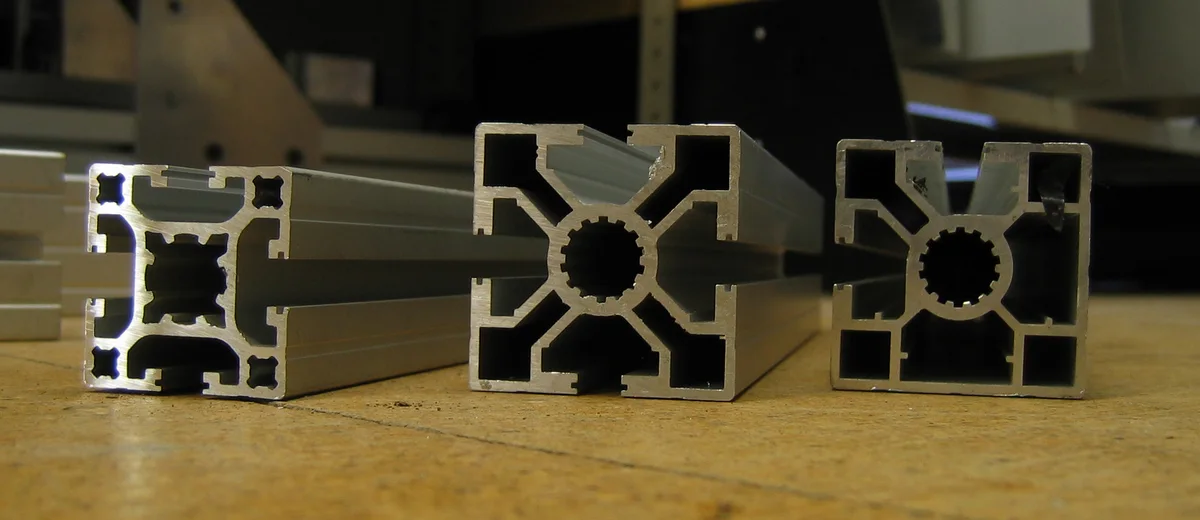
5005 is the leanest of the common 5xxx alloys. Its magnesium content of 0.5 – 1.1 % is enough to raise strength above 1xxx and 3xxx grades, but low enough that the alloy behaves almost like pure aluminium in forming and finishing. It is non-heat-treatable: strength comes from magnesium in solid solution and, in rolled tempers, from cold work.
The property that sets 5005 apart is its anodising response. Because it contains very little iron-manganese or silicon-rich phases that cloud the oxide film, it gives a clear, uniform anodic coating that matches the colour of 6063 extrusions. That is why architects pair 5005 sheet with 6063 frames, and why vehicle designers use 5005 for trim parts that are anodised and placed next to other bright aluminium.
Extruded 5005 is less common than 5005 sheet, but it has a place in automotive work: thin trim mouldings, window channels, door sill covers, interior strips and rails where a profile shape is needed and appearance after anodising matters more than structural strength. It also suits parts that are bent or flared after extrusion, because O and H111 profiles are very ductile.
5005 is registered with the Aluminum Association and appears in EN 573-3 as EN AW-5005 (AlMg1(B)). The variant EN AW-5005A has slightly tighter limits for decorative anodising. Each lot is certified with its measured analysis.
| Element | Minimum | Maximum | Role in the alloy |
|---|---|---|---|
| Silicon (Si) | — | 0.30 | Kept low for anodising clarity |
| Iron (Fe) | — | 0.7 | Impurity; lower iron gives brighter finish |
| Copper (Cu) | — | 0.20 | |
| Manganese (Mn) | — | 0.20 | |
| Magnesium (Mg) | 0.50 | 1.1 | Solid-solution strengthening |
| Chromium (Cr) | — | 0.10 | |
| Zinc (Zn) | — | 0.25 | |
| Others, each / total | — | 0.05 / 0.15 | |
| Aluminium (Al) | Remainder | About 97 – 99.5 % |
Some product literature states that 5005 contains "5 % magnesium". That is incorrect: the limit is 0.5 – 1.1 %. Alloys with around 5 % magnesium are 5083, 5182 and 5056, which behave very differently.
The specified minimums below follow EN 755-2 for extruded 5005 profiles with wall thickness up to 25 mm. F temper (as fabricated) has no guaranteed properties; H112 is as extruded with tested minimums; O and H111 are annealed, with H111 allowing slight strain from straightening.
| Temper | Wall (mm) | Tensile strength Rm | Yield strength Rp0.2 | Elongation A | Elongation A50 |
|---|---|---|---|---|---|
| F | — | not specified | not specified | — | — |
| H112 | ≤ 25 | ≥ 100 MPa | ≥ 40 MPa | ≥ 18 % | ≥ 16 % |
| O / H111 | ≤ 25 | 100 – 150 MPa | ≥ 40 MPa | ≥ 20 % | ≥ 18 % |
Typical results lie a little above the minimums: annealed 5005 usually shows about 125 MPa tensile and 40 – 50 MPa yield strength.
As extruded with no property guarantee. Economical for trim where only dimensions and finish matter and the part is not load-bearing.
As extruded with tested minimum properties. The default for automotive profiles that need a certificate showing strength.
Annealed and then lightly straightened. Good when the part will be bent or flared and must also be straight on delivery.
Fully annealed for maximum ductility: tight bends, end-forming and roll-forming into curved mouldings.
| Extrusion type | Typical size range | Typical wall |
|---|---|---|
| Round tube | 25 – 250 mm OD | 3 – 19 mm |
| Square tube | 25 – 200 mm | 3 – 12 mm |
| Rectangular tube | 25 × 50 to 200 × 300 mm | 3 – 12 mm |
| Angle | 25 × 25 to 200 × 200 mm | 3 – 12 mm |
| T and U profiles | 25 – 150 mm legs | 3 – 12 mm |
| Trim and moulding profiles | to drawing | from about 1 mm |
Every custom profile is drawing-specific. Send the section drawing with critical dimensions and tolerances so feasibility can be confirmed.
Unless the drawing states tighter values, profile dimensions follow the general tolerance tables of the order standard. Automotive programmes often add their own limits on critical features such as mounting faces, wall thickness at crush zones and twist over the part length. For anodised trim, surface quality is often the critical requirement: agree a limit sample for die lines, streaks and colour variation before series production.
Gives a clear, even film suitable for natural, black and coloured finishes. Specify anodising quality material and film thickness (for example 10 – 25 µm for exterior trim).
O and H111 profiles bend tightly and flare easily. H112 bends well with appropriate radii.
Weldable by TIG and MIG with ER5356 filler; weld colour after anodising will differ slightly from the base metal.
Soft and gummy; use sharp, polished tools with high rake and lubricant.
Accepts powder coat and wet paint after conversion coating.
Not heat-treatable. Annealing only restores ductility; it does not add strength.
5005 is not a structural or crash alloy. For load-bearing parts, use a heat-treatable 6xxx grade such as 6063 or 6082.
| Property | 5005-H112 | 6063-T5 | 5052-H112 | 3003-H112 |
|---|---|---|---|---|
| Typical tensile strength | about 125 MPa | about 185 MPa | about 195 MPa | about 110 MPa |
| Heat-treatable | No | Yes | No | No |
| Decorative anodising | Excellent | Excellent | Good (yellowish tint) | Fair (grey) |
| Formability | Very good | Good | Good | Very good |
| Extrudability | Good | Excellent | Fair | Very good |
6063 is the default for decorative profiles and is stronger; 5005 is chosen when a profile must be heavily formed after extrusion, or must match 5005 sheet exactly after anodising.
0.50 – 1.1 %. It is the leanest common 5xxx alloy, not a 5 % magnesium alloy.
No. 5005 is non-heat-treatable. Strength comes from magnesium in solid solution; annealing only softens it.
When the part is heavily formed after extrusion, or must match 5005 sheet exactly after anodising. Otherwise 6063 is stronger and easier to extrude.
Both are annealed. H111 has a small amount of strain from straightening or stretching, which keeps long profiles straight; properties are practically the same.
EN 755-2 specifies at least 100 MPa tensile and 40 MPa yield strength for walls up to 25 mm, with elongation of 16 – 18 % or more.
Yes. Metline supplies 5005 profiles worldwide from Mumbai with 3.1 certificates and export packing, on EXW, FOB, CIF or DAP terms.
Send the drawing, temper, finish and volume. We will reply with feasibility, certification and a delivered price.





