Laptop and tablet trim
Palm rests, lid decor panels and bezels where an even anodised colour matters.



5005 is a low-magnesium aluminium alloy (0.5 – 1.1 % Mg) chosen for computer, communication and consumer-electronics parts where the anodised finish is what the customer sees. In H14 and H34 tempers it gives about 145 – 185 MPa tensile strength, forms and stamps easily, and anodises to a clear, even surface with fewer streaks than higher-alloy grades. Metline supplies anodising-quality 5005 sheet and slit strip to device and component makers worldwide.
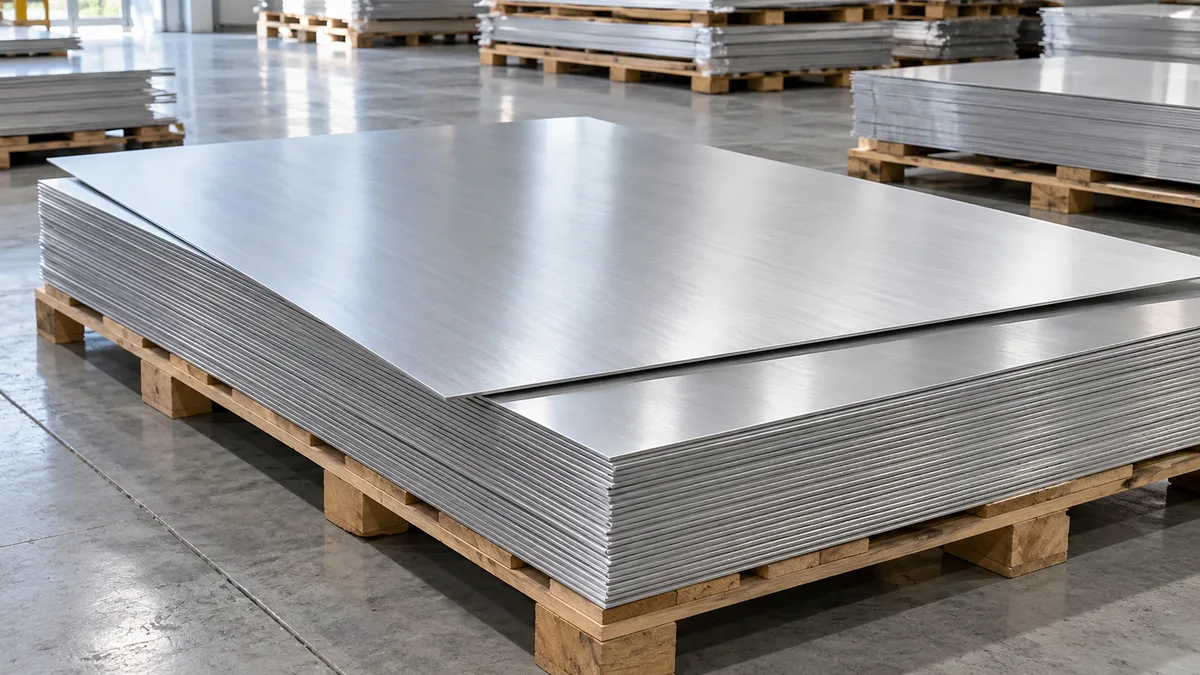
Consumer devices are judged by their surface. A laptop palm rest, a speaker grille, a remote-control face or a set-top box bezel has to anodise to the same colour batch after batch, without bands, streaks or spots. 5005 is close to commercially pure aluminium with a small magnesium addition, so its anodic film is clear and colourless and takes dyes evenly.
That magnesium gives roughly 30 – 40 % more strength than 1050 or 1100 in the same temper, enough for thin covers and trim to resist dents, while keeping excellent formability for stamping, bending and embossing. 5005 is also the alloy used for anodised architectural sheet that must match 6063 extrusions, a sign of how predictable its finish is.
Where a part needs more stiffness or strength, for example a structural bottom cover or keyboard plate, designers usually move to 5052-H32. Where it is machined from solid, 6063, 6013 or 7xxx alloys are the norm. 5005 is the choice when appearance comes first and loads are modest.
| Element | Limit | Note |
|---|---|---|
| Magnesium (Mg) | 0.50 – 1.1 | Solid-solution strengthening |
| Silicon (Si) | 0.30 max | Kept low in anodising-quality material |
| Iron (Fe) | 0.7 max | Lower Fe gives a clearer film |
| Copper (Cu) | 0.20 max | |
| Manganese (Mn) | 0.20 max | |
| Chromium (Cr) | 0.10 max | |
| Zinc (Zn) | 0.25 max | |
| Others, each / total | 0.05 / 0.15 | |
| Aluminium | Remainder |
Registered limits (Aluminum Association, EN 573-3 EN AW-5005) allow quite wide iron and silicon. For decorative anodising, buyers usually agree tighter internal limits and a controlled grain structure with the mill, often described as anodising quality (AQ).
| Temper | Tensile strength (MPa) | Yield strength min (MPa) | Elongation min (%) | Typical hardness |
|---|---|---|---|---|
| O | 105 – 145 | 35 | 18 – 22 | about 28 HB |
| H14 (strain-hardened, half hard) | 145 – 185 | about 115 – 120 | 2 – 6 (by thickness) | about 45 HB |
| H34 (strain-hardened and stabilised) | 140 – 185 | about 105 – 110 | 3 – 7 (by thickness) | about 41 HB |
| H18 (full hard) | 185 min | about 165 | 1 – 2 | about 51 HB |
Ranges summarised from ASTM B209 and EN 485-2; minimum elongation rises with thickness. Density 2.70 g/cm³, thermal conductivity about 200 W/m·K, electrical conductivity about 52 % IACS.
H14 and H34 have almost the same strength. H34 is stabilised by a low-temperature treatment after rolling, which prevents age softening at room temperature and gives slightly better ductility, so it is often preferred for parts with tighter bends. H14 is common for flat, lightly formed trim.
More on finishing in our anodising guide.
| Thickness (mm) | Precision tolerance often agreed (mm) |
|---|---|
| 0.25 – 0.50 | ±0.01 – 0.02 |
| > 0.50 – 1.00 | ±0.02 – 0.03 |
| > 1.00 – 2.00 | ±0.03 – 0.04 |
| > 2.00 – 4.00 | ±0.05 – 0.06 |
| > 4.00 – 6.00 | ±0.08 – 0.10 |
Standard tolerances follow EN 485-4 or ASTM B209; the precision values above are typical of what electronics buyers agree as a special requirement.
Palm rests, lid decor panels and bezels where an even anodised colour matters.
Speaker grilles, amplifier fascias and headphone cups, often brushed and anodised.
Set-top box and router covers, remote-control faces and appliance panels.
Anodised, printed or engraved labels and logos.
Low-load internal brackets where a non-magnetic, corrosion-resistant part is needed.
Simple stamped plates exploiting good thermal conductivity.
| Point | 1050-H14 | 5005-H34 | 5052-H32 | 5252-H32 |
|---|---|---|---|---|
| Typical tensile (MPa) | 110 | 160 | 228 | 235 |
| Anodised clarity | Very good | Very good | Good, slight tint | Excellent (bright trim) |
| Formability | Excellent | Very good | Good | Good |
| Dent resistance | Low | Moderate | Good | Good |
| Typical role | Cheap decorative parts | Visible anodised trim | Structural housings | Bright-dip trim |
Both are strain-hardened to about half hard with similar strength. H34 is also stabilised, so its properties do not drift at room temperature and it bends slightly better.
5005 anodises clearer and more uniformly, which suits visible decorative parts. 5052 is stronger and stiffer, so it is better for structural covers and keyboard plates.
Yes. It dyes evenly in black, grey and colours. Keep one material lot per colour batch to avoid shade variation.
Most parts use 0.5 – 2.0 mm. Thinner gauges suit badges and grilles; thicker for bezels that are machined after stamping.
Yes. It can be slit to narrow strip on 405, 505 or 605 mm cores for progressive-die stamping.
Send temper, size, surface and quantity. We reply with availability, certification and a delivered quote.





