Bright finish
Polished on the pattern side to a mirror-like shine, usually in 3003. The classic look of toolboxes and truck trim. Supplied with protective film.



Aluminium diamond plate (aluminum diamond plate, also called tread plate or checker plate) is sheet or plate rolled with a raised pattern of diamonds or bars on one face for grip, stiffness and a hard-wearing look. It is the standard material for truck and trailer floors, toolboxes, steps, ramps, walkways, wall protection and boat decks. This guide explains which alloy to choose, the difference between bright and mill-finish plate, common sizes and weights, and how to order. Metline supplies aluminium diamond plate in sheet, plate and coil worldwide.
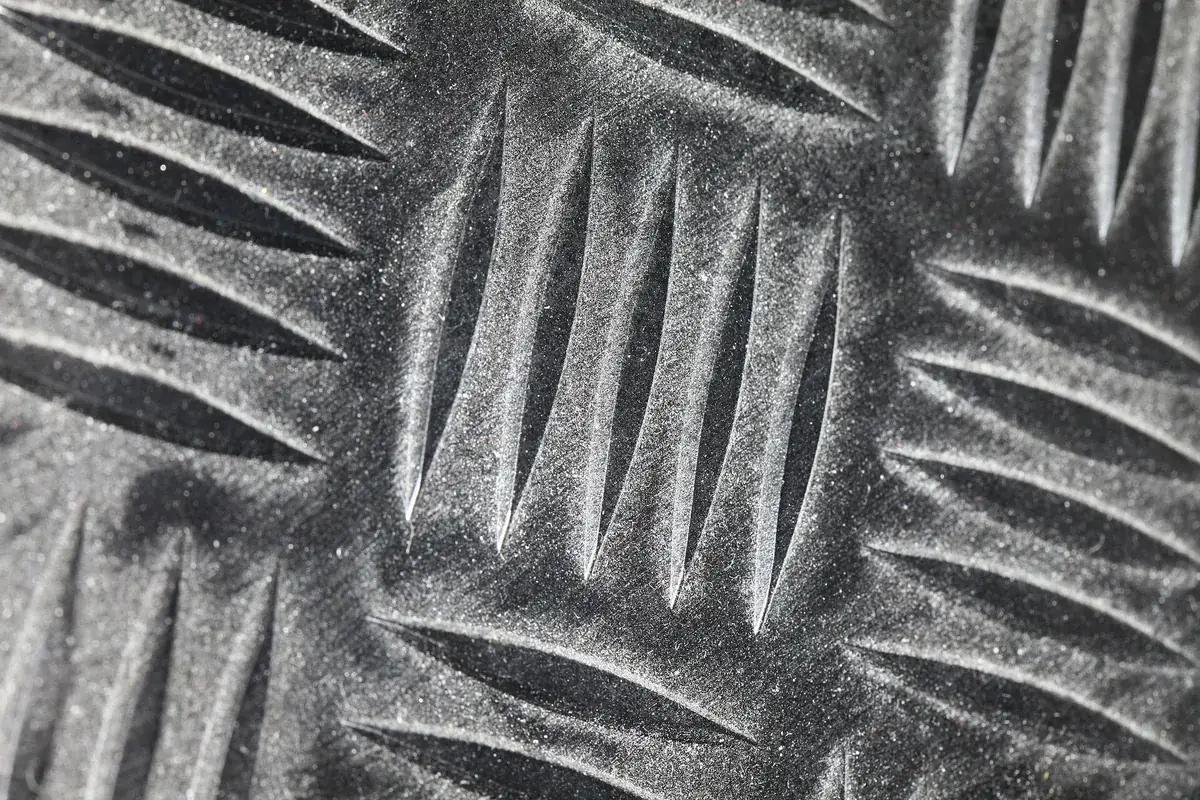
Diamond plate is made by passing hot or cold aluminium through a roll engraved with the pattern, which raises the design on one face while the back stays flat. The raised lugs give traction underfoot, hide scratches and dents, and add some stiffness compared with plain sheet of the same base thickness.
The term "diamond plate" is used loosely. In North America it usually means a pattern of elongated raised diamonds (sometimes called "1-bar"). In Europe and Asia the same product is often called tread plate or chequer plate, and other patterns are common: 3-bar and 5-bar (groups of parallel raised bars set at right angles), lentil or "pointer" patterns, and fine stucco or orange-peel embossing for decorative use. All are covered by tread plate standards such as ASTM B632 and EN 1386.
Aluminium replaces steel tread plate where weight and corrosion matter. It weighs about one third as much, does not rust, needs no painting, and keeps a clean appearance for years, which is why it dominates on vehicles, boats and outdoor access structures.
| Alloy and temper | Character | Typical uses |
|---|---|---|
| 3003-H22 / H14 | Formable, easy to bend and polish; moderate strength; the standard bright tread plate | Toolboxes, wall and corner guards, kick plates, trailer and truck trim, decorative work |
| 5052-H32 / H114 | Stronger and more corrosion resistant; good for welding and saltwater exposure | Boat decks, refrigerated truck floors, oil tanker walkways, humid and coastal sites |
| 5086-H32 / 5754-H114 | Higher-magnesium marine alloys with higher strength | Marine decks, ship stairs, offshore walkways |
| 6061-T6 | Heat-treated for the highest strength of common tread plates; less formable | Load-bearing floors, ramps, stair treads, platforms, trailer floors |
The alloy sets strength, formability and corrosion resistance; the tread pattern affects appearance and grip but not the base properties. Mechanical requirements for each alloy and temper are given in ASTM B632 (US) and EN 1386 with EN 485-2 (Europe); every delivery carries a mill test certificate.
As a quick guide: choose 3003 for bright, formable, decorative and light-duty uses; 5052 when the plate will be in water, salt air or welded; and 6061-T6 when the plate must carry load over a span, such as ramps and access floors. Note that 6061-T6 cracks if bent tightly, so bends should be generous or made in a softer alloy. See also 5052 tread plate for tankers and 3003 tread plate.
Polished on the pattern side to a mirror-like shine, usually in 3003. The classic look of toolboxes and truck trim. Supplied with protective film.
As rolled, with a dull, slightly uneven sheen. Lower cost; used where function matters more than looks, such as floors, platforms and industrial walkways.
Anodising (black, bronze, red, blue and others) adds a hard, coloured oxide layer. Results are most even on alloys and surfaces prepared for anodising.
Applied after cutting for colour matching on vehicles and buildings.
Stucco embossed or 5-bar patterns for walls, insulation cladding and floors where a different look or grip is wanted.
PE or PVC film on the pattern side protects bright and anodised plate during fabrication; remove it soon after installation outdoors.
The table gives the weight of the flat base sheet for common thicknesses, calculated at 2.73 g/cm³ (3003). The raised pattern adds extra metal on top of this, proportionally more on thin plate, so ask for the mill's tread plate weight table for exact figures.
| Fraction (in) | Decimal (in) | Base weight (lb/ft²) | Base weight (kg/m²) |
|---|---|---|---|
| 3/64 | 0.045 | 0.64 | 3.12 |
| 1/16 | 0.063 | 0.89 | 4.37 |
| 5/64 | 0.080 | 1.14 | 5.55 |
| — | 0.100 | 1.42 | 6.93 |
| 1/8 | 0.125 | 1.77 | 8.67 |
| 3/16 | 0.188 | 2.67 | 13.04 |
| 1/4 | 0.250 | 3.55 | 17.34 |
| 5/16 | 0.312 | 4.44 | 21.67 |
Diamond plate cuts with the same tools as other aluminium: shears and saws for straight cuts, and laser, plasma or waterjet for profiles. Bend with the pattern on the outside of the bend where possible, and allow larger bend radii for 5052 and especially 6061-T6 than for 3003. Pattern lugs on the inside of a tight bend can crush or mark the press brake tooling, so use protective film or urethane pads for bright plate.
All common tread plate alloys can be MIG or TIG welded. Use ER5356 filler for 5xxx alloys and either ER4043 or ER5356 for 6061 and 3003, remembering that welding reduces strength near the weld in 6061-T6 and in strain-hardened tempers. Fasten aluminium to steel frames with insulating washers or tape and stainless fasteners to avoid galvanic corrosion.
| Factor | Aluminium diamond plate | Steel tread plate |
|---|---|---|
| Weight | About one third of steel | Heavy |
| Corrosion | No rust; no painting needed | Needs galvanising or paint, rusts at damage |
| Appearance | Bright or anodised finishes available | Usually painted or galvanised |
| Strength for same thickness | Lower; use thicker plate or 6061-T6 | Higher |
| Sparking | Low spark risk compared with steel | Can spark on impact |
| Cost per sheet | Higher | Lower |
They are names for the same family of patterned sheet. "Diamond plate" usually refers to the raised-diamond pattern common in North America; "tread plate" and "chequer plate" are broader terms that also cover 3-bar and 5-bar patterns.
6061-T6 is the strongest of the common grades and is used for ramps, platforms and floors that span between supports. 5052-H32 is next and is preferred for marine use; 3003-H22 is softer and mainly decorative or light-duty.
Yes, in 5052 or 5086, which resist saltwater well and weld easily. Bright 3003 is less suitable for constant seawater exposure.
Nominal thickness refers to the base sheet, not including the height of the raised pattern. Measure away from the lugs or check the mill certificate.
3003 bends easily; 5052 needs slightly larger radii; 6061-T6 should be bent only over generous radii or it may crack. Bend with the pattern on the outside where possible.
Common sheets are 4 × 8 ft, 4 × 10 ft and 5 × 10 ft, with metric 1250 × 2500 and 1500 × 3000 mm sizes, from about 1.2 to 8 mm thick. Sheets can also be cut to size or supplied in coil.
Send the alloy, thickness, sizes, finish, quantity and destination. Our team will reply with availability, certification and a delivered price.






