Bright 3003 diamond plate
The familiar shiny pattern on truck toolboxes and trim. Chosen for appearance; strong enough for boxes and cladding but not ideal for heavily loaded floors.



Aluminium tread checker plate (also called chequer, diamond, durbar or treadplate) is rolled aluminium sheet or plate with a raised pattern on one face that gives grip underfoot and stiffens the sheet. It is supplied as cut sheets or as coil for fabricators who cut their own lengths. This guide covers grades, patterns, coil versus sheet supply, sizes, tolerances under EN 1386 and how to choose the right plate for floors, vehicles, steps and boxes.
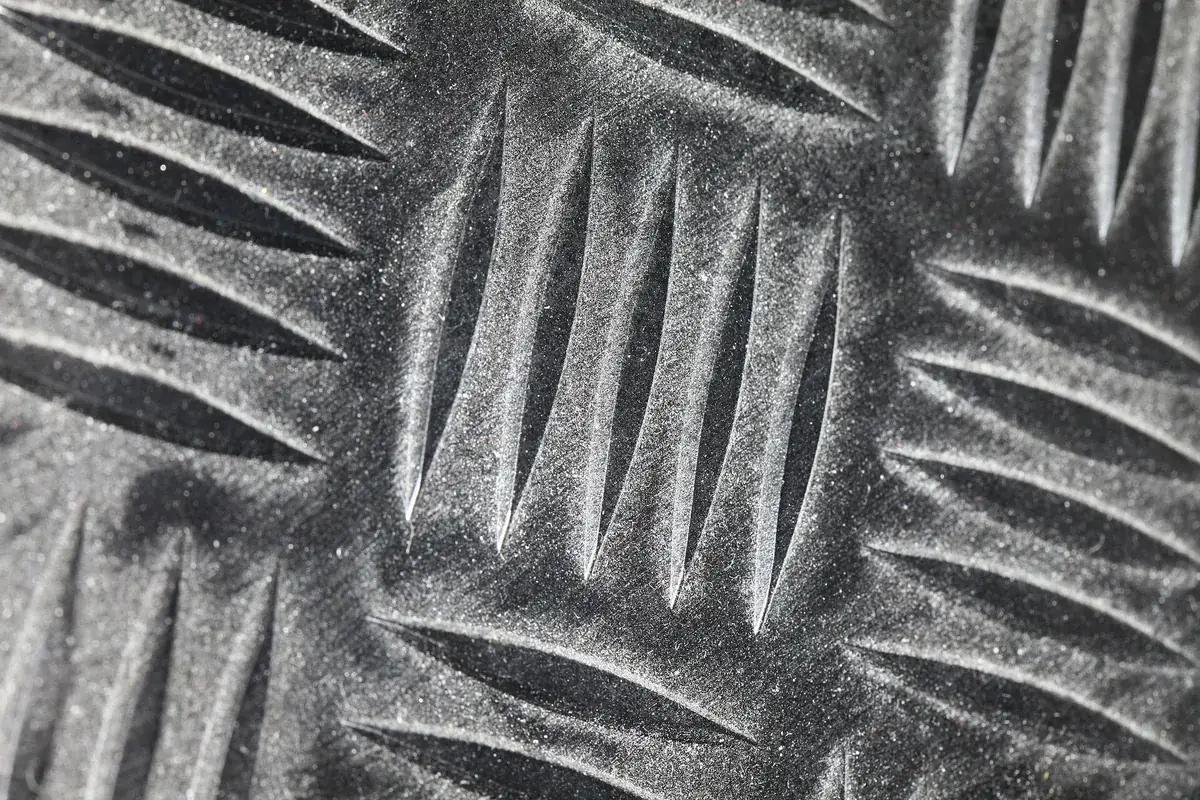
Tread plate is made by hot or cold rolling aluminium through a pair of rolls, one of which is engraved with the pattern. The raised ribs are formed from the metal of the sheet itself, so they cannot wear off or peel like a coating. The underside stays flat.
The pattern does three jobs: it gives a slip-resistant walking surface, it hides scratches and dents that would show on flat sheet, and it adds a little stiffness. Because aluminium does not rust, tread plate is used where steel chequer plate would need painting and regular maintenance: truck and trailer floors, toolboxes, ramps, stair treads, boat decks, wall protection and cold-store floors.
Names vary by region. "Diamond plate" is common in North America, "chequer plate" and "durbar" in the UK, India and Australia, and "tread plate" in European standards. They all describe the same product; what matters is the alloy, the temper, the base thickness and the pattern type.
The alloy controls strength, corrosion resistance, appearance and cost. Values below are typical properties of the base material in the tempers normally used for tread plate; certified minimums are on the mill certificate.
| Alloy & temper | Typical tensile strength | Corrosion resistance | Bright finish | Typical uses |
|---|---|---|---|---|
| 1050 / 1060 (H14, H24) | About 105 – 125 MPa | Very good | Good | Decorative panels, packaging, cold-store lining, light steps |
| 3003 / 3105 (H22, H24) | About 150 – 160 MPa | Very good | Excellent (classic bright diamond plate) | Toolboxes, truck boxes, wall protection, trim |
| 5052 (H32, H114) | About 230 MPa | Excellent, incl. marine | Fair | Truck and trailer floors, boat decks, tanker walkways |
| 5754 (H22, H114) | About 230 – 250 MPa | Excellent | Fair | European vehicle and marine flooring |
| 5083 / 5086 (H111, H114) | About 270 – 300 MPa | Excellent in seawater | Fair | Ship decks, offshore walkways, heavy-duty ramps |
| 6061 / 6082 (T6) | About 290 – 310 MPa | Good | Fair | Structural flooring, loading ramps, platforms |
The familiar shiny pattern on truck toolboxes and trim. Chosen for appearance; strong enough for boxes and cladding but not ideal for heavily loaded floors.
The default for vehicle and marine floors. Higher strength, excellent corrosion resistance and good weldability with 5356 filler.
Used where the plate spans between supports and carries load. Highest strength of the common choices, but loses strength near welds.
| Pattern | Description | Strengths | Typical uses |
|---|---|---|---|
| Diamond (single diamond) | Elongated diamond-shaped ribs in a herringbone layout | Strong visual identity, good grip in all directions | Toolboxes, trim, steps, North American trailers |
| 5-bar | Groups of five short parallel bars arranged at right angles | Very good slip resistance, easy to clean, hides wear | Industrial floors, vehicle beds, ramps, European and Asian markets |
| 3-bar / 2-bar | Groups of three or two bars | Coarser grip, simple look | Walkways, stairs, platforms |
| Lentil (needle or grain) | Small raised lens or grain shapes | Fine, decorative texture, good for thin gauges | Lifts, interiors, cold stores, shopfitting |
| Fine diamond / mini pattern | Smaller, shallower diamonds | Lightweight, decorative | Wall protection, cabinets, signage |
Pattern height usually ranges from about 0.5 mm on thin lentil and fine patterns to about 2.5 mm on heavy 5-bar plate. EN 1386 defines the patterns, their nominal raised heights for each thickness band and the permitted deviations. A pattern that is too shallow loses grip, especially when wet or oily, so state the pattern height when slip resistance matters.
Slip resistance depends on pattern, wear, contamination and footwear, not on the alloy. If a slip-resistance rating is required, specify the test method (for example a ramp or pendulum test) and test the actual product.
| Factor | Coil | Cut sheet / plate |
|---|---|---|
| Typical thickness | Thinner gauges, about 1.2 – 3 mm | About 1.5 – 8 mm and heavier |
| Best for | High-volume fabricators with their own cut-to-length lines, roll forming, long vehicle floors | Project buyers and workshops |
| Lengths | Any length cut by the user, very long floors without joints | Standard sizes such as 1220 × 2440 mm, 1250 × 2500 mm, 1500 × 3000 mm, or cut to size |
| Handling | Needs decoiler and levelling; coil set must be removed | Ready to use |
| Yield | Minimal offcut waste | Offcuts depend on nesting |
Coils are specified by width, thickness, inner diameter (commonly 505 or 610 mm) and coil weight. Very long single-piece floors, for example in trailers and rail vehicles, are often cut from coil to avoid transverse joints. Thicker floor plate is normally supplied flat.
Thickness of tread plate is normally the base thickness, excluding the pattern. The table gives the weight of the base only, at 2.70 kg per m² per mm; the raised pattern adds a few percent, depending on pattern height and density, so ask for the weight of the specific pattern when freight or vehicle weight is critical.
| Base thickness (mm) | Base kg per m² | 1220 × 2440 mm (kg, base) | 1500 × 3000 mm (kg, base) |
|---|---|---|---|
| 1.5 | 4.05 | 12.1 | 18.2 |
| 2 | 5.40 | 16.1 | 24.3 |
| 2.5 | 6.75 | 20.1 | 30.4 |
| 3 | 8.10 | 24.1 | 36.5 |
| 4 | 10.80 | 32.1 | 48.6 |
| 5 | 13.50 | 40.2 | 60.8 |
| 6 | 16.20 | 48.2 | 72.9 |
| 8 | 21.60 | 64.3 | 97.2 |
EN 1386 gives tolerances for base thickness, pattern height, width, length and squareness; ASTM B632 and ANSI H35.2 are the references for orders to US specifications. Thickness tolerances widen as the plate gets thicker and wider, so check the tolerance band on the order if the plate fits into a frame or rebate.
Shear, saw, laser, plasma or waterjet. Put the pattern face up on shears to avoid marking it, and deburr edges for safety.
Bend with the pattern on the outside and allow generous radii, particularly in harder tempers. Soft tempers (O, H111, H22) bend most easily.
5xxx and 6xxx tread plate weld well by MIG and TIG; 5356 filler is typical for 5052, 5754 and 5083, and 4043 or 5356 for 6061.
Bright plate can be polished; mill-finish plate can be anodised, painted or powder coated. Clean the pattern valleys thoroughly before coating.
They are regional names for the same product: aluminium plate with a raised anti-slip pattern. Diamond plate usually means the single-diamond pattern; checker or chequer plate is often used for 5-bar and other patterns.
5052 or 5754 in H32, H114 or similar tempers is the usual choice: strong, corrosion resistant and weldable. 6061-T6 is used where more strength is needed and welds are limited; bright 3003 is better kept for boxes and trim.
Normally no. Tread plate is ordered by base thickness, and the raised pattern height is specified separately. Use the base thickness for strength calculations.
Yes, thinner gauges are commonly supplied in coil for fabricators who cut their own lengths or need long floors without joints. Heavier plate is usually supplied as flat sheets.
The base weighs 2.70 kg per m² for each millimetre of thickness; the pattern adds a few percent. A 1220 × 2440 mm sheet with a 3 mm base weighs about 24 kg before the pattern allowance.
Yes. Metline supplies aluminium tread checker plate in sheet and coil worldwide from Mumbai, with mill certificates and moisture-proof export packing on pallets or in wooden cases.
Send the alloy, pattern, base thickness, size or coil width and quantity. We reply with availability, certification and a delivered price.






