Bare (uncoated)
Rolled and annealed foil without coating. The lowest-cost option, with the highest base thermal contact. Suits indoor units and dry conditions, but condensate forms droplets that bridge fins and raise air-side pressure drop.



8006 fin stock is thin aluminium-iron-manganese foil used to make the fins of air-conditioning coils, refrigeration evaporators, condensers and radiators. Its iron and manganese content gives more strength than 8011 or 1100 fin stock at the same thickness while keeping the ductility needed for deep fin collars. This guide covers chemistry, tempers, coatings, dimensions, inspection and how to choose 8006 against other fin alloys.
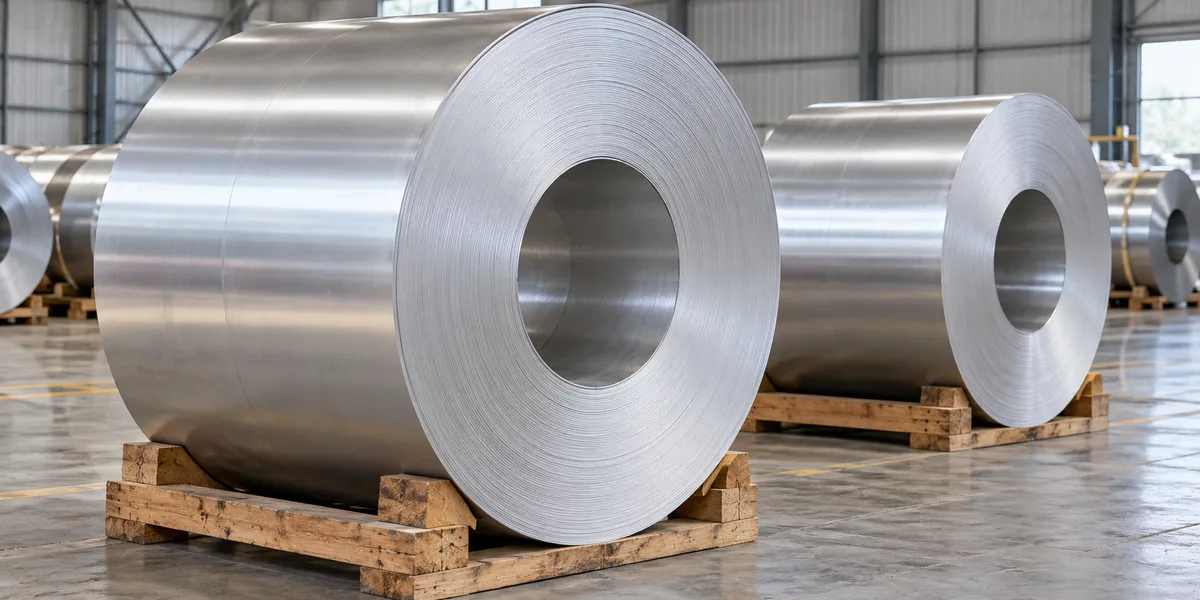
In a round-tube plate-fin heat exchanger, thousands of thin aluminium fins are stamped from coil, stacked, and pierced by copper or aluminium tubes. The tubes are then expanded mechanically so that they grip collars drawn up from each fin. The fin material must be thin, strong enough to stay flat and keep its pitch, and ductile enough to form tall collars without cracking.
8006 meets that combination well. It contains 1.2 – 2.0 % iron and 0.3 – 1.0 % manganese, which form a fine dispersion of Al-Fe-Mn particles. These particles strengthen the alloy and stabilise a fine grain during annealing, so partially annealed tempers such as H22 and H24 combine useful strength with high elongation. That lets designers use thinner fins or taller collars than with 1100, 8011 or 3102 fin stock.
The same alloy is used for semi-rigid food containers, where strength at low gauge matters for the same reasons. For heat exchangers, 8006 is supplied bare or with functional coatings that control how condensate behaves and how well the fin resists corrosion.
Limits per EN 573-3 (EN AW-8006), which match the Aluminum Association registration. Single values are maximums.
| Element | Limit | Role |
|---|---|---|
| Silicon (Si) | ≤ 0.40 | Impurity; kept low so Fe-Mn particles stay fine |
| Iron (Fe) | 1.2 – 2.0 | Main addition; forms strengthening intermetallics |
| Copper (Cu) | ≤ 0.30 | Impurity; slight strength contribution |
| Manganese (Mn) | 0.30 – 1.0 | Strengthens and refines the Fe-bearing particles |
| Magnesium (Mg) | ≤ 0.10 | Impurity |
| Zinc (Zn) | ≤ 0.10 | Impurity |
| Others, each / total | ≤ 0.05 / ≤ 0.15 | |
| Aluminium (Al) | Remainder | About 96 % or more |
| Temper | Condition | Typical use in fins |
|---|---|---|
| O | Fully annealed | Deep collars, high-collar designs and parts drawn rather than stamped |
| H22 | Strain-hardened and partially annealed, quarter-hard | Most common balance of collar height and fin stiffness |
| H24 | Strain-hardened and partially annealed, half-hard | Thinner fins, higher strength, moderate collars |
| H26 | Strain-hardened and partially annealed, three-quarter hard | Stiff, low-collar fins and narrow-pitch designs |
In the H2x tempers the foil is rolled harder than required and then partly annealed back. Compared with H1x tempers at the same strength, H2x material has noticeably higher elongation, which is why fin stock is almost always ordered as H22, H24 or H26 rather than H14 or H16.
EN 683-2 sets the tensile strength, proof strength, elongation and cupping requirements for each fin-stock alloy and temper. Instead of quoting generic figures, specify EN 683-2 (or your own fin specification) on the order; the mill certificate then reports actual values for each coil. When comparing offers, look at elongation and Erichsen cupping as closely as at tensile strength, because collar cracking is the most common fin defect.
Properties also depend on thickness: very thin foil (under about 0.1 mm) shows lower elongation than thicker fin stock in the same temper.
Rolled and annealed foil without coating. The lowest-cost option, with the highest base thermal contact. Suits indoor units and dry conditions, but condensate forms droplets that bridge fins and raise air-side pressure drop.
A thin coating, often over a corrosion-resistant primer, makes condensate spread into a thin film that drains away. This reduces bridging between fins, lowers air resistance and noise, and limits odour and mould growth. Standard for evaporators of split air conditioners.
A coating with a high water contact angle makes condensate bead and run off quickly. Used where frost or water retention is the problem, such as refrigeration evaporators and dehumidifiers.
A thin polyurethane or epoxy-type corrosion-resistant layer, typically about 3 – 4 g/m² per side (around 2 – 3 µm). The colour identifies the coating and makes coverage easy to inspect.
A heavier corrosion-resistant layer, typically about 5 – 6 g/m² per side (around 4 – 5 µm), for coastal, industrial and outdoor condensers exposed to salt and pollutants.
Self-lubricating coatings that allow stamping with little or no volatile oil, anti-mould and antibacterial coatings, and epoxy coatings for aggressive environments.
Coating weights shown are typical supply values; the exact system, colour and weight are agreed per order.
Width tolerance and edge quality matter as much as thickness on a high-speed fin press. Slit edges should be clean with no burrs or cracks, coils should be wound tightly with little telescoping or edge wander, and any joins (splices) should be marked so the press operator can remove them.
| Test | Purpose | Typical method or requirement |
|---|---|---|
| Chemistry | Confirms 8006 limits | Spectrometer analysis per cast |
| Tensile and elongation | Strength and formability | Per EN 683-2 for the temper |
| Erichsen cupping | Collar-forming ability | Per EN 683-2 |
| Coating adhesion | Coating stays on during stamping | Cupping or cross-cut test on both faces, EN 13523 methods; no peeling |
| Coating weight and thickness | Uniform protection | Gravimetric or gauge measurement per side |
| Hydrophilicity | Condensate spreading | Water contact angle, initial and after durability cycling |
| Salt spray | Corrosion resistance of coated foil | Neutral salt spray to ASTM B117 or ISO 9227 for agreed hours |
| Oil and solvent resistance | Coating survives stamping oils | Immersion test without blistering or loss of hydrophilicity |
| Odour | No smell after heating | Heating and immersion tests |
| Surface and edges | No defects | Visual inspection for voids, wrinkles, stripes, colour variation, scratches and corrosion |
Inspection results are reported on an EN 10204 3.1 certificate. For a new design or new supplier, run a press trial and an assembled-coil test before full release; laboratory values do not always predict collar cracking at production speed.
Labelling and packing. Fin stock is easily damaged at the edges and by moisture. A typical export specification looks like this; we adapt it to your decoilers and warehouse.
| Alloy | Main additions | Relative strength | Formability | Typical fin use |
|---|---|---|---|---|
| 1100 / 1200 | Commercially pure | Lowest | Excellent | Low-cost fins, thick gauges |
| 8011 | Fe, Si | Low–medium | Very good | Most common AC fin alloy |
| 8006 | Fe, Mn | Medium | Very good | Thin fins, tall collars, high-performance coils |
| 3102 | Mn | Low–medium | Very good | Fins and brazed heat-exchanger tube |
| 3003 | Mn, Cu | Medium | Good | Heavier fins, radiators |
| 5052 | Mg | High | Fair | Special high-strength or coloured fins |
In practice 8011 is the default fin stock for residential air conditioners, and 8006 is chosen when the designer wants to reduce thickness, increase collar height or improve fin stiffness at a given gauge. See our 8011 air-conditioner foil guide for that alloy, the 5052 fin stock page for high-strength fins, and the general aluminium fin stock overview.
Fins are made on high-speed presses that pierce, draw and iron the collars, cut louvres or slits, and cut the strip to length in one progressive die. The collar is drawn in several stages and then flared so the next fin sits at the correct pitch. Each stage stretches the foil, so small differences in elongation, thickness or lubricant film show up as cracked collars or uneven pitch.
Conventional bare and coated fin stock is stamped with a light, volatile evaporating oil that flashes off in the oven after coil assembly. Self-lubricating coatings reduce or remove that oil, which cuts emissions and cleaning, but the die and press settings usually need re-tuning when switching.
8006 contains more iron plus a manganese addition, which makes it stronger than 8011 at the same thickness while keeping good elongation. 8011 is cheaper and the default for standard AC fins; 8006 is chosen for thinner fins, taller collars or stiffer fins.
H22 suits most fin designs with standard collars. Use O for very tall or drawn collars, H24 for thinner fins that need more stiffness, and H26 for low-collar, narrow-pitch fins.
Hydrophilic coatings spread condensate into a draining film and are standard for AC evaporators. Hydrophobic coatings bead water so it runs off quickly and are preferred where frost or water retention is the issue, such as refrigeration evaporators.
The colours identify corrosion-resistant coatings. Blue coatings are lighter (around 3 – 4 g/m² per side); gold coatings are heavier (around 5 – 6 g/m² per side) for coastal and industrial outdoor units.
EN 573-3 for chemistry, EN 683-1/-2/-3 for fin-stock delivery conditions, mechanical properties and dimensions, EN 13523 methods for coating tests, and EN 10204 for the inspection certificate.
Most residential AC fins are about 0.095 – 0.15 mm thick. 8006 makes the lower end of that range practical because of its higher strength.
Send the thickness, width, temper, coating and coil requirements. We will reply with availability, test documentation and a delivered price.





