Matching temper to the die schedule
Harder rod (H14, H16) needs fewer passes to reach H19 hard-drawn wire for overhead conductors; softer rod suits drawing to fine or annealed wire.



Electrical aluminium wire rod is continuously cast and rolled rod, most often 9.5 mm in diameter, that cable makers draw into wire for overhead conductors, power cables and building wire. The standard grade is EC (electrical conductor) aluminium, registered as 1350, with at least 61 % IACS conductivity; alloy rods in 6101/6201 and 8xxx series serve higher-strength and building-wire applications. Metline supplies rod to ASTM B233, IS 5484 and EN 1715 to cable plants worldwide.
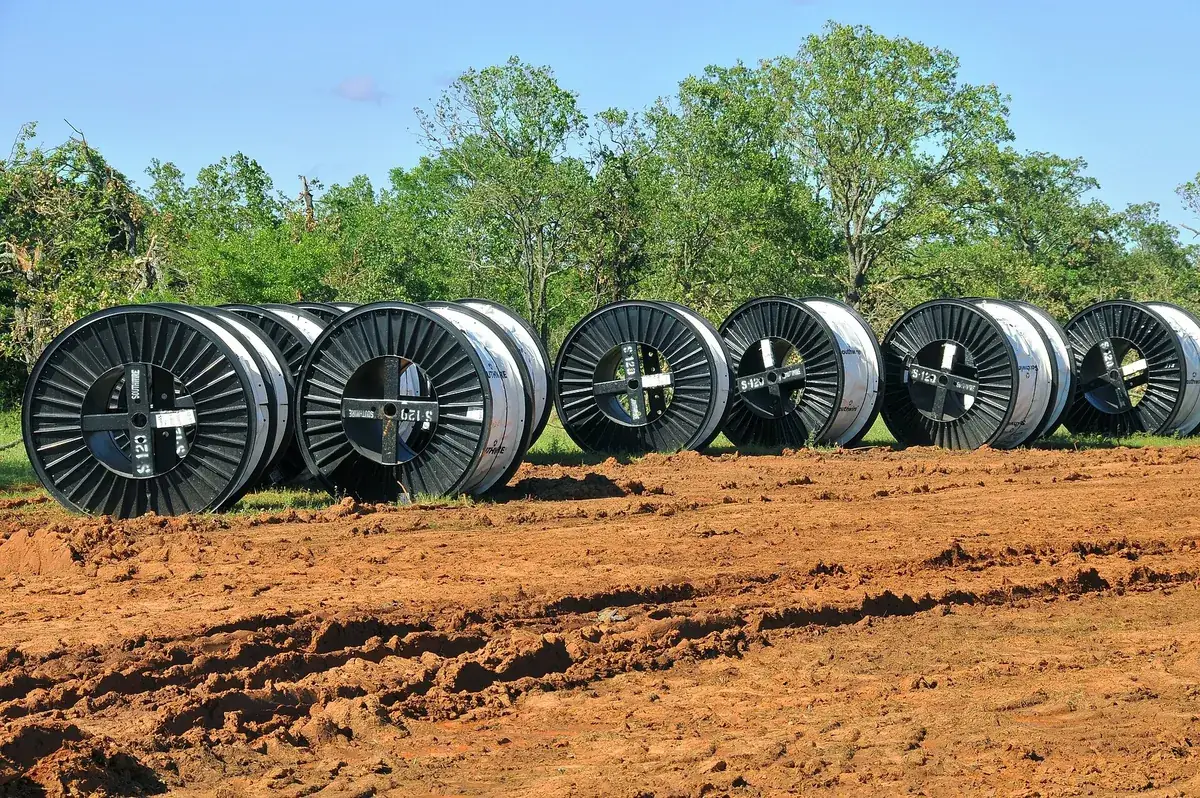
Wire rod is the semi-finished link between molten metal and finished conductor. It is produced on a continuous casting and rolling line: liquid aluminium is cast into a bar on a rotating wheel or between belts, and the hot bar goes straight into a multi-stand rolling mill that reduces it to round rod, which is coiled.
Electrical rod is made from high-purity aluminium with tight limits on the elements that hurt conductivity. Titanium, vanadium, chromium and manganese are the worst offenders, so the melt is often treated with boron, which ties them up as insoluble borides. The result is EC grade aluminium, registered by the Aluminum Association as 1350, with 99.5 % minimum aluminium and conductivity of about 61.8 % IACS in the annealed state.
By weight, aluminium conducts about twice as well as copper: it has around 61 % of copper's conductivity but only 30 % of its density. That is why almost all overhead transmission lines and a large share of power cables use aluminium conductors drawn from rod like this.
| Grade | Type | Typical conductivity | End products |
|---|---|---|---|
| 1350 (EC grade) | Unalloyed, high purity | 61.0 – 62 % IACS | ACSR and AAC overhead conductors, power cable cores, busbar wire |
| 1370 | High-purity variant | ≥ 61.8 % IACS | Magnet and winding wire, special conductors |
| 6101 / 6201 | Al-Mg-Si heat-treatable | 52 – 57 % IACS after ageing | AAAC all-aluminium-alloy conductors, high-strength wire |
| 8030 / 8176 (AA-8000 series) | Al-Fe(-Cu) alloys | About 61 % IACS | Building wire and flexible cable with better creep and bend resistance |
| Heat-resistant Al-Zr | Zirconium-alloyed | About 58 – 60 % IACS | High-temperature (TAL / ZTAL) overhead conductors |
Unalloyed 1350 dominates by volume. Alloy rods are chosen when the conductor must carry more mechanical load (6201 for AAAC spans), resist creep at terminations (8xxx in building wire), or run hotter without annealing (zirconium-alloyed rod).
ASTM B233 classifies 1350 drawing stock by temper, each with a tensile strength band and a minimum conductivity. Harder tempers are drawn with fewer passes; softer tempers are used where the finished wire must be soft or will be annealed.
| Temper (ASTM B233) | Tensile strength | Minimum conductivity |
|---|---|---|
| O | 59 – 97 MPa (8.5 – 14.0 ksi) | 61.8 % IACS |
| H12 / H22 | 83 – 117 MPa (12.0 – 17.0 ksi) | 61.5 % IACS |
| H14 / H24 | 103 – 138 MPa (15.0 – 20.0 ksi) | 61.4 % IACS |
| H16 / H26 | 117 – 152 MPa (17.0 – 22.0 ksi) | 61.3 % IACS |
ASTM B233 covers rod from 9.52 mm to 25.40 mm diameter; the H14 and H16 ranges apply up to 12.7 mm. Indian IS 5484 grades rod by similar tensile bands with a maximum resistivity of 0.028264 Ω·mm²/m at 20 °C (61.0 % IACS).
Coil weight and dimensions are agreed with each order to match your handling equipment.
A metre of 9.5 mm rod weighs about 0.192 kg, so a 2-tonne coil contains roughly 10.4 km of rod. Drawn down to 3 mm wire, the same coil yields about 104 km of wire, because the cross-section is reduced by a factor of ten.
| Standard | Scope |
|---|---|
| ASTM B233 | Aluminum 1350 drawing stock for electrical purposes |
| ASTM B230 / B231 / B232 | 1350-H19 wire, concentric-lay conductors and ACSR made from the drawn wire |
| ASTM B398 / B399 | 6201-T81 wire and AAAC conductors |
| ASTM B800 / B801 | 8000-series alloy wire and conductors for building wire |
| IS 5484 | EC grade aluminium rod produced by continuous casting and rolling (India) |
| EN 1715-1 / -2 | Drawing stock for electrical purposes (Europe) |
| IEC 60889 / IEC 60104 | Hard-drawn aluminium wire and Al-Mg-Si alloy wire for overhead lines |
The standard you name should match the downstream product. A cable plant making IEC conductors may still buy rod to ASTM B233 or IS 5484, but the conductivity and tensile limits for the finished wire are set by the conductor standard, so both should be stated on the order.
Harder rod (H14, H16) needs fewer passes to reach H19 hard-drawn wire for overhead conductors; softer rod suits drawing to fine or annealed wire.
Cold work lowers conductivity slightly. Starting rod with margin above 61 % IACS keeps finished H19 wire within its minimum.
Oxide films and inclusions cause breaks at fine diameters. Clean rod, proper filtration and good degassing in casting are the main controls.
Cold-pressure or butt welds join coils; the agreed number and strength of welds should be stated.
Keep coils dry and covered; condensation causes surface oxidation that can carry into the wire.
6101/6201 rod is solution-treated and the drawn wire is artificially aged to reach strength and conductivity together.
EC stands for electrical conductor. It is high-purity aluminium (registered as 1350) with 99.5 % minimum Al and strict limits on titanium, vanadium, chromium and manganese, giving conductivity of at least 61 % IACS.
9.5 mm (3/8 in) is the standard. Rod from about 7.6 mm up to 25 mm is also made for specific drawing lines and conductor types.
1350 is unalloyed and has the highest conductivity (about 61.8 % IACS) but low strength. 6201 contains magnesium and silicon, and after drawing and ageing the wire is roughly twice as strong, with conductivity around 52.5 % IACS. It is used for AAAC conductors.
For hard-drawn overhead conductor wire, H14 or H16 rod is common because it reaches H19 with fewer passes. For soft or annealed wire and cable cores, O or H12 rod is often preferred. Match the temper to your die schedule.
A metre of 9.5 mm rod weighs about 0.192 kg, so a 2-tonne coil contains roughly 10 km of rod.
Yes. Each lot is supplied with a mill test certificate showing chemistry, tensile strength, elongation and resistivity or conductivity.
Send the grade, diameter, temper, coil weight and monthly quantity. We will reply with availability, certification and a delivered price.





