


ACSR Conductor (Aluminium Conductor Steel Reinforced)
ACSR is the most widely used bare overhead conductor in the world: layers of hard-drawn 1350 aluminium wire carry the current, wrapped around a galvanised steel core that carries much of the mechanical load. The combination gives high strength for long spans and heavy ice at a moderate cost. Metline supplies ACSR in ASTM, IEC/EN, BS and IS constructions, with a choice of steel core coatings, to utilities and contractors worldwide.
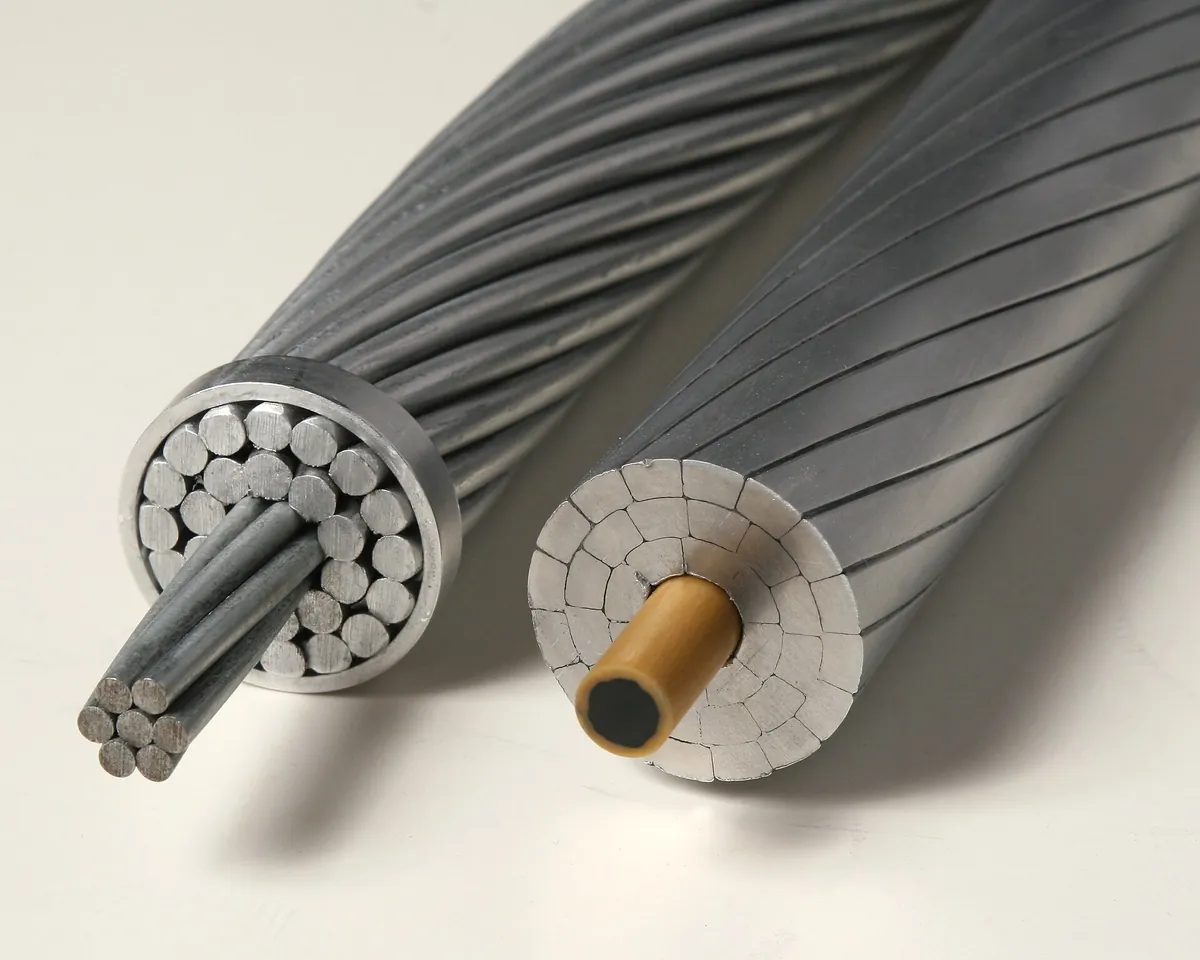
- Aluminium wires
- 1350-H19, ≈ 61 % IACS
- Core
- Galvanised, Zn-Al or aluminium-clad steel
- Typical builds
- 6/1, 26/7, 30/7, 54/7, 54/19
- Standards
- ASTM B232 · IEC 61089 · EN 50182 · IS 398-2
How ACSR works
Aluminium conducts well and is light but not very strong; steel is strong but a poor conductor. ACSR puts each where it works best. The steel core, a single wire or a stranded group of 7, 19 or more wires, gives the conductor high tensile strength and a low coefficient of expansion. The aluminium layers around it carry almost all the current.
The ratio of steel to aluminium sets the character of the conductor. A 6/1 construction (six aluminium wires around one steel wire) has a high steel share and is strong for its size, used on rural distribution lines with long spans. A 54/7 or 45/7 construction has less steel and more aluminium, so it carries more current per kilogram and is used on high-voltage transmission. Constructions such as 26/7 and 30/7 sit in between.
Because the steel carries a growing share of tension as the conductor heats and the aluminium expands, ACSR sags less at high temperature than all-aluminium conductors. This "knee point" behaviour is one reason ACSR remains the default for long spans, river crossings and lines in heavy ice or wind areas.
Aluminium wires, steel core and coatings
Component materials
- Aluminium wires
- 1350-H19 hard-drawn (ASTM B230) or IEC 62641 type A1; ≈ 61 % IACS
- Steel core wire
- High-carbon steel; regular, high, extra-high or ultra-high strength grades
- Core stranding
- 1, 7, 19 or 37 wires depending on size
- Lay
- Adjacent layers laid in opposite directions; outer layer normally right-hand lay
- Grease
- Neutral corrosion-inhibiting grease on the core or inner layers when specified for corrosive areas
| Core coating | Designation (ASTM / IEC) | Use |
|---|---|---|
| Zinc coating, class A | ASTM B498 class A; IEC S1A, S2A, S3A | Normal atmospheres; the standard choice |
| Heavier zinc, classes B and C | ASTM B498 class B / C; IEC S1B | Moderately to more corrosive environments |
| Zinc-5 % aluminium-mischmetal alloy | ASTM B802 / B803 (often called MA) | Better corrosion life than zinc of the same weight |
| Aluminium-clad steel | ASTM B502 (ACSR/AW); IEC 20SA type | Coastal and industrial pollution; also slightly lowers resistance |
The core coating matters because a corroded core cannot be seen from the ground. In salt or industrial atmospheres, specify heavier zinc, Zn-Al alloy or aluminium-clad core, and consider greasing the core.
Common ASTM B232 ACSR code names
North American ACSR sizes carry bird code names. Nominal data for frequently specified sizes:
| Code word | Size (AWG / kcmil) | Stranding (Al / steel) | Overall diameter (mm) | Mass (kg/km) |
|---|---|---|---|---|
| Turkey | 6 AWG | 6 / 1 | 5.04 | 54 |
| Swan | 4 AWG | 6 / 1 | 6.36 | 85 |
| Raven | 1/0 AWG | 6 / 1 | 10.11 | 216 |
| Penguin | 4/0 AWG | 6 / 1 | 14.31 | 433 |
| Linnet | 336.4 kcmil | 26 / 7 | 18.29 | 688 |
| Hawk | 477 kcmil | 26 / 7 | 21.79 | 975 |
| Drake | 795 kcmil | 26 / 7 | 28.14 | 1628 |
| Condor | 795 kcmil | 54 / 7 | 27.76 | 1522 |
Nominal values rounded from published ASTM B232 data; Drake has a rated strength of about 140 kN (31,500 lbf) and a DC resistance near 0.072 Ω/km at 20 °C. Confirm exact figures against the edition named in your specification.
Common IS 398-2 / BS animal code names
India, the Middle East, Africa and many Commonwealth markets use animal code names from BS 215-2 and IS 398-2. Values below are from IS 398 (Part 2); BS 215 figures differ slightly, so do not mix the two in one specification.
| Code word | Nominal Al area | Stranding (Al + steel, mm) | Overall diameter (mm) | Mass (kg/km) | Rated strength (kN) | DC resistance 20 °C (Ω/km) |
|---|---|---|---|---|---|---|
| Dog | 100 mm² | 6/4.72 + 7/1.57 | 14.15 | 394 | 32.4 | 0.2792 |
| Panther | 200 mm² | 30/3.00 + 7/3.00 | 21.00 | 974 | 89.7 | 0.1390 |
| Zebra | 420 mm² | 54/3.18 + 7/3.18 | 28.62 | 1621 | 130.3 | 0.0687 |
IEC 61089 and EN 50182 use a systematic notation instead of code names, for example "434-AL1/56-ST1A", meaning 434 mm² of A1 aluminium and 56 mm² of class 1, coating A steel. Many tenders give both forms.
Electrical, mechanical and thermal performance
| Parameter | Typical range across standard sizes | Notes |
|---|---|---|
| DC resistance at 20 °C | ≈ 0.02 – 2.2 Ω/km | Set by aluminium area; the steel adds very little conductance |
| Rated breaking strength | ≈ 5 – 250 kN and above | Depends on steel area and grade as well as aluminium area |
| Mass | ≈ 50 – 3,500 kg/km | Distribution to large transmission sizes |
| Everyday tension | Commonly about 15 – 25 % of rated strength | Limited by aeolian vibration; set by line design rules |
| Maximum continuous temperature | Commonly 75 – 100 °C | Higher temperatures anneal the 1350 wires over time |
Ampacity is not a fixed catalogue value: it depends on ambient temperature, wind, solar radiation, emissivity and the maximum conductor temperature allowed. It is calculated per project using IEEE 738 or CIGRE methods. Where more capacity is needed on existing towers, high-temperature conductors such as ACSS (annealed aluminium on a high-strength steel core, ASTM B856) can operate at much higher temperatures with limited extra sag.
ACSR compared with AAC, AAAC and ACAR
| Item | ACSR | AAC | AAAC (6201) | ACAR |
|---|---|---|---|---|
| Strength per diameter | Highest | Low | High | Medium to high |
| Mass | Heaviest | Light | Light | Light |
| Sag at high temperature | Lowest | High | High | High |
| Resistance (same aluminium area) | Low | Low | About 15 % higher | Between AAC and AAAC |
| Corrosion in coastal air | Core risk if coating fails | Very good | Very good | Very good |
| Magnetic losses | Small (from steel) | None | None | None |
| Typical use | Long spans, transmission, heavy ice | Short urban spans | Coastal distribution, moderate spans | Tuned strength, re-conductoring |
A common error is to say ACSR conducts better than all-aluminium designs because of its core. It does not: the steel adds strength, not conductivity. Choose ACSR for mechanical reasons; choose AAAC or ACAR where corrosion, weight or losses dominate. See our 6201 AAAC and ACAR pages.
Where ACSR is used
- High-voltage and extra-high-voltage transmission: single and bundled conductors on lattice towers
- Rural distribution: long spans between poles with 6/1 and 6/1-type constructions
- River, valley and highway crossings: high-strength constructions with extra steel
- Heavy ice and high-wind regions: where mechanical loading governs conductor choice
- Line extensions and upgrades: matching existing ACSR circuits and hardware
Supply, testing and packing
What we supply
- Constructions
- ASTM B232, IEC 61089 / EN 50182, BS 215-2 and IS 398-2 sizes, or utility specifications
- Core options
- Class A, B or C zinc, Zn-5Al-MM, or aluminium-clad steel; greased or ungreased
- Tests
- Wire tensile, elongation, wrap and resistivity; zinc coating mass; conductor diameter, lay ratio, mass per km, DC resistance; breaking load and stress-strain on request
- Documents
- EN 10204 3.1 certificate and type or routine test reports; third-party inspection on request
- Packing
- Non-returnable wooden or returnable steel drums with lagging; drum lengths to suit tension stringing sections
- Delivery terms
- EXW, FOB, CIF or DAP
References and standards
- ASTM B232/B232M – Concentric-Lay-Stranded Aluminum Conductors, Coated-Steel Reinforced (ACSR)
- ASTM B498/B498M – Zinc-Coated (Galvanized) Steel Core Wire for Use in Overhead Electrical Conductors
- IEC 61089 – Round wire concentric lay overhead electrical stranded conductors
- EN 50182 – Conductors for overhead lines: round wire concentric lay stranded conductors
- IS 398 (Part 2) – Aluminium conductors for overhead transmission purposes: aluminium conductors galvanized steel-reinforced
- IEEE 738 – Calculating the Current-Temperature Relationship of Bare Overhead Conductors
ACSR conductor: frequently asked questions
What span conditions suit ACSR?
Long spans, river and valley crossings, and regions with heavy ice or wind loading, where its high rated strength and lower high-temperature sag reduce the number or height of structures needed.
Does the steel core affect conductivity?
Only slightly. The steel carries very little current, so resistance is set by the aluminium area. The steel adds weight and, in alternating current, small magnetic losses, but its purpose is strength.
How do I choose between ACSR and AAAC?
Run a sag-tension study for the spans and loads. Choose ACSR when strength and high-temperature sag govern; choose AAAC when corrosion, weight or losses matter more and spans are moderate, as on many coastal distribution lines.
Which steel core coating should I specify?
Class A zinc for normal atmospheres; heavier zinc (class B or C), zinc-aluminium alloy or aluminium-clad steel for coastal and industrial areas. Greasing the core adds protection in very corrosive environments.
What do ACSR code names like Drake, Zebra or Panther mean?
They identify standard constructions. North American ASTM sizes use bird names (Drake is 795 kcmil, 26/7), and BS and IS sizes use animal names (Zebra is 54/3.18 + 7/3.18 mm). IEC 61089 uses a systematic notation of aluminium and steel areas instead.
Can you supply ACSR to a utility specification?
Yes. Send the specification, construction, core coating and drum lengths. Metline supplies aluminum conductor steel reinforced (ACSR) with test reports and export packing to projects worldwide.
Need ACSR conductor?
Send the code name or construction, standard, core coating and total length. Our team will reply with technical data and a delivered quotation.






