6101
An Al-Mg-Si alloy with higher conductivity than 6201 and lower strength. Common for busbar in T6/T61/T63 tempers and used in some conductor specifications.



AAAC (all aluminium alloy conductor) is a concentric-lay stranded conductor made entirely of heat-treated aluminium-magnesium-silicon alloy wire, usually 6201-T81. With no steel core it is light, corrosion-resistant and free of galvanic attack, yet strong enough to replace ACSR on many distribution and sub-transmission lines. Metline supplies AAAC to ASTM B399, EN 50182, IEC 61089, BS 3242 and DIN 48201 tables, with test certificates and export drums, worldwide.
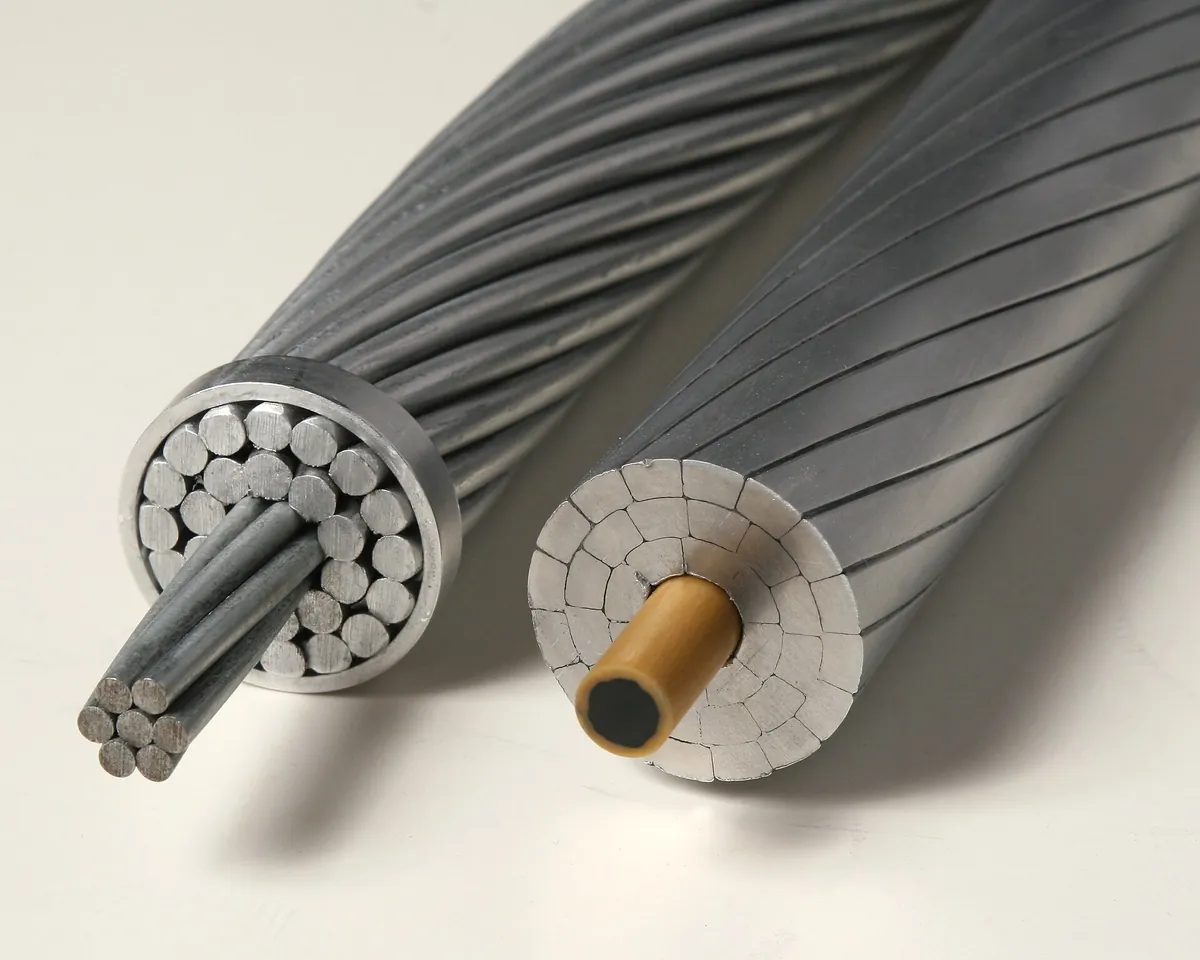
AAAC was developed to combine the corrosion resistance of all-aluminium conductors with strength close to that of steel-reinforced designs. Every strand is the same heat-treatable alloy, so the conductor behaves as one homogeneous material.
The wire is drawn from 6201 (or the closely related 6101-family alloys used in some national standards), solution heat-treated, drawn and artificially aged to the T81 temper. Magnesium and silicon form fine Mg2Si precipitates that roughly double the strength of pure 1350 wire, at the cost of conductivity falling from about 61 % to 52.5 % IACS.
Because all strands share one expansion coefficient and modulus, AAAC has a simple, predictable sag-tension behaviour. Its hard surface resists nicks and scratches during stringing, which helps keep corona loss and radio interference low on higher-voltage lines. And with no steel inside, there is no galvanic cell to attack the conductor from within in coastal, desert-saline or industrial air.
Limits below are the registered values for 6201, used by ASTM B398 for 6201-T81 wire. Close control of iron and of the Mg:Si ratio is what allows the alloy to reach both its strength and conductivity targets.
| Element | Minimum | Maximum | Purpose |
|---|---|---|---|
| Silicon (Si) | 0.50 | 0.90 | Forms Mg2Si with magnesium |
| Magnesium (Mg) | 0.60 | 0.90 | Main strengthening element |
| Iron (Fe) | — | 0.50 | Impurity; limited to protect conductivity |
| Copper (Cu) | — | 0.10 | Kept low for conductivity and corrosion resistance |
| Manganese (Mn) | — | 0.03 | Strongly reduces conductivity, so tightly limited |
| Chromium (Cr) | — | 0.03 | Same reason as manganese |
| Zinc (Zn) | — | 0.10 | Impurity |
| Boron (B) | — | 0.06 | Added to precipitate transition-metal impurities and recover conductivity |
| Others, each / total | — | 0.03 / 0.10 | |
| Aluminium (Al) | Remainder |
International practice recognises two strength classes of Al-Mg-Si conductor wire. The higher-strength class is the 6201-T81 type used in most AAAC; the second trades some strength for slightly better conductivity. Values are specified minimums for single wires before stranding.
| Property | High-strength type (6201-T81, IEC A3) | Higher-conductivity type (IEC A2) |
|---|---|---|
| Tensile strength, d ≤ 3.50 mm | ≥ 325 MPa | ≥ 295 MPa |
| Tensile strength, d > 3.50 mm | ≥ 315 MPa | ≥ 295 MPa |
| Elongation (250 mm gauge) | ≥ 3.0 % | ≥ 3.5 % |
| Conductivity | ≥ 52.5 % IACS | ≥ 53.0 % IACS |
| Resistivity at 20 °C | ≤ 32.84 nΩ·m | ≤ 32.53 nΩ·m |
ASTM B398 sets its own diameter-banded minimums for 6201-T81 (around 305 – 330 MPa). Use the table in the standard named in your specification for design.
AAAC is built from identical round wires laid in concentric layers around a single centre wire, with each layer laid in the opposite direction to the one beneath and the outer layer right-hand unless specified otherwise. Standard constructions follow the 1 + 6 + 12 + 18 + 24 + 30 pattern.
| Construction | Layers | Typical conductor sizes | Typical use |
|---|---|---|---|
| 7 wires (1 + 6) | 1 | about 15 – 120 mm² | LV and MV distribution |
| 19 wires (1 + 6 + 12) | 2 | about 120 – 220 mm² | MV distribution, sub-transmission |
| 37 wires (… + 18) | 3 | about 220 – 500 mm² | Sub-transmission and transmission |
| 61 wires (… + 24) | 4 | about 500 – 1,000 mm² | Transmission and heavy feeders |
| 91 wires (… + 30) | 5 | above about 1,000 mm² | Large transmission conductors |
Lay ratios, mass per kilometre and resistance include a small allowance for stranding: helically laid wires are slightly longer than the conductor, so a 7-wire conductor weighs and resists about 1 – 2 % more than its straight-wire area suggests.
During stringing, AAAC should be pulled under controlled tension through sheaves with a groove diameter large enough for the conductor, since its hard strands can be marked by undersized or worn sheaves. Allow for initial creep in sag-tension calculations: like all aluminium conductors, AAAC elongates slowly under everyday tension during its first years, and lines are commonly over-tensioned or pre-stressed at installation to compensate.
European and Commonwealth utilities often order AAAC by tree code name. The table shows representative sizes with approximate data; current ratings depend on ambient temperature, wind and solar assumptions and are therefore omitted.
| Code | Stranding (no. × mm) | Area (mm²) | Diameter (mm) | Mass (kg/km) | Rated strength (kN) | DC resistance 20 °C (Ω/km) |
|---|---|---|---|---|---|---|
| Almond | 7/2.34 | 30.1 | 7.02 | 82.2 | 8.88 | 1.0926 |
| Fir | 7/2.95 | 47.8 | 8.85 | 130.6 | 14.11 | 0.6875 |
| Hazel | 7/3.30 | 59.9 | 9.90 | 163.4 | 17.66 | 0.5494 |
| Oak | 7/4.65 | 118.9 | 13.95 | 324.5 | 35.07 | 0.2767 |
| Ash | 19/3.48 | 180.7 | 17.40 | 496.1 | 53.31 | 0.1830 |
| Poplar | 37/2.87 | 239.4 | 20.09 | 659.4 | 70.61 | 0.1387 |
| Upas | 37/3.53 | 362.1 | 24.71 | 997.5 | 106.82 | 0.0917 |
| Yew | 37/4.06 | 479.0 | 28.42 | 1,319.6 | 141.31 | 0.0693 |
| Rubus | 61/3.50 | 586.9 | 31.50 | 1,622.0 | 173.13 | 0.0567 |
| Redwood | 61/4.56 | 996.2 | 41.04 | 2,753.2 | 293.88 | 0.0334 |
Approximate values; certified data for your order comes from the governing standard and type tests. ASTM B399 sizes (e.g. Akron, Darien, Elgin, Greeley) and IEC 61089 A2/A3 metric sizes are supplied in the same way.
| Factor | AAAC (6201-T81) | ACSR | AAC (1350-H19) |
|---|---|---|---|
| Strength member | All strands share load | Steel core carries much of the load | All strands, low strength |
| Mass for similar strength | Lower | Higher (steel core) | n/a (much weaker) |
| Conductivity of aluminium part | 52.5 % IACS | 61 % IACS (plus steel core) | 61 % IACS |
| Resistance for same diameter | Slightly higher than ACSR aluminium area alone, but no magnetic core loss | Low; small core magnetisation effect in 3-layer designs | Lowest |
| Corrosion behaviour | Excellent; no galvanic couple | Core can corrode in saline or polluted air | Excellent |
| Surface hardness / damage resistance | High | Moderate | Low |
| Long spans and heavy ice | Good to medium spans | Best | Short spans only |
Claims that AAAC always carries more current than ACSR need care. For the same overall diameter, AAAC and ACSR have similar resistance because AAAC fills the space occupied by the steel core with conducting alloy. Its real advantages are weight, corrosion life and the simplicity of a single material; ACSR's are strength and lower sag on very long spans.
An Al-Mg-Si alloy with higher conductivity than 6201 and lower strength. Common for busbar in T6/T61/T63 tempers and used in some conductor specifications.
The standard AAAC and ACAR-core alloy, with the best strength among conductor wires at 52.5 % IACS.
Al-Fe-based alloys with small copper or other additions, designed for building and distribution cable conductors where creep resistance and termination reliability matter. Not used for overhead AAAC.
For lines that must run at 150 – 230 °C; see our page on heat-resistant aluminium alloy wire.
Concentric layers of identical heat-treated aluminium-magnesium-silicon alloy wires, usually 6201-T81. There is no steel or other core material.
Neither is better in every case. AAAC is lighter, resists corrosion far better and has a harder surface; ACSR is stronger and sags less on very long spans and under heavy ice. Choose on span length, loading, environment and lifetime cost.
About 52.5 % IACS for 6201-T81 wire (resistivity up to 32.84 nΩ·m at 20 °C), or 53 % for the higher-conductivity class. That compares with 61 % for 1350 wire used in AAC and ACSR.
They are standard size names from BS 3242 and EN 50182 tables. Each code fixes the stranding, wire diameter and therefore area, mass, strength and resistance, so ordering by code avoids ambiguity.
Suspension clamps can often be shared if the diameter matches, but compression dead-ends and joints differ because AAAC has no steel core. Use fittings specifically rated for AAAC.
On wooden or steel drums sized for the stringing equipment, with conductor ends sealed, drum lagging for sea freight, drum lists and test certificates.
Send the size, standard and drum lengths. Our team will reply with conductor data, certificates and a delivered quote.






