Conductivity
Measured on every coil or lot, reported as resistivity at 20 °C and % IACS against the temper limit.



Aluminium conductor wire rod, often called EC (electrical conductor) grade rod or redraw rod, is the 9.5 – 25 mm coiled rod that cable makers draw down into wire for overhead lines, power cables, building wire and windings. The workhorse is 1350 at a minimum of about 61 % IACS conductivity; 6101 and 6201 trade some conductivity for much higher strength, and 8xxx alloys add flexibility and creep resistance for building wire. This guide explains the grades, tempers, standards and what to check when buying.
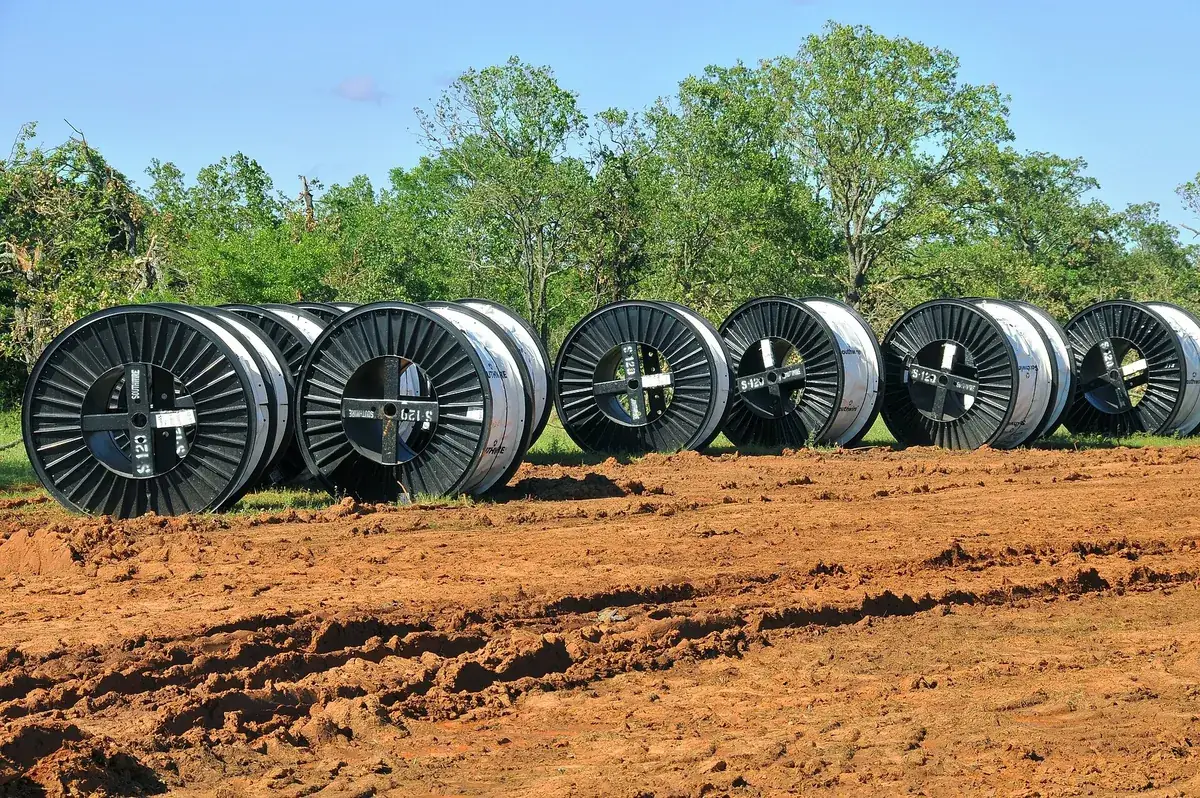
Wire rod is the semi-finished input for wire drawing. Molten aluminium is continuously cast into a bar and immediately hot-rolled in a multi-stand mill into round rod, which is coiled in large, continuous lengths. Cable makers then draw the rod through a series of dies to the final wire diameter, anneal it if required, and strand, insulate or enamel it.
"EC grade" originally meant electrical conductor quality aluminium of at least 99.5 % purity, now designated 1350 (EN AW-1350, EAl99.5). Purity matters because almost every impurity lowers conductivity, and some, such as titanium, vanadium, chromium and manganese, lower it sharply even at very small levels. Producers therefore treat the melt with boron, which ties these elements up as borides that settle out or have less effect on conductivity.
Aluminium replaced copper in overhead lines decades ago and is now used widely in power cables, building wire and windings because of its weight and cost. At 61 % IACS, 1350 needs about 1.6 times the cross-section of annealed copper for the same resistance, yet the aluminium conductor weighs roughly half as much, because copper is about 3.3 times denser.
| Alloy | Type | Typical conductivity | Main uses |
|---|---|---|---|
| 1350 (EAl99.5) | High-purity aluminium | 61.3 – 61.8 % IACS min (by temper) | AAC and ACSR conductor strands, power cable conductors, busbar wire |
| 1370 (EAl99.7) | Higher-purity aluminium | Slightly higher than 1350 | Cables where maximum conductivity is required, fine wire |
| 1050A / 1070A | Commercial-purity aluminium | Lower guaranteed values than 1350 | General electrical and non-critical conductors, earthing |
| 6101 (EAlMgSi) | Heat-treatable Al-Mg-Si | About 55 – 60 % IACS in bus tempers (by temper) | Busbar and conductors needing strength |
| 6201 (EAlMg0.7Si) | Heat-treatable Al-Mg-Si | 52.5 % IACS min as 6201-T81 wire (ASTM B398) | All-aluminium alloy conductors (AAAC) for overhead lines |
| 8017, 8030, 8076, 8176 | Al-Fe(-Cu/Mg) conductor alloys | About 61 % IACS (close to 1350) | Building wire and flexible cable; better creep and connection performance |
In overhead lines, 1350 strands carry current while a steel or alloy core carries the mechanical load (ACSR, ACSS, ACAR). 6201 lets a conductor be made entirely of aluminium alloy (AAAC), with enough strength to span between towers without steel. In buildings, 8xxx alloys (the AA-8000 series covered by ASTM B800 for wire) were developed so that aluminium wire terminates reliably under clamping screws, with lower creep and better elongation than 1350.
Limits below are the Aluminum Association registrations, followed by EN 573-3. Note the combined limit on transition elements in 1350, which is what protects its conductivity.
| Element | 1350 | 6101 | 6201 |
|---|---|---|---|
| Silicon (Si) | ≤ 0.10 | 0.30 – 0.70 | 0.50 – 0.90 |
| Iron (Fe) | ≤ 0.40 | ≤ 0.50 | ≤ 0.50 |
| Copper (Cu) | ≤ 0.05 | ≤ 0.10 | ≤ 0.10 |
| Manganese (Mn) | see Cr+Mn+Ti+V | ≤ 0.03 | ≤ 0.03 |
| Magnesium (Mg) | — | 0.35 – 0.80 | 0.60 – 0.90 |
| Chromium (Cr) | Cr+Mn+Ti+V ≤ 0.02 | ≤ 0.03 | ≤ 0.03 |
| Zinc (Zn) | ≤ 0.05 | ≤ 0.10 | ≤ 0.10 |
| Boron (B) | ≤ 0.05 | ≤ 0.06 | ≤ 0.06 |
| Gallium (Ga) | ≤ 0.03 | — | — |
| Aluminium | ≥ 99.50 | Remainder | Remainder |
Always confirm limits against the edition of the standard named in your purchase order; the mill certificate reports the actual analysis of each cast.
ASTM B233 covers 1350 drawing stock from 9.52 mm to 25.40 mm in diameter. The temper sets the tensile window, which the wire drawer chooses to suit the final wire temper and the number of drawing passes. Values below are the specified limits:
| Temper | Tensile strength | Min. conductivity | Max. resistivity at 20 °C |
|---|---|---|---|
| 1350-O | 59 – 97 MPa (8.5 – 14 ksi) | 61.8 % IACS | 0.027899 Ω·mm²/m |
| 1350-H12 / H22 | 83 – 117 MPa (12 – 17 ksi) | 61.5 % IACS | 0.028035 Ω·mm²/m |
| 1350-H14 / H24 | 103 – 138 MPa (15 – 20 ksi) | 61.4 % IACS | 0.028080 Ω·mm²/m |
| 1350-H16 / H26 | 117 – 152 MPa (17 – 22 ksi) | 61.3 % IACS | 0.028126 Ω·mm²/m |
Source: ASTM B233. Upper tensile limits for H14 and H16 apply up to 12.7 mm diameter; larger sizes are agreed at enquiry. EN 1715-2 and IS 5484 use their own temper tables, so state which standard governs.
Softer rod (O, H12) is chosen for fine and flexible wire because it allows more reduction before annealing; harder rod (H14, H16) is used when the drawn wire must reach hard-drawn H19 strength for overhead strands. 6101 and 6201 rod is normally supplied in T4 or a controlled as-rolled condition and reaches its final strength through drawing and artificial ageing at the cable maker, for example to 6201-T81.
| Nominal diameter | Typical use | Typical diameter tolerance |
|---|---|---|
| 9.5 mm (3/8 in) | The standard redraw size for most cable plants | About ±0.3 – 0.4 mm |
| 12 mm | Larger wire sizes, fewer passes for thick strands | About ±0.4 mm |
| 15 mm | Heavy strands, flat wire and strip conversion | About ±0.5 mm |
| 19 – 25 mm | Busbar wire, earthing rod, special conductors | About ±0.8 – 1.0 mm |
Measured on every coil or lot, reported as resistivity at 20 °C and % IACS against the temper limit.
Tested to confirm the rod sits inside the temper window; too hard causes wire breaks, too soft causes inconsistent drawing.
Spectrometer analysis per cast, with attention to Ti, V, Cr and Mn in 1350 and to Mg/Si balance in 6xxx.
Free of laps, slivers, oxide inclusions, oil and aluminium fines that would score dies or break fine wire.
Shows hidden defects and inclusions by twisting a sample until it fails.
Diameter and ovality checked along the coil so the first die receives uniform rod.
Each delivery should carry an EN 10204 3.1 certificate listing chemistry, tensile strength, elongation and resistivity per coil or lot. For utility tenders, buyers often add third-party inspection and type test references for the finished conductor.
| Property | 1350 aluminium | Annealed copper (ETP) |
|---|---|---|
| Conductivity | About 61 – 62 % IACS | 100 % IACS (reference) |
| Density | 2.70 g/cm³ | 8.89 g/cm³ |
| Cross-section for equal resistance | About 1.6 × | 1 × |
| Mass for equal resistance | About 0.5 × | 1 × |
| Tensile strength, annealed | About 60 – 95 MPa | About 220 – 250 MPa |
| Oxide behaviour | Hard, insulating oxide; needs proper terminations | Conductive oxide, easier terminations |
Aluminium wins on weight and material cost per unit of conductance, which is why it dominates overhead lines and is widely used in medium-voltage and large low-voltage cables. Copper keeps the advantage where space is tight or terminations are frequent. Correctly rated connectors, oxide-inhibiting compound and 8xxx alloys for building wire address the termination concerns that gave early aluminium wiring a poor reputation.
Metline supplies EC grade and alloy conductor rod, drawn wire and busbar to cable and electrical manufacturers worldwide, with full certification and export packing.
EC stands for electrical conductor. It is high-purity aluminium of at least 99.5 %, designated 1350 or EN AW-1350 (EAl99.5), with tight limits on elements such as titanium, vanadium, chromium and manganese that would lower conductivity. Its minimum conductivity is about 61.3 – 61.8 % IACS depending on temper.
9.5 mm (3/8 in) is the standard redraw size used by most cable plants. 12 mm and 15 mm are common for larger wires and strip, and sizes up to about 25 mm are made for special conductors.
1350 is nearly pure aluminium with the highest conductivity but low strength. 6201 is an Al-Mg-Si alloy that, after drawing and ageing to T81, is far stronger while keeping a minimum of 52.5 % IACS. It is used for all-aluminium alloy overhead conductors that span between towers without a steel core.
It depends on the wire you will draw. Softer O or H12 rod allows more reduction for fine or flexible wire; H14 or H16 rod is used when the drawn wire must reach hard-drawn strength for overhead conductor strands. Your wire-drawing practice and final wire specification decide it.
Alloys such as 8176 and 8030 keep conductivity close to 1350 but have better creep resistance and elongation, so connections under screws stay tight over time. They are covered by ASTM B800 and are the alloys permitted for aluminium building wire under North American codes.
Yes. Metline ships coils worldwide in moisture-protected export packing, with EN 10204 3.1 certificates reporting chemistry, tensile and resistivity for each coil or lot.
Tell us the alloy, standard, temper, diameter and monthly volume. We will reply with certification details and delivered terms.





