6201 wire rod
Continuously cast and rolled rod, usually 9.5 mm, delivered in a condition suitable for drawing and subsequent ageing. This is the feedstock for wire mills.



6201 is the heat-treatable aluminium-magnesium-silicon alloy used to make all-aluminium alloy conductor (AAAC) and the strength wires of ACAR. In its T81 temper it is roughly twice as strong as hard-drawn 1350 while keeping a minimum conductivity of 52.5 % IACS, so an overhead line can span further without a steel core. Metline supplies 6201 rod, T81/T83 round wire and finished AAAC worldwide.
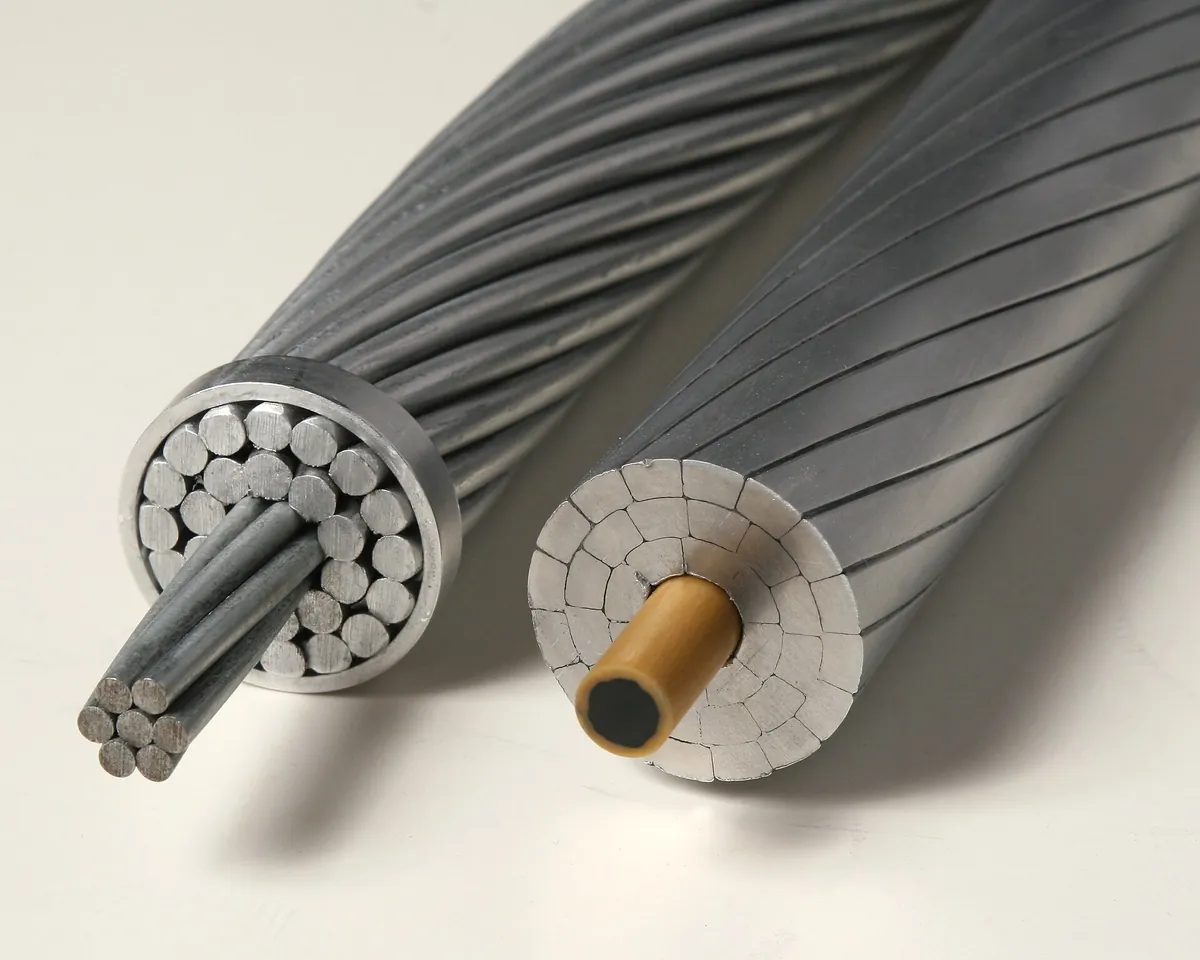
Pure electrical-grade aluminium (1350) conducts well but is too weak to hold long spans on its own, which is why conventional overhead lines wrap it around a galvanised steel core (ACSR). 6201 offers another route. A small addition of magnesium and silicon makes the alloy heat-treatable, so the drawn wire can be aged to high strength while giving up only part of the conductivity of pure aluminium.
A conductor stranded entirely from 6201 wires is called AAAC (all-aluminium alloy conductor); in Europe and many IEC markets the alloy is also known by the trade name Almelec or by the IEC wire type AL3. Because every wire is the same material, AAAC has no steel core to corrode, no galvanic couple between core and outer layers, and no magnetic losses. It is lighter than ACSR of similar diameter and has a harder surface than AAC, so it resists handling damage during stringing.
The trade-off is conductivity. 6201-T81 must reach at least 52.5 % IACS against about 61 % for 1350, so an AAAC conductor has roughly 15 % higher resistance than an AAC of the same cross-section. For many distribution and sub-transmission lines, especially in coastal or polluted areas, the corrosion and weight advantages outweigh that difference.
Continuously cast and rolled rod, usually 9.5 mm, delivered in a condition suitable for drawing and subsequent ageing. This is the feedstock for wire mills.
Drawn wire, aged to temper, typically from about 1.5 to 4.8 mm diameter, on reels for stranding into conductors.
Concentric-lay stranded conductor of 7, 19, 37, 61 or 91 wires, supplied on drums to ASTM B399, IEC 61089 / EN 50182 or national standards.
6201-T81 wires combined with 1350-H19 wires in ACAR conductor to tune strength against conductivity.
6201 strands used as the load-bearing neutral messenger in aerial bundled cables and as the conductor of covered (spacer) overhead lines.
Alloy strands used where an earthing conductor must also carry mechanical load.
| Element | Minimum | Maximum | Role |
|---|---|---|---|
| Silicon (Si) | 0.50 | 0.90 | Forms Mg2Si with magnesium for strength |
| Magnesium (Mg) | 0.60 | 0.90 | Main strengthening element |
| Iron (Fe) | — | 0.50 | Impurity |
| Copper (Cu) | — | 0.10 | Kept low for conductivity and corrosion resistance |
| Manganese (Mn) | — | 0.03 | Kept very low because it reduces conductivity |
| Chromium (Cr) | — | 0.03 | Kept very low for conductivity |
| Zinc (Zn) | — | 0.10 | Impurity |
| Boron (B) | — | 0.06 | Added to remove titanium and vanadium from solution |
| Others, each / total | — | 0.03 / 0.10 | |
| Aluminium | Remainder |
Compared with the structural alloy 6061, 6201 has no deliberate copper or chromium and very tight manganese and chromium limits. Those elements stay in solid solution and scatter electrons, so leaving them out is what keeps conductivity above 52.5 % IACS.
Both tempers follow the same route: the rod is solution heat-treated (or quenched directly from the rolling mill), cold drawn to final size and then artificially aged. Ageing time and temperature, and the amount of cold work, decide where the wire sits on the strength-conductivity curve.
| Item | 6201-T81 | 6201-T83 |
|---|---|---|
| Description in ASTM B398 | Standard hard temper | Hard temper with higher conductivity |
| Minimum conductivity | 52.5 % IACS | Higher than T81 |
| Minimum tensile strength | Highest of the two; roughly 310 – 330 MPa depending on diameter | Lower than T81 |
| Typical use | Most AAAC and ACAR conductors | Lines where lower resistance is worth some loss of strength |
Exact minimum tensile, elongation and resistivity values by diameter are tabulated in ASTM B398/B398M; use the current edition named in your specification.
| Standard | Covers | Notes |
|---|---|---|
| ASTM B398/B398M | 6201-T81 and T83 round wire for electrical purposes | Wire chemistry, tensile, elongation, bend and resistivity |
| ASTM B399/B399M | Concentric-lay-stranded 6201-T81 AAAC | Constructions, lay ratios, rated strength, mass and resistance |
| ASTM B524/B524M | ACAR (1350 plus 6201 wires) | For combined conductors |
| IEC 62641:2022 | Aluminium and alloy wires for overhead conductors | Type AL3 corresponds to 6201-class Al-Mg-Si wire; replaced IEC 60104 |
| IEC 61089 / EN 50182 | Round-wire concentric-lay overhead conductors | Designates AAAC as AL3 conductors |
| National standards | For example IS 398-4 (India), BS EN 50182 (UK) | Widely used in utility tenders |
Utility tenders usually specify the conductor by code name and standard, for example a 19-wire or 37-wire AAAC to ASTM B399 or IS 398-4, and then list rated strength, DC resistance and mass per kilometre. Always confirm the edition, the lay direction of the outer layer, the greasing requirement (if any) and the drum size before quoting.
AAAC is built from wires of equal diameter laid in concentric layers around a single centre wire, each layer laid in the opposite direction to the one beneath it, with the outer layer usually right-hand lay.
| Number of wires | Layer build-up | Typical use |
|---|---|---|
| 7 | 1 + 6 | Small distribution conductors and messengers |
| 19 | 1 + 6 + 12 | Medium distribution and sub-transmission |
| 37 | 1 + 6 + 12 + 18 | Larger distribution and transmission |
| 61 | 1 + 6 + 12 + 18 + 24 | Large transmission conductors |
| 91 | 1 + 6 + 12 + 18 + 24 + 30 | Very large cross-sections |
Because 6201 is weaker than steel, an AAAC conductor of equal diameter has lower rated strength than a high-steel-content ACSR, but its strength-to-weight ratio is similar or better, so sag under everyday conditions is comparable. Its higher coefficient of expansion means more sag at high operating temperatures than ACSR, which matters on lines designed for heavy emergency loading. Engineers run a sag-tension calculation for the actual spans, ice and wind loads before choosing between the two.
| Item | AAC (1350) | AAAC (6201) | ACAR (1350 + 6201) | ACSR (1350 + steel) |
|---|---|---|---|---|
| Wire materials | 1350-H19 | 6201-T81 | 1350-H19 and 6201-T81 | 1350-H19 and galvanised steel |
| Conductivity of aluminium wires | ≈ 61 % IACS | ≥ 52.5 % IACS | Between the two, set by wire ratio | ≈ 61 % IACS (steel adds little) |
| Strength-to-weight | Low | High | Medium to high | High |
| Corrosion in coastal air | Very good | Very good | Very good | Risk at core if zinc is lost |
| Magnetic losses | None | None | None | Small, from the steel core |
| High-temperature sag | High | High | High | Lower once steel carries the load |
| Typical use | Short urban spans | Distribution and sub-transmission, coastal lines | Lines needing a tuned strength/conductivity mix | Long spans and transmission |
For conductivity-driven circuits with short spans, AAC is cheapest. Where a line runs along the coast or through industrial pollution and spans are moderate, 6201 AAAC is often the best whole-life choice. Where spans are long or ice loads are heavy, ACSR remains common; see our ACSR conductor page.
Mainly for AAAC (all-aluminium alloy conductor) overhead lines, as the strength wires in ACAR conductors, and as the load-bearing messenger in aerial bundled cables and covered conductors.
Both are solution heat-treated, cold drawn and artificially aged. T81 is the standard hard temper with the higher strength and a minimum conductivity of 52.5 % IACS; T83 is processed for higher conductivity with somewhat lower minimum strength. ASTM B398 gives the limits for each.
It depends on the line. AAAC is lighter, does not corrode at the core and has no magnetic losses, which suits coastal and polluted areas and moderate spans. ACSR has higher rated strength and less sag at high temperature, which suits long spans and heavy ice loads.
At least 52.5 % IACS for T81, equal to a resistivity of 0.032841 Ω·mm²/m at 20 °C. 1350 aluminium is about 61 % IACS.
IEC 62641 designates Al-Mg-Si alloy wire of this class as type AL3, and IEC 61089 / EN 50182 call conductors stranded from it AL3 conductors. The French trade name Almelec is also widely used.
Yes. Metline supplies 6201 wire rod for wire mills, T81/T83 drawn wire for conductor makers and finished AAAC on drums, with EN 10204 3.1 certificates and export packing.
Send the construction or code name, standard, quantity and destination. We will reply with specification, packing and a delivered quotation.






