Cigarette and confectionery laminates
Foil-paper inner liners and wraps are a classic use for the thinnest gauges, where barrier, appearance and fold matter more than strength.



0.0045 mm (4.5 µm) aluminium foil sits at the thin end of commercial foil. It is rolled in O temper from 1235, 8079 or 8011 alloy and is almost always laminated to paper, PET or PE film, which carries the strength while the foil provides a light, oxygen and moisture barrier, reflection or conductivity. This guide covers alloys, how such thin foil is made, pinholes, weights and real applications.
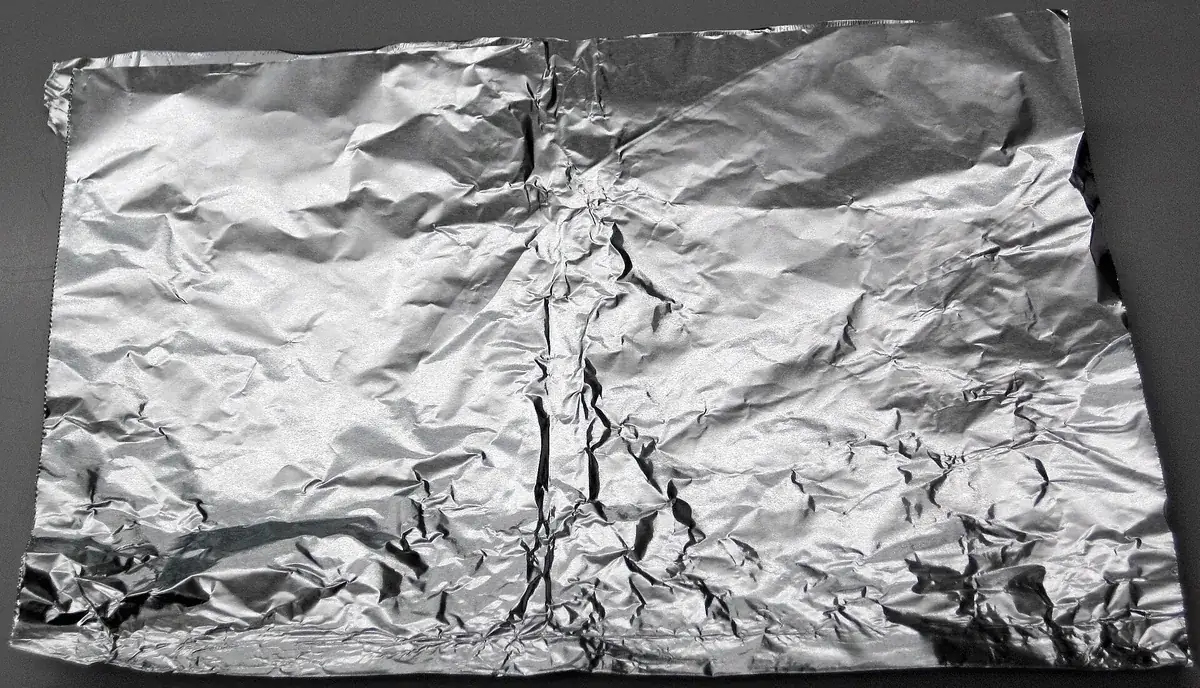
A human hair is roughly 50 – 100 µm across; 4.5 µm foil is ten to twenty times thinner. At this gauge a kilogram of foil covers about 82 square metres, so even a small reduction in gauge saves a large amount of metal in a high-volume laminate.
Foil this thin is sometimes called "double-zero" foil because its thickness in millimetres begins with two zeros after the decimal point (0.00xx mm). It is produced only by pack rolling, where two webs are rolled together in the last pass, and it is supplied fully annealed so that it is soft, dead-folding and free of rolling oil.
On its own, 4.5 µm foil tears easily and contains some pinholes. Its value appears once it is laminated: bonded to paper or a polymer film, it adds a very effective barrier to light, oxygen, moisture and aromas, and it provides metallic reflection and electrical conductivity, with the lowest possible metal content.
| Alloy | Composition basis | Characteristics at very thin gauges | Typical uses |
|---|---|---|---|
| 1235 | Commercially pure aluminium, at least 99.35 % Al | Good conductivity and corrosion resistance; the standard choice for thin converter foil | Cigarette and food laminates, cable and insulation laminates, capacitor foil |
| 8079 | Al with about 0.7 – 1.3 % Fe and a little Si | Iron raises strength and ductility of annealed foil; tends to give fewer pinholes and better dead-fold at the thinnest gauges | Aseptic liquid packaging, pouches, pharmaceutical laminates |
| 8011 | Al with about 0.5 – 1.0 % Fe and 0.5 – 0.9 % Si | Stronger and widely produced, but usually rolled at slightly heavier gauges | Household, container and lidding foil; laminates at 7 µm and above |
| 1145 / 1100 | Pure aluminium variants | Used where a specification calls for them, mainly in North America | Insulation facings, flexible packaging |
Chemical limits follow the Aluminum Association registrations and EN 573-3. For the thinnest gauges, the cleanliness of the cast stock matters as much as the alloy: hard particles and inclusions larger than the foil thickness are the main cause of pinholes and web breaks, so the re-roll stock is selected and filtered carefully.
EN 546-1 covers foil from about 6 µm; for 4.5 µm foil the tolerances and pinhole limits should be written into the purchase specification.
Gauge, weight and coverage are directly linked. The table uses a density of 2.71 g/cm³, typical for 1xxx and 8xxx foil:
| Thickness (µm) | Weight (g/m²) | Coverage (m²/kg) |
|---|---|---|
| 4.5 | 12.2 | 82 |
| 5 | 13.6 | 74 |
| 5.5 | 14.9 | 67 |
| 6 | 16.3 | 62 |
| 6.35 | 17.2 | 58 |
| 7 | 19.0 | 53 |
| 9 | 24.4 | 41 |
| 12 | 32.5 | 31 |
| 20 | 54.2 | 18 |
Pinholes are tiny openings created when a hard particle or a rolling defect is pressed through the web. Foil of about 50 µm and heavier is essentially pinhole-free, but the count rises steeply as gauge falls. At 4.5 – 7 µm some pinholes are normal, and the laminate design accounts for them: the adhesive and the film or paper layer seal them, so the finished laminate still behaves as a barrier.
Foil-paper inner liners and wraps are a classic use for the thinnest gauges, where barrier, appearance and fold matter more than strength.
Paperboard / PE / foil laminates use a thin foil layer, typically around 6 µm, as the oxygen and light barrier.
PET / foil / PE structures for coffee, snacks and pharmaceuticals, usually at 6 – 9 µm; 4.5 – 6 µm where the film layers provide strength.
Foil laminated to PET film is slit into shielding tapes for data and coaxial cables.
Foil-paper and foil-scrim laminates for building insulation and HVAC ducts.
Thin foil electrodes in film-foil capacitors and thin conductive layers in flexible circuits.
Some uses need heavier foil. Blister-pack lidding is normally around 20 – 25 µm hard foil, and lithium-ion cathode current collectors are typically about 10 – 20 µm hard-temper foil, sometimes carbon-coated. Thinner current collectors are an active development area, but a 4.5 µm web is very hard to coat at production speeds, so samples and trials are the right first step. See our ultra-thin mirror sheet guide if you need reflective rather than barrier properties.
Running 4.5 µm foil on a laminator demands low, even web tension, clean idler rolls and good edge guiding; the web will crease or break if tension spikes during splicing or acceleration. Many converters keep the same laminator settings as for 6 or 7 µm foil and then wonder why web breaks increase, so trial runs with tension profiling are worthwhile before a gauge change.
Foil should be stored in its sealed packing in a dry area at stable temperature and conditioned to room temperature before opening, to avoid condensation that causes staining and adhesion problems. Use material first in, first out, because surface wettability can slowly decline in long storage.
Commercial converter foil is rolled down to about 4.5 – 6 µm. Below that, aluminium layers are normally applied by vacuum metallising onto film rather than rolled as foil.
A single web has low strength, so it must be handled with low, even tension. Once laminated to paper or film, the laminate carries the load and the foil provides barrier and appearance.
Some pinholes are normal at this gauge. They are controlled by clean stock and rolling practice, limited in the purchase specification, and sealed by the adhesive and film layers in the laminate.
1235 is the standard pure-aluminium foil alloy. 8079 contains iron, which improves the strength and ductility of annealed foil and usually gives better performance in the thinnest packaging laminates.
About 82 m². Foil weighs roughly 2.71 g per m² for every micron of thickness, so 4.5 µm foil is about 12.2 g/m².
Yes. Sample rolls of 4.5 – 7 µm foil can be arranged for laminating trials, with the alloy, width and core you specify.
Tell us the alloy, gauge, width, core, reel size and application. Our team will propose suitable foil and arrange samples for delivery worldwide.






