ODS aluminium is aluminium strengthened by a fine, uniform dispersion of insoluble oxide particles rather than by precipitates that dissolve or coarsen when heated. The result keeps its strength, grain structure and conductivity at temperatures where conventional heat-treated alloys soften. This guide explains how ODS aluminium is made, how it compares with standard alloys and aluminium matrix composites, where it is used and how to specify it.
Oxide dispersion strengthened (ODS) aluminium is an aluminium or aluminium alloy matrix containing a small volume fraction, typically a few percent, of very fine oxide particles, most often aluminium oxide (Al2O3). The particles are usually tens of nanometres across and evenly spaced throughout the metal.
Those particles block the movement of dislocations, the line defects whose motion is how metals deform. Dislocations must bow around each particle, which raises the stress needed to deform the metal. The particles also pin grain boundaries, keeping the grain size fine through hot working and heat treatment.
The key difference from conventional strengthening is stability. A 2xxx or 7xxx alloy gets its strength from precipitates formed by ageing. Heat the alloy above its ageing temperature for long enough and those precipitates grow, dissolve or transform, and strength falls: most precipitation-hardened aluminium alloys lose a large share of their strength after long exposure above about 150 – 200 °C. Oxide particles are chemically inert in aluminium and insoluble up to the melting point, so an ODS material keeps much of its strength and its fine grain structure at temperatures where conventional alloys over-age.
Background
From SAP to modern nano-ODS aluminium
The first dispersion-strengthened aluminium was SAP (sintered aluminium powder), developed in the 1940s and 1950s. Fine flake aluminium powder carries a natural oxide film on every particle; when the powder is compacted, sintered and extruded, that film breaks up into oxide fragments distributed through the metal. Depending on powder type, SAP contained from a few percent up to well over ten percent oxide. It kept useful strength and creep resistance at temperatures that ruined conventional alloys, and it was studied for elevated-temperature parts and as nuclear fuel cladding.
SAP had two weaknesses. The oxide was relatively coarse and irregularly distributed, which limited ductility, and its properties were destroyed by fusion welding temperatures. From the 1970s, mechanical alloying (high-energy ball milling of powders) produced much finer and more uniform dispersions of oxides and carbides in aluminium and aluminium alloys, giving mechanically alloyed Al-Mg and Al-Cu-Mg materials with better strength-ductility balance.
Today's research and development focuses on nanoscale dispersions made by several routes: finer powders with controlled oxide content, in-situ reactions that create oxide particles inside the melt or powder, ultrasonic dispersion of nanoparticles into liquid aluminium, and near-net-shape processing that reduces machining of these relatively costly materials. Research reports nanocrystalline Al-Mg matrices with oxide dispersions keeping grain sizes below 50 nm up to 500 °C, and mechanically alloyed ODS aluminium with improved yield strength at 240 – 340 °C compared with forged equivalents.
How it is made
Production routes for ODS aluminium
Route
How the oxide is introduced
Strengths
Limitations
Powder metallurgy (SAP-type)
Natural oxide film on fine powder broken up during compaction and extrusion
Simple, proven, high oxide content possible
Coarser dispersion, lower ductility
Mechanical alloying
High-energy milling folds oxide and powder together repeatedly, giving a very fine, uniform dispersion
Finest and most uniform dispersions; alloyed matrices possible
Milling time and contamination control add cost
In-situ reaction
Oxide particles formed by a chemical reaction within the powder or melt
Clean particle-matrix interface, fine particles
Process control is specialised
Melt dispersion (ultrasonic or stirring)
Nanoparticles added to liquid aluminium and dispersed by cavitation or stirring before casting
Uses casting routes; larger billets possible
Particles tend to cluster; volume fraction limited
Spray forming and additive routes
Reactive atomisation or particle-loaded feedstock
Near-net shape, rapid solidification
Emerging; limited standards
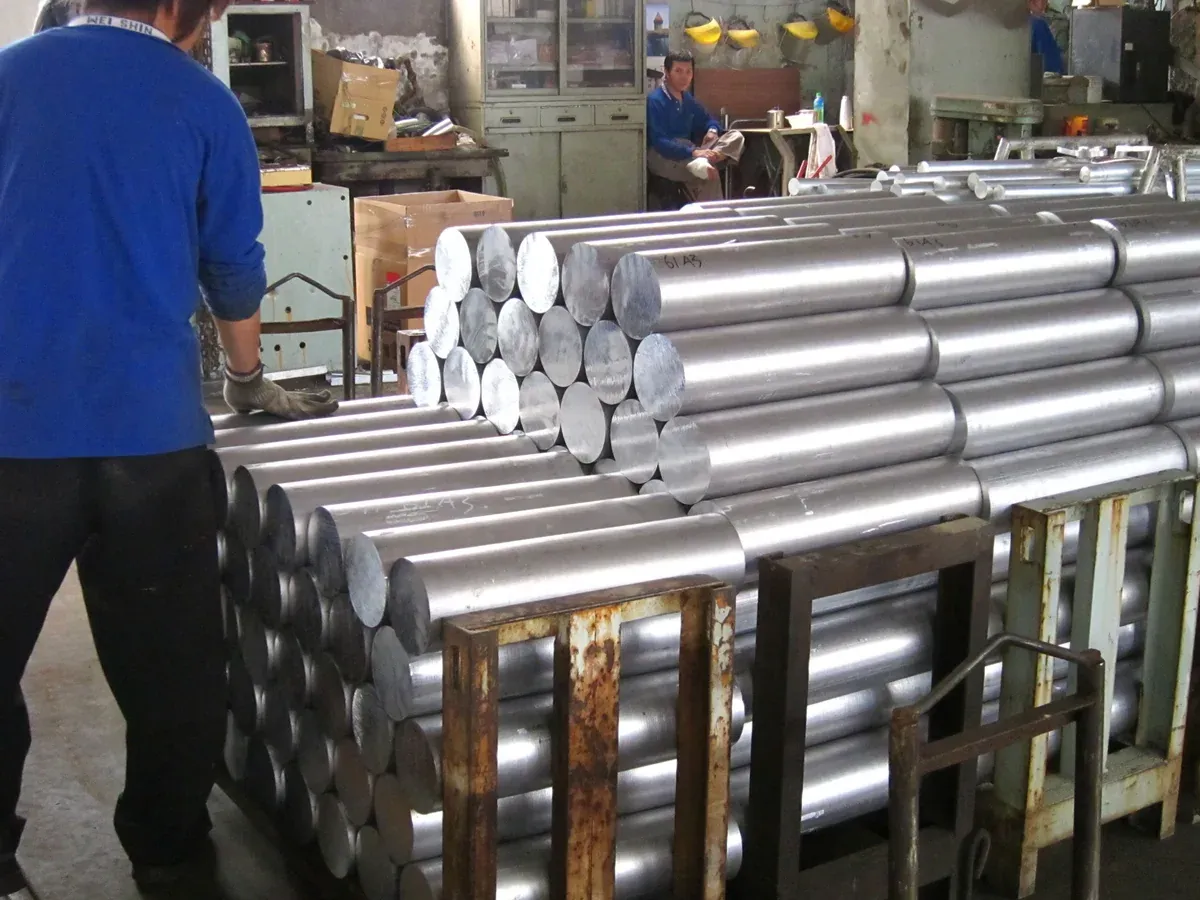
Whatever the route, the consolidated material is usually canned and degassed, hot-pressed or hot-isostatically pressed into a billet, and then extruded, forged or rolled. Hot working is important: it breaks up oxide clusters, closes porosity and aligns the microstructure. Billets can be produced as round billets for extrusion and forging, slabs for rolling, and hollow or elliptical billets for tube and special sections, within the size limits of the consolidation equipment.
Comparison
ODS aluminium vs conventional alloys and aluminium matrix composites
ODS aluminium sits between conventional alloys and particle-reinforced aluminium matrix composites (Al-MMCs). The distinction is mainly particle size and volume fraction, which control how the reinforcement works.
Feature
Precipitation-hardened alloy (2xxx, 7xxx)
ODS aluminium
Particle-reinforced Al-MMC
Reinforcement
Fine precipitates formed by ageing
Nanoscale oxide particles, a few vol %
Ceramic particles (SiC, B4C, Al2O3), typically micrometre-sized, 10 – 30 vol % or more
Main mechanism
Precipitates impede dislocations
Dispersoids impede dislocations and pin grains
Load transfer to stiff particles plus matrix strengthening
Stability at temperature
Over-ages above about 150 – 200 °C
Stable; strength largely retained
Particles stable; matrix may still over-age
Stiffness
About 70 GPa
Close to the matrix (about 70 GPa)
Raised substantially, often 90 – 150 GPa
Thermal expansion
About 23 × 10⁻⁶/K
Close to the matrix
Reduced, often 8 – 17 × 10⁻⁶/K
Ductility
Good
Moderate to good
Lower
Machinability
Very good
Good
Abrasive; diamond tooling needed
Cost
Low to moderate
High
High
Ranges are indicative. Properties of ODS materials and Al-MMCs depend strongly on matrix alloy, particle type and fraction, and processing route; specify by test results, not by family name.
Electrical
ODS aluminium for high-strength, heat-resistant conductors
Pure aluminium conducts well but is weak, and alloying it to gain strength lowers conductivity because solute atoms scatter electrons. A dispersion of oxide particles strengthens the metal while leaving the matrix nearly pure, so conductivity stays close to that of electrical-conductor aluminium. The particles also resist softening at high conductor temperatures, which matters for overhead lines that run hot under high load.
Conductor material
Strengthening
Typical conductivity
Strength level
Heat resistance
1350 (EC) aluminium, hard drawn
Cold work only
About 61 – 62 % IACS
Low
Softens at elevated temperature
6201-T81 alloy wire
Mg2Si precipitates
About 52.5 % IACS (minimum)
High
Limited (over-ages)
Al-Zr heat-resistant alloys
Al3Zr dispersoids
About 58 – 61 % IACS
Similar to 1350
High; rated for higher continuous temperatures
ODS aluminium wire
Oxide dispersoids
About 60 % IACS reported
Higher than 1350
High
Heat-resistant aluminium-zirconium wires are standardised in IEC 62641 for overhead conductors; ODS conductor materials are newer and normally supplied against a project specification, with conductivity tested to ASTM B193 or IEC 60468 and strength measured before and after a heat-ageing exposure that represents the line rating. ODS conductors are of interest as a lighter alternative to copper in some busbar and winding duties, and for overhead lines where higher operating temperature increases capacity.
Thermal management
ODS aluminium tubes for heat exchangers
Air-conditioning and refrigeration coils use thin-walled aluminium tube (commonly 3003 or 1xxx alloys) with internal grooves to boost heat transfer. Two problems limit them: pitting corrosion that perforates thin walls, and low strength that limits how thin the wall can be. Dispersion-strengthened tube addresses both. The fine, stable grain structure and near-pure matrix can raise strength above 3003 in the annealed condition while keeping thermal conductivity higher than that of manganese-alloyed 3003, and several developers report improved resistance to pitting in acidified salt spray testing (SWAAT, ASTM G85 Annex A3).
When evaluating such tube, compare it with zinc-coated or zinc-diffused 3003 tube, the usual corrosion-resistant baseline, under the same SWAAT duration and with the same fin and brazing system, since the fin alloy and flux residues affect corrosion as much as the tube does. See our pages on inner-grooved tube and heat-exchanger tube for the conventional options.
Structural
Dispersion-strengthened 2xxx, 7xxx and Al-Li alloys
Adding a dispersion to an alloyed matrix combines two mechanisms: precipitation hardening for peak strength at room temperature, and dispersoids for grain refinement and stability. The aims differ by family.
ODS 2xxx (Al-Cu-Mg)
Fine, stable grains and dispersoids improve fatigue performance and reduce the difference in properties between rolling and transverse directions. Targeted at fatigue-critical structure and elevated-temperature parts where 2024 or 2618 would otherwise be used.
ODS 7xxx (Al-Zn-Mg-Cu)
Aimed at the highest strength levels. Fine grains can improve formability of thin sheet and bending behaviour; developers report strength levels above those of 7075-T6 in research and pilot material. Thin-gauge sheet for electronics housings and hinge parts is one target market.
ODS aluminium-lithium
Lithium lowers density and raises stiffness: as a rule of thumb, each 1 wt % lithium reduces density by about 3 % and raises elastic modulus by about 6 %. Dispersions help control the grain structure and anisotropy that challenge conventional Al-Li alloys such as 2195 and 2060.
Semi-solid formed parts
Dispersion-strengthened 7xxx alloys are being developed for semi-solid (rheo) forming, which makes complex near-net-shape parts with fewer defects than conventional casting.
Most of these materials are in development or early production, and published figures usually come from specific test programmes. For any design, require tensile, fatigue and corrosion results on the actual product form, thickness and direction you will use.
Composites
Aluminium matrix composites alongside ODS
Where stiffness and low thermal expansion matter more than ductility, particle-reinforced aluminium matrix composites are the usual choice. Common systems include 6061 or 6092 with SiC particles, 2009 with SiC for higher strength, and aluminium with boron carbide (B4C) for neutron-absorbing panels in spent-fuel storage. Al/SiC with high particle loadings is used for electronic packaging and heat spreaders because its expansion can be matched to ceramics and semiconductors.
Material class
Density (g/cm³)
Elastic modulus (GPa)
Thermal expansion (10⁻⁶/K)
Typical uses
Wrought aluminium alloy
2.70 – 2.80
69 – 72
About 23
General structure
Al/SiC particulate (wrought, 15 – 25 vol %)
About 2.8 – 2.9
About 95 – 115
About 15 – 18
Stiff structure, brake discs, bicycle and aerospace parts
Al/SiC high-loading (electronic packaging)
About 2.9 – 3.0
About 150 – 200
About 7 – 10
Heat spreaders, IGBT baseplates
Al/B4C
About 2.6 – 2.7
Above unreinforced
Below unreinforced
Neutron absorber panels, armour
Indicative ranges from published literature; exact values depend on particle fraction, size and matrix alloy.
Light conductor with higher strength than 1350 and good heat resistance
ODS aluminium or Al-Zr heat-resistant wire
Conductivity and strength after heat ageing
Corrosion-resistant thin-wall heat-exchanger tube
Dispersion-strengthened tube or zinc-coated 3003
SWAAT results with your fin and brazing system
Fatigue-critical structure at room or moderate temperature
ODS 2xxx, or conventional 2024 / 2324 / 7050
Fatigue data in the loading direction
Highest strength-to-weight in thin sheet
ODS 7xxx or conventional 7075 / 7055
Bendability and stress-corrosion tests
Low density and high stiffness
Al-Li alloys (2195, 2060, 8090), with or without dispersion
Anisotropy and toughness
Low expansion and high stiffness
Al/SiC or other Al-MMC
Machinability and joining route
Strength at 200 – 300 °C
ODS aluminium, or heat-resistant alloys such as 2618
Creep and tensile tests at temperature
Processing
Machining, joining and testing ODS aluminium
Machining
ODS aluminium machines much like conventional alloys with sharp carbide tools; the fine grain gives a good finish. Particle-reinforced composites are abrasive and need PCD or diamond-coated tools.
Joining
Fusion welding melts the matrix and lets oxide particles cluster, so it is generally avoided. Friction-stir welding, mechanical fastening and adhesive bonding are preferred; brazing must be qualified for each material.
Forming
Hot working is usually done by extrusion, forging or rolling of the consolidated billet. Cold formability depends on oxide content; higher oxide fractions reduce ductility.
Testing
Room-temperature tensile tests (ASTM E8 / ISO 6892-1), elevated-temperature tensile (ASTM E21), creep (ASTM E139), conductivity (ASTM B193) and corrosion tests matched to the application.
Supply
How Metline supports ODS and advanced aluminium projects
Metline supplies the full range of aluminium alloys from 1xxx to 8xxx and sources advanced aluminium materials, including dispersion-strengthened aluminium, aluminium matrix composites and aluminium-lithium alloys, on enquiry. Forms can include billets for your own extrusion or forging, and finished extrusions, tube, wire, plate and forgings, depending on the material system.
Describe the applicationWhat the part does, operating temperature, loads, environment and the property that limits the current material.
State the form and sizeBillet, wire, tube, sheet, plate, extrusion or forging, with dimensions and quantity for trial and production.
Agree target properties and testsStrength, conductivity, fatigue or corrosion targets, and the test standards that will prove them.
Trial materialDevelopment materials normally start with a trial lot and test report before production orders.
Documents and shippingTest certificates (EN 10204 3.1), traceability and export packing; shipped worldwide.
ODS stands for oxide dispersion strengthened. The aluminium contains a small fraction of very fine, insoluble oxide particles, usually alumina, that block dislocation movement and pin grain boundaries.
What is the advantage of ODS aluminium over 6061 or 7075?
Stability at temperature. Heat-treated alloys such as 6061 and 7075 lose strength when held above about 150 – 200 °C because their precipitates coarsen. Oxide particles do not, so ODS aluminium keeps more of its strength and fine grain structure when hot.
Is ODS aluminium the same as an aluminium matrix composite?
They are related but different. ODS materials use nanoscale oxides at a few percent by volume, mainly to strengthen. Aluminium matrix composites use larger ceramic particles at 10 – 30 % or more, mainly to raise stiffness and lower thermal expansion.
Can ODS aluminium be welded?
Fusion welding is generally avoided because melting lets the oxide particles cluster and removes the strengthening. Friction-stir welding, mechanical fastening and adhesive bonding are preferred.
Can ODS aluminium replace copper conductors?
In some uses. ODS aluminium keeps conductivity close to that of electrical-grade aluminium, about 60 % IACS, with higher strength and heat resistance. It still conducts less than copper, so a larger cross-section is needed, but the conductor is much lighter.
What forms is ODS aluminium available in?
Billets for extrusion or forging, and products such as wire, tube, extrusions, sheet and plate, depending on the material system and size. Development materials usually start with a trial lot.
How do I order ODS or advanced aluminium from Metline?
Send the application, product form, dimensions, quantity and target properties to sales@metline.in. We will review suitable material routes and test documentation.
Evaluating ODS or advanced aluminium?
Share your application, product form and target properties. We will review material options, trial quantities and test plans with you.