Low TiB2, 7 % Si matrix
Best ductility and toughness with a clear strength gain. A good first step for teams moving from AlSi10Mg, and for parts that see impact or assembly loads.



Ceramic aluminium-based composite powders are gas-atomised Al-Si-Mg alloy powders, typically AlSi7Mg or AlSi10Mg, containing fine titanium diboride (TiB2) or similar ceramic particles. In laser powder bed fusion (LPBF) and directed energy deposition (DED), the particles refine the grain, improve laser absorption and raise strength, stiffness and dimensional stability above standard AlSi10Mg. This guide explains the powder chemistry, particle size, quality limits, typical printed properties, process tips and safe handling.
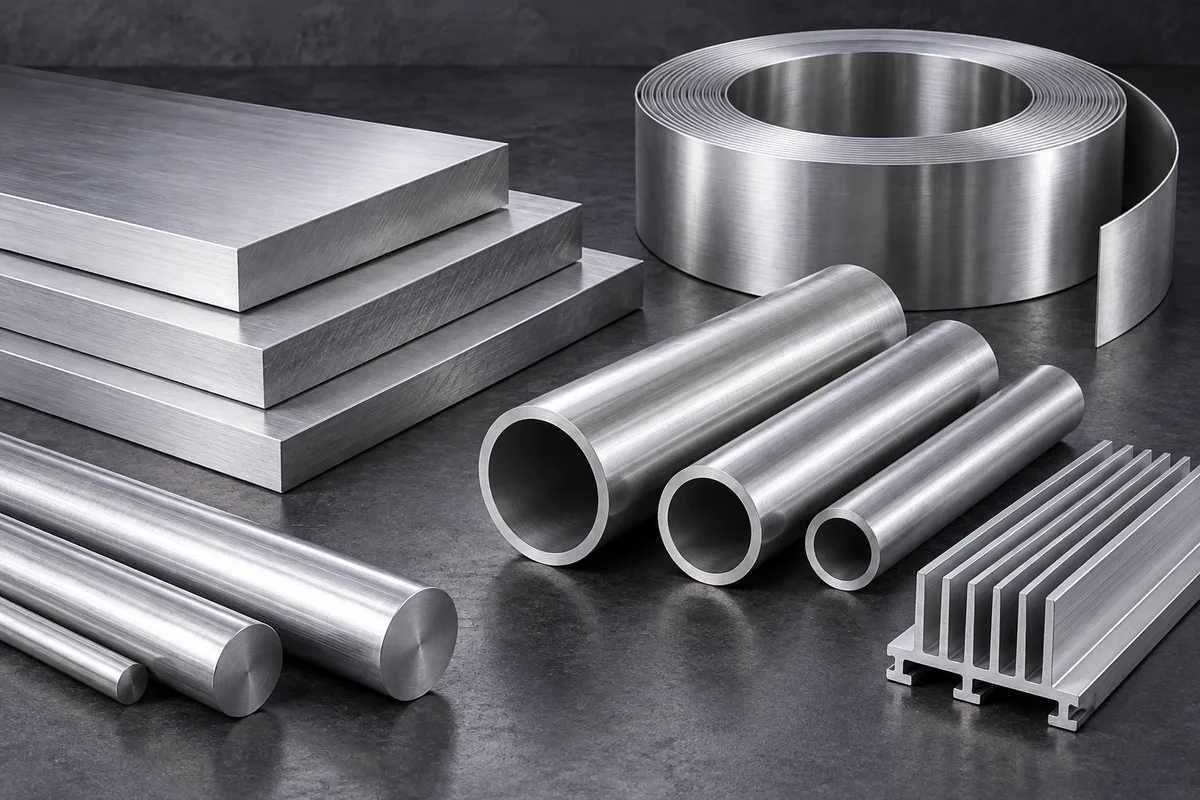
AlSi10Mg is the workhorse aluminium alloy for laser powder bed fusion. It prints reliably because its near-eutectic silicon content resists solidification cracking, but its strength and stiffness are modest and it is sensitive to process settings. High-strength wrought alloys such as 6061 or 7075 crack badly when printed. Ceramic-reinforced powders aim to close that gap.
Fine TiB2 particles, usually well under a micron, act in three ways during printing. They provide nucleation sites that turn the columnar grains typical of laser melting into fine, equiaxed grains, which reduces anisotropy and cracking. They increase absorption of the laser beam, because aluminium itself reflects much of the infrared energy, so the melt pool becomes more stable and the process window wider. And once solidified, they strengthen and stiffen the metal by dispersion strengthening and load transfer.
The result, according to a growing body of published research, is printed material with tensile strength roughly 100 – 200 MPa higher than conventional AlSi10Mg, a modest increase in stiffness and, in well-optimised grades, useful ductility. Higher ceramic fractions push stiffness and strength further at the expense of elongation.
Two matrix families dominate. A 7 % silicon matrix with relatively high magnesium (close to AlSi7Mg0.6 / A357) gives the best combination of strength and ductility after heat treatment. A 10 % silicon matrix (close to AlSi10Mg) prints very easily and offers lower thermal expansion and better thin-wall capability. Each is offered with a range of TiB2 contents.
| Element (wt %) | AlSi7Mg-type matrix | AlSi10Mg-type matrix |
|---|---|---|
| TiB2 (reinforcement) | About 1, 2, 6 or 10 (± 0.5) | About 1, 2, 6 or 10 (± 0.5) |
| Silicon (Si) | 6.5 – 7.5 | 9.0 – 11.0 |
| Magnesium (Mg) | 0.9 – 1.5 | 0.30 – 0.55 |
| Iron (Fe) | ≤ 0.40 | ≤ 0.55 |
| Copper (Cu) | ≤ 0.10 | ≤ 0.10 |
| Manganese (Mn) | ≤ 0.20 | ≤ 0.45 |
| Zinc (Zn) | ≤ 0.20 | ≤ 0.10 |
| Nickel (Ni) | ≤ 0.08 | ≤ 0.05 |
| Aluminium | Balance | Balance |
Representative composition windows for commercial TiB2/Al-Si composite powders. The AlSi10Mg-type matrix follows the limits used for standard AlSi10Mg (for example in ASTM F3318). Confirm the exact chemistry on the powder certificate.
Most TiB2-reinforced powders are pre-alloyed: the TiB2 is formed in the melt by reaction and the composite melt is then gas-atomised, so every powder particle contains reinforcement. This gives better uniformity than mechanically blending ceramic powder with aluminium powder, which can segregate during spreading.
| Size range | Process | Typical D10 / D50 / D90 (µm) |
|---|---|---|
| 15 – 45 µm | LPBF / SLM, fine-feature parts | About 20 / 33 / 50 |
| 15 – 53 µm | General LPBF, range of machine types | About 23 / 35 / 58 |
| 45 – 106 µm | Laser DED, powder-fed cladding and repair | About 45 / 70 / 100 |
ISO/ASTM 52907 sets out methods to characterise metal powders for additive manufacturing.
Ask for a powder certificate per lot showing chemistry including TiB2 content, particle size distribution, O/N/H, flow and density, and SEM images of morphology. Consistency between lots matters more than any single value, because printing parameters are tuned to a powder.
Properties of printed parts depend on the machine, parameters, build orientation, wall thickness and post-processing as much as on the powder. The table gives indicative ranges from published research and supplier data for LPBF test bars, alongside standard AlSi10Mg for reference.
| Material (LPBF) | Tensile strength | Yield strength | Elongation | Elastic modulus |
|---|---|---|---|---|
| AlSi10Mg, as built | About 350 – 460 MPa | About 230 – 280 MPa | About 3 – 8 % | About 70 GPa |
| AlSi10Mg, stress relieved | About 280 – 350 MPa | About 180 – 230 MPa | About 6 – 12 % | About 70 GPa |
| TiB2/Al-Si, low TiB2 (1 – 2 %) | About 400 – 500 MPa | About 260 – 360 MPa | About 8 – 12 % | About 70 – 74 GPa |
| TiB2/Al-Si, high TiB2 (6 – 10 %) | About 470 – 550 MPa | About 320 – 440 MPa | About 3 – 7 % | About 75 – 82 GPa |
Indicative ranges only, compiled from published LPBF studies on TiB2-reinforced Al-Si alloys and AlSi10Mg data. Not design allowables; qualify each machine, parameter set and heat treatment with your own test coupons.
Heat treatment typically raises yield strength of the reinforced grades by a few tens of megapascals while elongation falls slightly, and the modulus is unchanged. Higher TiB2 content gives higher stiffness and strength, with lower elongation; the 10 % silicon matrix gives slightly higher stiffness and lower expansion than the 7 % matrix at the same TiB2 level.
Best ductility and toughness with a clear strength gain. A good first step for teams moving from AlSi10Mg, and for parts that see impact or assembly loads.
Easy printing of thin walls and complex lattices, with better strength than plain AlSi10Mg.
High strength and stiffness for structural brackets, hinges and housings; elongation still useful after heat treatment.
Highest stiffness and lowest expansion, for precision and semiconductor equipment parts where dimensional stability dominates.
Fine aluminium powder is combustible and, as a dust cloud, can explode. Composite powders carry the same hazard. Handle them under the guidance of the safety data sheet and recognised standards such as NFPA 484 (combustible metals) and local ATEX or equivalent regulations.
Hinge arms, brackets, ducts and topology-optimised structural fittings that need forging-like strength in a printed part.
Stiff, dimensionally stable frames and bonding-machine parts where high modulus and low expansion reduce vibration and drift.
Mirror mounts, instrument housings and lattices that must hold alignment through thermal cycles.
Lightweight suspension, powertrain and cooling components produced in low volumes.
DED cladding and repair of worn aluminium parts with a harder, wear-resistant deposit.
Thin-walled lattice structures that benefit from the fine microstructure and higher strength.
Send your requirements to Metline with the machine model and part targets. We will advise on matrix, reinforcement level and powder size and confirm what can be supplied, with documentation and dangerous-goods compliant packing for shipment.
A gas-atomised Al-Si-Mg alloy powder in which fine titanium diboride particles are distributed inside each powder particle. When printed, the TiB2 refines the grain and strengthens and stiffens the metal.
Published LPBF results typically show tensile strength roughly 100 – 200 MPa higher than standard AlSi10Mg, reaching about 450 – 550 MPa depending on TiB2 content, process and heat treatment.
15 – 45 µm or 15 – 53 µm for laser powder bed fusion, and 45 – 106 µm for directed energy deposition and cladding. Your machine maker's recommendation is a good starting point.
They are a starting point only. The composite absorbs laser energy better, so energy density usually needs adjusting. Validate density and properties with test coupons before production.
Yes, after sieving, within limits. Track oxygen, hydrogen and particle size over reuse cycles and blend with fresh powder as your quality plan requires.
Fine aluminium powder is combustible and is shipped as dangerous goods in sealed, inert-filled containers. Store it dry and follow the safety data sheet and NFPA 484 or local rules.
Send your machine, part and property targets. Metline will advise on composite powder options and documentation.





