Stir casting
Ceramic powder is stirred into molten alloy and cast as billet, ingot or shaped castings. The lowest-cost route and the one used for most brake and wear parts. Particle wetting, porosity and clustering must be controlled.



A ceramic aluminium matrix composite is an aluminium alloy that carries a dispersed ceramic phase, usually silicon carbide, alumina or titanium diboride particles, to raise stiffness, wear resistance and dimensional stability while keeping aluminium-level density. This guide explains how the main composite families differ, what properties to expect, how they are made and machined, and how to write a specification that a supplier can quote against.
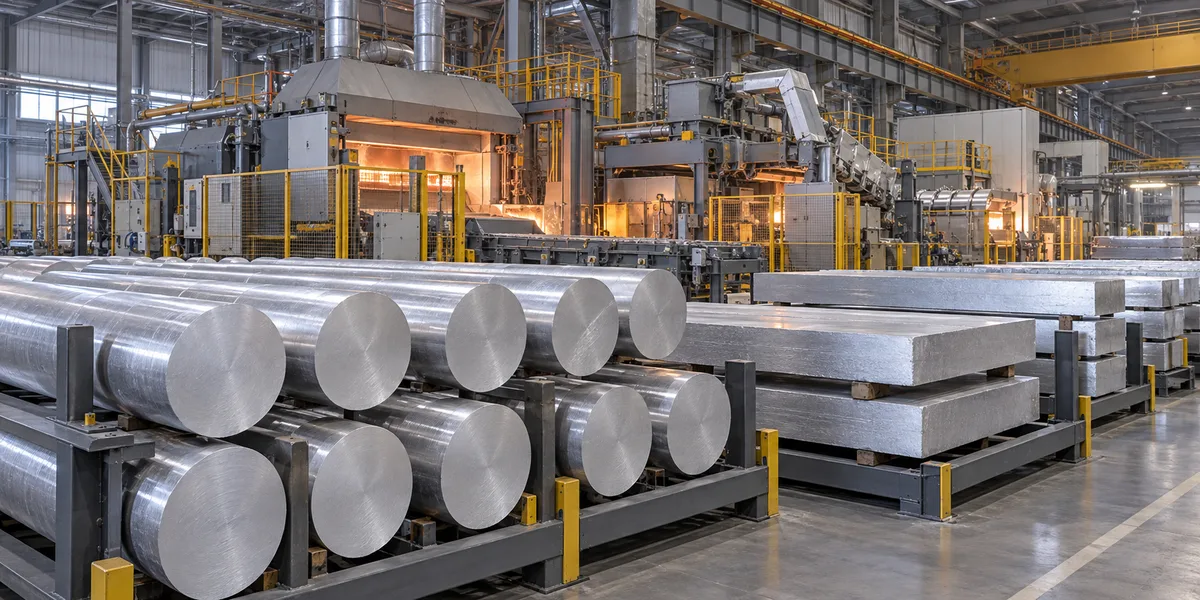
Conventional aluminium alloys are strengthened by alloying and heat treatment, but their elastic modulus barely moves: almost every wrought grade sits between 68 and 73 GPa. Adding a hard, stiff ceramic phase is the only practical way to make aluminium substantially stiffer, which is why aluminium matrix composites (AMCs or Al-MMCs) exist.
In an Al-MMC the aluminium alloy is the continuous phase (the matrix) and the ceramic is the discontinuous phase (the reinforcement). Load is transferred from the ductile matrix to the stiff particles across the interface, so the composite carries more load for the same strain. The ceramic also has a much lower coefficient of thermal expansion (CTE) than aluminium, so the composite grows less with temperature, and it resists abrasion far better than the unreinforced alloy.
The family is broad. At the low end, a few volume per cent of very fine in-situ particles gives a material that machines, welds and extrudes much like a normal alloy but is noticeably stiffer and keeps its strength better at temperature. At the high end, 55 – 70 vol % silicon carbide infiltrated with aluminium (often called AlSiC) behaves more like a metal-bonded ceramic and is used for electronic packaging where its CTE has to match silicon or gallium arsenide devices.
The reinforcement chemistry, particle size and how the particles are introduced decide almost everything about the composite: its stiffness, ductility, machinability and price. The four systems below cover most commercial material.
| Reinforcement | How it is added | Typical loading | Strengths | Watch-outs |
|---|---|---|---|---|
| Silicon carbide (SiC) particles | Ex-situ: stirred into melt, powder metallurgy or pressure infiltration | 10 – 30 vol % structural; 55 – 70 vol % packaging | Largest modulus gain per volume, low CTE, high thermal conductivity, very wear resistant | Highly abrasive to tools; can react with molten Al to form Al4C3 if over-heated |
| Alumina (Al2O3) particles | Ex-situ stir casting, mainly in 6061 and 2014 matrices | 10 – 20 vol % | Chemically stable in the melt, good wear resistance, extrudable | Smaller stiffness gain than SiC for the same loading |
| Titanium diboride (TiB2) | In-situ: formed inside the melt by salt reaction | 2 – 10 vol % | Fine, clean particle interfaces; keeps ductility and machinability closer to the base alloy | Moderate modulus gain; agglomeration must be controlled |
| Boron carbide (B4C) | Ex-situ casting or powder metallurgy | 10 – 30 vol % | Very light, absorbs neutrons; used in spent-fuel storage baskets | Specialist application; limited suppliers |
Ex-situ composites are made by adding pre-made ceramic powder to the aluminium. In-situ composites grow the ceramic inside the melt by a chemical reaction, which produces smaller particles with cleaner, better-bonded interfaces. As a rule of thumb, ex-situ SiC gives the biggest jump in stiffness and wear resistance, while in-situ TiB2 gives the best balance of stiffness gain and retained ductility.
Composite properties depend on matrix alloy, temper, reinforcement type, particle size, volume fraction and processing route, so published values vary widely. The table shows the direction and approximate size of the change relative to the unreinforced alloy, drawn from published literature on SiC- and TiB2-reinforced grades. Treat it as a screening guide; design values must come from the supplier datasheet and test certificate for the specific material.
| Property | Unreinforced wrought alloy | ~20 vol % SiC particle composite | ~5 vol % in-situ TiB2 composite | 55 – 70 vol % SiC (AlSiC) |
|---|---|---|---|---|
| Density | 2.70 – 2.81 g/cm³ | About 2.8 – 2.9 g/cm³ | About 2.75 – 2.85 g/cm³ | About 2.9 – 3.0 g/cm³ |
| Elastic modulus | 68 – 73 GPa | Roughly 95 – 110 GPa | Roughly 10 – 15 % above base | Roughly 170 – 220 GPa |
| CTE (20 – 100 °C) | 22 – 24 µm/m·K | Roughly 16 – 18 µm/m·K | Slightly below base | Roughly 7 – 10 µm/m·K |
| Tensile strength | Set by alloy and temper | Same or higher than matrix | Same or higher than matrix | Not a structural metric for this class |
| Elongation | 8 – 15 % typical (T6) | Usually 2 – 6 % | Often 6 – 12 % | Below 1 % |
| Wear resistance | Poor | Excellent | Improved | Excellent |
| Thermal conductivity | 120 – 200 W/m·K | Similar to matrix | Similar to matrix | About 120 – 200 W/m·K |
Indicative ranges compiled from published studies and supplier literature; they are not specified minimums. Request a datasheet and EN 10204 3.1 certificate for the exact grade before design.
The key design number is specific stiffness (modulus divided by density). Steel, titanium and plain aluminium all have almost the same specific stiffness, around 25 – 26 GPa·cm³/g. A 20 % SiC composite reaches roughly 35 – 38, which means a beam of the same weight deflects about 30 % less. That is the real reason AMCs replace steel in rotating, reciprocating and precision parts.
The trade-off is ductility and fracture toughness. Ceramic particles act as crack initiators, so elongation falls as loading rises, and fatigue performance depends heavily on particle size and cleanliness. Fine particles (a few micrometres or less) and uniform distribution are the most important quality features to ask about.
Ceramic powder is stirred into molten alloy and cast as billet, ingot or shaped castings. The lowest-cost route and the one used for most brake and wear parts. Particle wetting, porosity and clustering must be controlled.
Salts such as K2TiF6 and KBF4 react in the melt to precipitate TiB2. Produces fine particles with clean interfaces; the melt can then be cast as billet for extrusion and forging or poured into shaped castings.
Alloy powder and ceramic powder are blended, compacted, degassed and consolidated by hot pressing, HIP or extrusion. Gives the most uniform distribution and best properties; used for aerospace bar and plate.
Molten aluminium is forced into a porous ceramic preform. Used for very high loadings (AlSiC baseplates, lids and heat spreaders) and for locally reinforced pistons and liners.
Shaped composite castings with low porosity, often heat-treated to T6. Suits housings, brackets and wheel or brake components.
Pre-alloyed powders containing fine ceramic particles for laser powder-bed fusion. The particles also refine grain structure, which helps prevent hot cracking in high-strength alloys.
Downstream, billet made by casting or powder metallurgy can be rolled into plate, extruded into bar and profiles, or forged into rings and discs, then heat-treated like the matrix alloy (T4, T6, T651, T851 and so on). The usual product forms are therefore the same as for conventional aluminium: plate, extruded bar and sections, forgings, castings and powder.
Composite producers usually group their materials by matrix and route, because that decides where the material can be used. Metline has separate guides for each group:
| Group | Typical matrix | Forms | Typical uses |
|---|---|---|---|
| High-strength wrought | 2xxx (2024, 2124, 2009) and 7xxx (7075, 7055) | Plate, extruded bar and profiles, forgings | Aerospace fittings, satellite and optical structures, high-speed machine parts |
| Medium-strength wrought | 6xxx (6061, 6082, 6092) | Extrusions, bar, plate | Bicycle and sporting frames, robot arms, automotive driveshafts |
| Cast | A356, A359, 4xxx foundry alloys | Sand, gravity, low-pressure and squeeze castings | Brake rotors and drums, pistons, pump housings, electronic housings |
| High-temperature | 2xxx and Al-Si-Cu-Ni matrices with thermally stable particles | Forgings, castings, extrusions | Engine and compressor parts that see 200 – 350 °C |
| Powder | Al-Si-Mg, Al-Cu, Al-Zn-Mg pre-alloyed powder | Gas-atomised powder | Additive manufacturing, powder forging |
See the dedicated pages on high-strength wrought Al-MMCs, cast Al-MMCs, high-temperature Al-MMCs and Al-MMC powder for each group in more detail.
SiC and B4C particles are harder than tungsten carbide, so uncoated carbide wears quickly. Polycrystalline diamond (PCD) tools are standard for production turning and milling of particle composites; diamond-coated carbide suits drilling and small cutters.
Run PCD at moderate to high speed with generous feed and flood coolant. Avoid rubbing and light finishing passes that dwell; they polish the tool edge and pull particles out of the surface.
Low-loading TiB2 composites machine much closer to the base alloy. Carbide tools work, with shorter tool life than on plain 6061 or 7075.
Fusion welding is difficult: molten SiC composites can form brittle aluminium carbide and particles segregate. Friction stir welding, brazing, adhesive bonding and mechanical fastening are the preferred joining methods.
Ductility is lower than the base alloy, so bend radii must be larger and most shaping is done by extrusion, forging or machining rather than sheet forming.
Anodising works but the coating is less uniform around particles; hard anodising and electroless nickel are common. Plasma electrolytic oxidation is used on wear surfaces.
Because tooling and cycle-time costs are higher than for conventional alloys, it pays to order composite parts close to net shape: near-net castings, forged blanks or extrusions sized with minimal machining allowance. Cast composite brake rotors, for example, are usually only finish-machined on the friction faces and mounting features.
Two composites with the same nominal description can perform very differently, because the properties are controlled by microstructure rather than by chemistry alone. Buyers should therefore ask for evidence of the microstructure, not just a chemical analysis of the matrix.
In design, use generous fillet radii and avoid sharp notches, since the lower ductility makes composites more notch-sensitive than the parent alloy. Keep thin walls away from highly stressed areas, allow for anisotropy in extruded or rolled product (particles tend to align with the working direction), and test joints and fastener holes early, because bearing and pull-out behaviour can differ from handbook values for plain aluminium.
| Property | 7075-T651 | 20 % SiC Al-MMC | Ti-6Al-4V | Carbon steel (C45) |
|---|---|---|---|---|
| Density (g/cm³) | 2.81 | ~2.8 – 2.9 | 4.43 | 7.85 |
| Elastic modulus (GPa) | 71.7 | ~95 – 110 | 114 | ~205 |
| Specific stiffness (GPa·cm³/g) | ~25 | ~35 – 38 | ~26 | ~26 |
| CTE (µm/m·K) | 23.4 | ~16 – 18 | 8.6 | ~11.5 |
| Machinability | Excellent | Difficult (PCD tooling) | Difficult | Good |
| Weldability | Poor | Poor (FSW preferred) | Good (inert) | Good |
| Relative material cost | Low | High | Very high | Very low |
Alloy values are typical published data; composite values are indicative ranges for illustration.
If a part fails on strength, a stronger alloy such as 7075-T651 or 2124-T851 is usually the cheaper answer. If it fails on stiffness, thermal distortion or wear, a composite is worth evaluating. A useful test: if doubling the section thickness of the aluminium part would solve the problem but is ruled out by weight or space, an Al-MMC is a strong candidate.
There is no single international standard covering all Al-MMC grades, so specifications are normally written around the matrix alloy plus the reinforcement description. ANSI H35.5 from the Aluminum Association sets a nomenclature: matrix alloy / reinforcement / volume fraction and form, for example 6092/SiC/17.5p-T6, where "p" means particulate.
An alloy changes the metal by dissolving or precipitating other metallic elements; its modulus stays near 70 GPa. A composite adds a separate ceramic phase such as SiC or TiB2 particles, which raises modulus, lowers thermal expansion and improves wear resistance in a way alloying cannot.
At around 20 vol % SiC particles, published values are typically in the region of 95 – 110 GPa, roughly 40 – 50 % above the unreinforced alloy. Low-loading in-situ TiB2 composites give smaller gains, around 10 – 15 %.
Conventional MIG and TIG welding of SiC composites is not recommended because molten aluminium reacts with SiC and the particles segregate. Friction stir welding, brazing, adhesive bonding and fasteners are the usual joining methods.
Polycrystalline diamond (PCD) tools for turning and milling, and diamond-coated carbide for drilling. Low-loading in-situ composites can be machined with carbide, with reduced tool life compared with plain aluminium.
Yes, when the matrix is heat-treatable. Composites with 2xxx, 6xxx and 7xxx matrices are solution-treated and aged to tempers such as T4, T6, T651 or T851, much like the base alloy. Ageing response can be slightly faster because of the particles.
There is no single all-grade material standard. The Aluminum Association’s ANSI H35.5 gives the naming system, and specifications are usually written around the matrix alloy, reinforcement content, product form and agreed test requirements.
Tell us the part, the property you need to improve and the quantity. Our technical team will help you choose between a composite and a conventional high-strength alloy.





