Sand casting
Suits large or low-volume parts and prototypes. Slower cooling gives a coarser structure; particle settling must be controlled by keeping the melt stirred until pouring.



Cast aluminium matrix composites are casting alloys such as A356 or A359 that contain fine ceramic particles, usually silicon carbide (SiC), alumina or titanium diboride (TiB2) grown in the melt. The particles raise stiffness, strength, wear resistance and dimensional stability, while the part is still made by sand, permanent-mould, low-pressure, squeeze or die casting. This guide explains the material families, casting routes, typical properties against A356, design and machining rules and where cast Al-MMCs pay off.
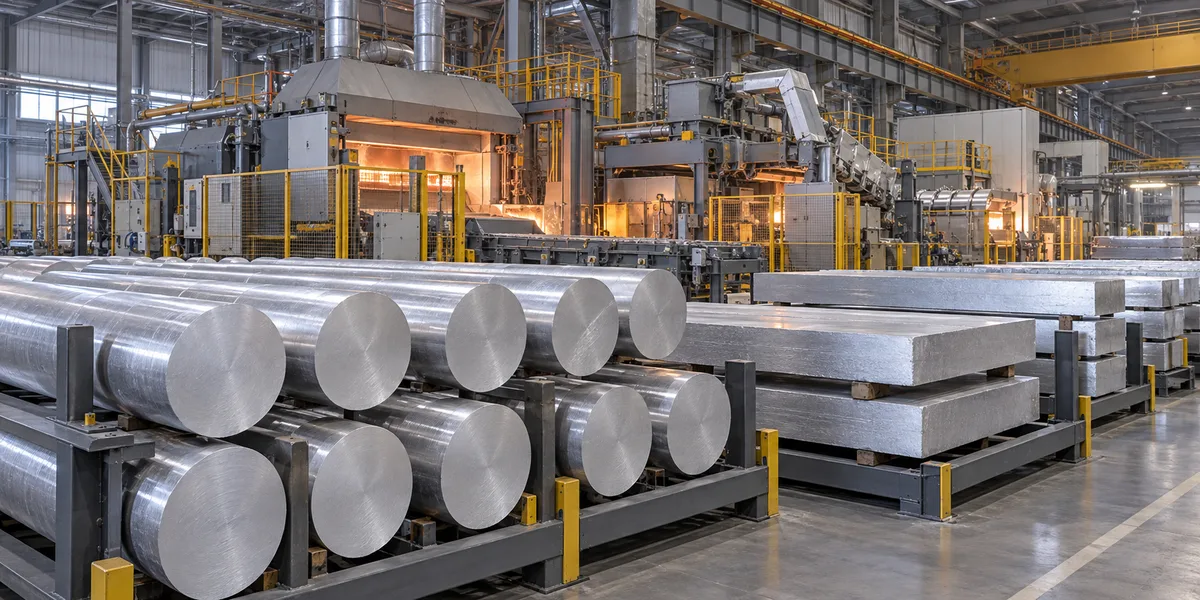
A metal matrix composite combines a metal with a second, non-metallic phase. In aluminium matrix composites (Al-MMCs) the matrix is an aluminium alloy and the reinforcement is a ceramic: particles, short fibres or whiskers of silicon carbide, aluminium oxide, boron carbide or titanium diboride. Cast Al-MMCs are the subset produced by melting and casting, rather than by powder metallurgy or infiltration of a ceramic preform.
The appeal is simple. Ordinary aluminium casting alloys have an elastic modulus of about 70 GPa, the same as wrought aluminium. Adding 10 – 20 % by volume of SiC particles lifts the modulus to roughly 85 – 100 GPa, raises yield strength, halves wear rates in many sliding applications and lowers thermal expansion, while density rises only slightly. Because the composite is still cast, designers keep the freedom of complex, near-net shapes.
Two broad production families exist. Ex-situ composites are made by stirring pre-made ceramic particles, typically SiC of around 10 – 20 µm, into the molten alloy. In-situ composites grow the ceramic inside the melt by chemical reaction, most commonly TiB2 particles from salts containing titanium and boron. In-situ particles are much finer, often 50 – 300 nm, clean and well bonded to the matrix, which tends to preserve ductility better.
| System | Typical reinforcement | Production | Key strengths | Watch-outs |
|---|---|---|---|---|
| Al-Si-Mg + SiC (e.g. A356/A359 + SiC) | 10 – 30 vol % SiC, ~10 – 20 µm | Stir casting into gravity, sand, low-pressure or investment castings | High modulus, wear resistance, low CTE | Low elongation; abrasive to tools; melt handling rules |
| High-Si Al + SiC | 10 – 20 vol % SiC | Die casting variants | Wear and thermal parts, brake rotors, pistons | Die wear, porosity control |
| Al + Al2O3 | 10 – 20 vol % alumina particles | Stir casting | Wear resistance, lower cost than SiC in some cases | Lower stiffness gain than SiC |
| In-situ Al + TiB2 | Several vol % TiB2, ~50 – 300 nm | Reaction in the melt; then normal casting | Strength and stiffness with better ductility; fine grain | Gains depend strongly on process; less public data |
| Squeeze-cast or infiltrated preforms | High-volume SiC or fibre preform | Pressure infiltration | Very high stiffness, tailored CTE (AlSiC for electronics) | Expensive; limited shapes |
Our separate pages cover the whole Al-MMC family, wrought high-strength grades, high-temperature grades and Al-MMC powders for additive manufacturing.
The figures below are representative published values for permanent-mould castings in T6 temper. They show the trade-off clearly: stiffness and strength rise with SiC content, while elongation falls. In-situ TiB2 composites sit between these, usually with a smaller stiffness gain but better ductility. Use them for screening only; design values must come from the supplier's data for the actual grade and casting process.
| Property (T6, permanent mould) | A356 unreinforced | A359 + 10 % SiC | A359 + 20 % SiC |
|---|---|---|---|
| Density (g/cm³) | 2.68 | About 2.71 | About 2.77 |
| Elastic modulus (GPa) | About 72 | About 86 | About 99 |
| Tensile strength (MPa) | About 260 – 280 | About 330 – 340 | About 310 – 360 |
| Yield strength (MPa) | About 190 – 210 | About 300 | About 300 – 340 |
| Elongation (%) | About 5 – 6 | About 1 | About 0.4 – 0.6 |
| Thermal expansion (µm/m·°C) | About 21 | About 20 | About 17 – 18 |
| Wear resistance | Baseline | Much better | Much better |
Values compiled from published data on SiC-reinforced A356/A359 castings and ASM data for A356-T6. Results vary widely with particle size, casting route, porosity and heat treatment.
Two practical points follow. First, the biggest single gain is stiffness, roughly 20 – 40 % above unreinforced aluminium; if a design is stiffness-limited, this is where MMCs shine. Second, the very low elongation of high-SiC grades means they are poor choices for parts that must absorb impact or tolerate misalignment; in-situ or low-fraction grades with higher ductility are preferred there.
Suits large or low-volume parts and prototypes. Slower cooling gives a coarser structure; particle settling must be controlled by keeping the melt stirred until pouring.
Good surface and properties for medium volumes; the reference process for much published MMC data.
Calm, bottom-up filling reduces oxide entrapment and porosity; widely used for wheels, chassis and structural MMC parts, followed by T6.
High pressure during solidification closes porosity, giving the best ductility and fatigue strength; used for safety-critical and high-stress parts.
Fast and economical for thin-walled parts; some composite grades are designed to be used without heat treatment.
Fine detail and tight tolerances for small, complex precision parts such as optical and instrument housings.
A useful way to justify an MMC is to compare the cost of a forged and machined part, or a steel or titanium part, against a near-net composite casting with minimal machining. The material costs more per kilogram than A356, but less material and fewer operations can reduce the total part cost.
Ceramic particles are harder than tungsten carbide grains, so SiC-reinforced composites wear conventional tools very quickly. Plan machining from the start, keep stock allowances small and finish as much as possible in the casting.
| Operation | Recommended tooling | Notes |
|---|---|---|
| Turning and milling | Polycrystalline diamond (PCD) inserts | PCD lasts far longer than carbide on SiC composites; use moderate speeds and steady feeds |
| Drilling | PCD-tipped or diamond-coated drills | Avoid dwelling; peck drilling in deep holes |
| Tapping | Thread milling preferred; form taps are unsuitable | Consider helical inserts for repeated assembly |
| Grinding | Diamond wheels | Silicon carbide or alumina wheels wear rapidly |
| Non-traditional | Wire EDM, waterjet, laser | Useful for complex profiles and difficult features |
In-situ TiB2 composites with sub-micron particles are much kinder to tools than coarse SiC grades, and many can be machined with carbide tooling, though tool life is still shorter than for unreinforced alloys.
Steering knuckles, control arms, subframes and wheel hubs replacing forgings or cast iron; brake discs and drums where wear resistance matters.
Pistons, cylinder liners, connecting rods and drive shafts, using wear resistance and stiffness.
Brackets, housings, optical benches and mechanisms where stiffness, low weight and thermal stability are needed, sometimes replacing titanium.
Brake discs, gearbox housings and bogie parts that need wear resistance and reduced unsprung mass.
Precision frames, stages and wire-bonding or welding machine parts that must stay dimensionally stable; AlSiC for heat-spreader bases.
Robot arms, machine-tool slides and high-speed rotating parts where lower deflection improves accuracy and speed.
| Option | Stiffness | Strength | Ductility | Shape freedom | Relative cost |
|---|---|---|---|---|---|
| A356-T6 casting | Baseline (~72 GPa) | Moderate | Good | High | Low |
| Cast Al-MMC (SiC) | High (85 – 100 GPa) | Higher | Low | High | Medium |
| Cast Al-MMC (in-situ TiB2) | Moderately higher | Higher | Moderate to good | High | Medium |
| 6061 / 6082 forging | Baseline (~69 GPa) | Higher | Good | Limited | Medium |
| 7075 forging or plate | Baseline (~72 GPa) | Very high | Moderate | Limited (machined) | High |
| Titanium alloy | About 110 GPa | Very high | Good | Limited | Very high |
Where impact toughness or ductility is critical and stiffness is not, a conventional aluminium forging is usually the safer choice.
An aluminium casting alloy containing fine ceramic particles such as SiC, Al2O3 or TiB2. The particles raise stiffness, strength and wear resistance while the part is still produced by conventional casting.
With about 20 % SiC by volume the modulus rises from about 72 GPa to roughly 99 GPa, an increase of around 35 – 40 %. A 10 % SiC grade reaches about 86 GPa.
Sometimes. In-situ and squeeze-cast composite grades can reach forging-like strength with adequate ductility, which allows near-net casting of parts such as steering knuckles. Each case must be validated by testing, especially fatigue and impact.
Ex-situ composites have pre-made ceramic particles, usually micron-sized SiC, stirred into the melt. In-situ composites grow fine ceramic particles such as TiB2 inside the melt by reaction, giving cleaner interfaces and usually better ductility.
SiC-reinforced grades are very abrasive and need PCD or diamond tooling. Fine in-situ TiB2 grades are easier and can often be cut with carbide tools. Keeping machining allowances small saves cost.
Some grades can be welded with qualified procedures, but mechanical joining is simpler. Composite scrap must be kept separate from ordinary aluminium scrap so the ceramic does not contaminate standard alloys.
Send the part drawing, current material and performance targets. Metline will advise on composite options, casting route and testing.





