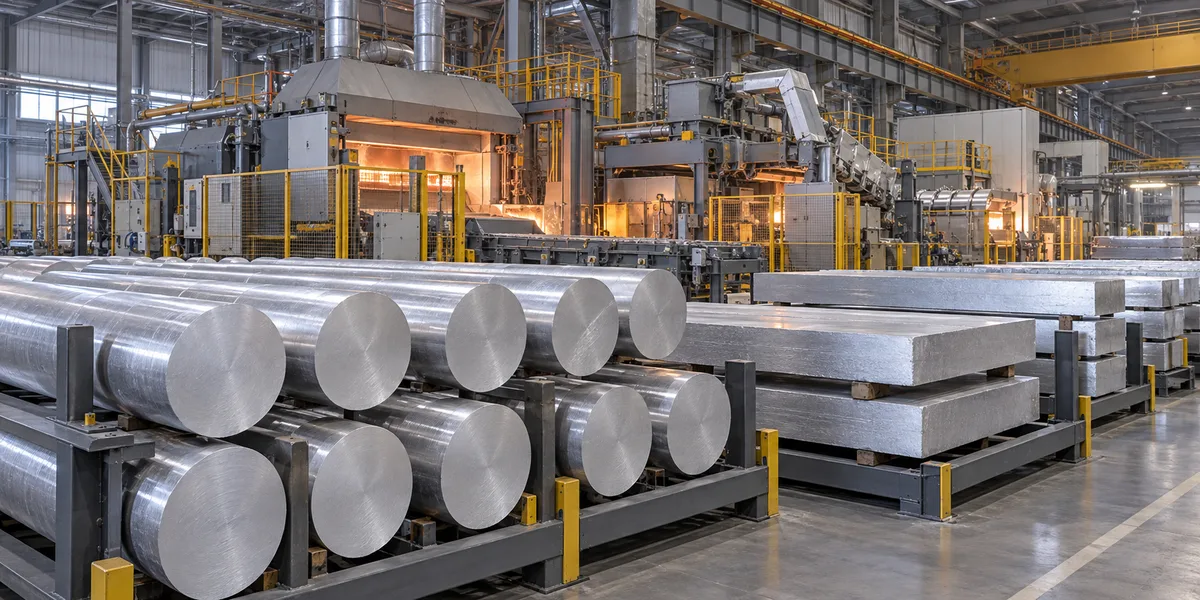
Ordinary aluminium alloys lose most of their strength between 200 and 350 °C because the fine precipitates that harden them coarsen or dissolve. High-temperature aluminium matrix composites add thermally stable ceramic particles that do not coarsen, so the material keeps more of its strength, stiffness and wear resistance in pistons, cylinder liners, brake rotors and other hot parts. This guide explains how they work, how they compare with heat-resistant alloys such as 2618 and 4032, and how to specify them.
Why conventional aluminium alloys fail at high temperature
Most high-strength aluminium alloys get their strength from nanometre-scale precipitates formed during ageing: Mg2Si in 6xxx alloys, MgZn2 in 7xxx alloys and Al-Cu or Al-Cu-Mg phases in 2xxx alloys. These precipitates are only stable close to the temperature at which they were formed. Hold the metal hotter for long enough and they grow, lose coherence with the matrix and stop blocking dislocations, a process called over-ageing.
The result is a steep loss of strength that is not recovered when the part cools down. A 6061-T6 or 7075-T6 component that sees 200 °C for a few hundred hours will be noticeably weaker at room temperature afterwards, and at 300 °C most precipitation-hardened alloys retain only a small fraction of their room-temperature yield strength. Creep (slow deformation under constant load) becomes a design limit as well, because aluminium melts at about 660 °C, so 300 °C is already roughly 60 % of its absolute melting temperature.
Engine and brake engineers meet this limit directly. Piston crowns and ring grooves in modern diesel and turbocharged petrol engines run at roughly 250 – 350 °C; brake rotors see short surface spikes far above that. Traditional answers are heavy: steel pistons, cast-iron liners, cast-iron discs. Ceramic-reinforced aluminium is the route that keeps aluminium-level density while pushing the useful temperature band upwards.
Mechanism
How ceramic particles keep aluminium strong when hot
A ceramic particle such as silicon carbide (SiC), alumina (Al2O3) or titanium diboride (TiB2) does not dissolve in aluminium and does not coarsen at engine temperatures. Once it is in the matrix it stays the same size and in the same place for the life of the part. That stability is the whole point: the particles go on doing their job long after the age-hardening precipitates around them have over-aged.
Mechanism
What happens
Effect at temperature
Load transfer
The stiff particles carry part of the applied stress through the particle–matrix interface
Raises modulus and strength; the gain is largely independent of temperature
Dislocation pinning (Orowan)
Fine particles block moving dislocations; strongest with sub-micrometre particles
Retained because the particles do not coarsen
Grain-boundary stabilisation
Particles at grain boundaries resist sliding and grain growth
Improves creep resistance and thermal-fatigue life
Thermal-expansion restraint
The ceramic expands far less than aluminium and restrains the matrix
Lower CTE, smaller thermal stresses and tighter running clearances
Wear-resistant phase
Hard particles stand slightly proud of the worn surface and carry the contact load
Ring grooves, liners and friction faces wear far more slowly
Two families exist. Coarser ex-situ particles (typically several micrometres to tens of micrometres, at 10 – 30 vol %) give the biggest gains in stiffness, wear resistance and CTE reduction. Fine or nano-scale particles formed in situ or dispersed at a few volume per cent give smaller stiffness gains but a much better balance of hot strength, creep resistance and retained ductility. Many high-temperature piston and engine materials combine both ideas with a matrix that is itself heat-resistant, such as an Al-Si-Cu-Ni-Mg piston alloy or a 2xxx alloy.
Before choosing a composite, check whether a standard heat-resistant alloy already meets the requirement; they are cheaper, easier to machine and covered by mature specifications. The temperature bands below are typical working ranges from published alloy literature, not guaranteed limits; the real limit depends on stress, time at temperature and the acceptable loss of strength.
Alloy
System
Main forms
Typical working range
Typical uses
2618 / 2618A
Al-Cu-Mg-Fe-Ni
Forgings, bar, plate
About 200 – 250 °C
Forged pistons, compressor wheels, aero-engine and turbocharger parts
2219
Al-Cu-Mn
Plate, forgings, extrusions
About 150 – 200 °C (also cryogenic)
Welded tanks, hot structures, aerospace fittings
2014 / 2024
Al-Cu-Mg
Forgings, plate, bar
About 125 – 150 °C
Medium-temperature load-bearing parts
4032
Al-Si-Cu-Mg-Ni
Forgings, bar
About 150 – 200 °C
Forged pistons, compressor parts; low expansion, good wear
Cast Al-Si-Cu-Ni-Mg piston alloys
Hypo- and eutectic Al-Si
Gravity and squeeze castings
Up to the low 300s °C at the crown
Cast pistons for diesel and petrol engines
8009 (Al-Fe-V-Si)
Rapidly solidified, dispersion strengthened
Powder-metallurgy extrusions, forgings
About 250 – 300 °C
Specialist aerospace and missile parts
Working ranges are indicative and drawn from Aluminum Association and ASM literature. Design values must come from elevated-temperature test data for the exact alloy, temper and exposure time.
Composites become worthwhile when the part needs more than these alloys can give: higher stiffness at temperature, lower CTE to control clearances, much better wear resistance, or longer life under thermal cycling. They are also chosen to replace steel or cast iron where an alloy alone would not be stiff or wear-resistant enough.
Material options
High-temperature composite systems and what each is good for
SiC particles in Al-Si casting alloys
Usually 10 – 20 vol % in an A356/A359-type matrix. The established material for lightweight brake rotors and drums: high wear resistance, low CTE and high thermal conductivity. Hot strength is limited by the casting matrix.
SiC or Al2O3 in 2xxx wrought matrices
Powder-metallurgy or stir-cast billet, extruded or forged. Combines a heat-resistant Al-Cu matrix with stable particles for compressor, aero-engine and high-speed rotating parts.
In-situ TiB2 composites
Fine TiB2 particles formed inside the melt at a few volume per cent. Keeps castability, machinability and more ductility than coarse-particle grades; used for cast engine parts and as a matrix for further reinforcement.
Nano-ceramic reinforced piston alloys
Sub-micrometre ceramic particles dispersed in piston alloys to raise hot strength, creep resistance and thermal-fatigue life at the crown and ring grooves without changing the casting process much.
Locally reinforced parts
A porous ceramic-fibre or particle preform placed in the mould and infiltrated by squeeze casting, so only the ring groove, bowl rim or liner bore is a composite and the rest of the part stays conventional.
Alumina-fibre and short-fibre composites
Short Al2O3 or aluminosilicate fibres in the hottest zone; one of the earliest production uses of MMCs in diesel piston bowls.
Property values for composites depend on matrix, reinforcement type, particle size, volume fraction, processing route and heat treatment, so any single number can mislead. The table shows the direction and approximate size of the change relative to the unreinforced matrix, based on published literature. Use it to shortlist; then design from the supplier datasheet and elevated-temperature test results for the actual material.
Property
Unreinforced heat-resistant alloy
Fine / nano-particle composite (few vol %)
Coarse SiC composite (15 – 25 vol %)
Room-temperature tensile strength
Set by alloy and temper
Similar or modestly higher
Similar or higher
Strength retained at 250 – 350 °C
Falls steeply with time at temperature
Noticeably higher than base alloy
Higher than base alloy; limited by matrix
Elastic modulus
About 70 – 80 GPa
About 10 – 15 % higher
Roughly 95 – 110 GPa
Coefficient of thermal expansion
About 19 – 23 µm/m·K
Slightly lower
Roughly 15 – 18 µm/m·K
Creep resistance
Moderate to poor above 200 °C
Improved
Improved
Wear resistance
Moderate (Si-rich alloys better)
Improved
Excellent
Elongation
Typically 1 – 10 % depending on alloy
Close to base alloy
Reduced, often 1 – 4 %
Damping
Low
Higher
Higher
Machinability
Good
Slightly harder on tools
Requires diamond (PCD) tooling
Indicative trends compiled from published studies and producer literature; they are not specified minimums.
The practical message: a composite will not turn aluminium into a 500 °C material, but it can move the safe operating band of a part by several tens of degrees, extend thermal-fatigue life and cut wear substantially. That is often enough to keep an aluminium piston, liner or housing in an engine whose power density has outgrown the plain alloy.
Applications
Where high-temperature Al-MMCs are used
Component
Service condition
Why a composite helps
Common route
Diesel and petrol pistons
Crown 250 – 350 °C, high firing pressure, cycling
Hot strength and thermal-fatigue life at the bowl rim; wear resistance at the top ring groove; lower expansion for tighter clearances
Gravity or squeeze casting, sometimes with local preform
Cylinder liners and bores
Sliding wear, 150 – 250 °C
Wear-resistant bore without a cast-iron sleeve, better heat transfer and matching expansion with the block
Cast-in or infiltrated preforms, composite liners
Brake rotors and drums
Repeated heating and cooling, surface spikes
Large unsprung-mass saving against cast iron, high conductivity spreads heat; design must keep friction-face temperature inside the matrix limit
SiC/Al-Si stir casting
Connecting rods and gudgeon-pin bosses
Fatigue at 120 – 200 °C
Higher specific stiffness and fatigue strength reduce mass in reciprocating parts
Forged composite billet
Compressor wheels and turbo housings
Rotating, 150 – 250 °C
Stiffness and creep resistance at speed
Forging or casting with 2xxx matrix
Electronics and power modules
Thermal cycling
CTE close to ceramics, good conductivity
Infiltrated high-loading SiC
Aerospace, rail and defence programmes use the same materials in hot structural brackets, missile fins and actuator housings, where they replace titanium in moderate-temperature zones. Each of these applications needs qualification testing on the actual part: material coupons alone do not capture the thermal gradients and residual stresses of a cast or forged component.
Design & processing
Design, machining and joining considerations
Design to hot data
Use tensile, creep and fatigue data measured at the operating temperature after representative exposure time, not room-temperature values with a margin.
Mind thermal mismatch
Composite CTE still differs from steel ring carriers, bolts and liners. Check clearances and bolt preload across the full temperature range.
Respect lower ductility
Avoid sharp corners and thin sections in coarse-particle grades; use generous radii and shot peening where fatigue matters.
Machining
SiC and Al2O3 particles are harder than tungsten carbide. Use PCD tools, rigid setups, flood coolant and steady feeds; avoid rubbing finish passes.
Joining
Fusion welding is difficult for SiC grades (particle segregation, aluminium carbide). Prefer mechanical fastening, friction stir welding, brazing or vacuum brazing where the matrix allows.
Coatings
Hard anodising, electroless nickel and plasma electrolytic oxidation are used on wear faces; coating adhesion should be checked on the composite itself.
Order composite parts as close to net shape as possible. Near-net castings and forged blanks cut PCD tool cost and cycle time, and they keep the most favourable particle distribution at the surface, where the part actually works.
Specification
How to specify a high-temperature aluminium composite
Define the thermal dutyPeak and steady temperatures, time at each, number and rate of thermal cycles, and the cooling medium.
Define the mechanical dutyStatic and cyclic loads, contact and sliding conditions, allowable distortion and clearance.
Set the target propertiesMinimum hot strength, creep limit, fatigue strength at temperature, CTE window and density limit.
Choose the route and formCasting, forging, extrusion or local reinforcement; blank size, machining allowance and heat-treatment condition.
Agree testingElevated-temperature tensile tests (ASTM E21), creep (ASTM E139), fatigue, CTE (ASTM E228 or E831), microstructure and particle distribution, and non-destructive testing of the part.
Agree documentationMaterial certificate to EN 10204 3.1 with chemistry, heat-treatment and test results, plus first-article inspection.
Metline supplies the conventional heat-resistant grades, including 2618, 2219, 2014 and 4032, as bar, plate and forgings with mill certificates, and handles enquiries for ceramic-reinforced aluminium in billet, forged blank and cast forms against your specification. Send the duty data above and we will review which route is realistic for your quantity and part size.
What is a high-temperature aluminium matrix composite?
It is an aluminium alloy containing a dispersed ceramic phase, such as SiC, Al2O3 or TiB2 particles, chosen and processed so the material keeps more strength, stiffness and wear resistance at roughly 150 – 350 °C than the unreinforced alloy.
How hot can aluminium composites run?
Most structural use sits between about 150 and 350 °C. The ceramic particles are stable far higher, but the aluminium matrix softens and creeps as it approaches about half its melting temperature, so continuous service above roughly 350 °C is outside what these materials are designed for.
Are composites better than 2618 or 4032 for pistons?
Not always. Forged 2618 and 4032 and cast piston alloys are proven and cheaper. Composites, or locally reinforced alloys, are chosen when firing pressure, crown temperature or ring-groove wear exceeds what those alloys can handle within the required life.
Can a ceramic aluminium composite replace a cast-iron brake disc?
SiC-reinforced aluminium rotors and drums are in production and save a large amount of unsprung mass. The braking system must be designed so the friction-face temperature stays within the composite limit, and friction materials must be matched to the composite surface.
How do you machine SiC-reinforced aluminium?
Use polycrystalline diamond tools, rigid setups, flood coolant and steady feeds. Uncoated carbide wears very quickly. Ordering near-net castings or forgings keeps machining to a minimum.
What tests should be on the certificate?
Chemistry of the matrix, reinforcement content, heat-treatment condition, room- and elevated-temperature tensile results (ASTM E21), and where relevant creep, CTE and microstructure reports, issued on an EN 10204 3.1 certificate.
Pushing aluminium beyond 200 °C?
Tell us the temperature, load, life and part form. We will recommend heat-resistant alloys or composite routes and quote the material.