Ingot and round billet
Remelt stock for alloy making, foil rolling and target production; round ingots in diameters from a few centimetres up to several hundred millimetres.



High-purity aluminium is metal refined to 99.99 % aluminium (4N) or better, with iron, silicon, copper and other impurities held to a few parts per million. It is chosen where impurities would spoil electrical, optical or semiconductor performance: capacitor foil, sputtering targets, bonding wire, reflectors and cryogenic conductors. This guide covers the grades, how purity is made and measured, and how to specify it; Metline supplies high-purity aluminium in ingot, plate, sheet, foil, disc and wire form worldwide.
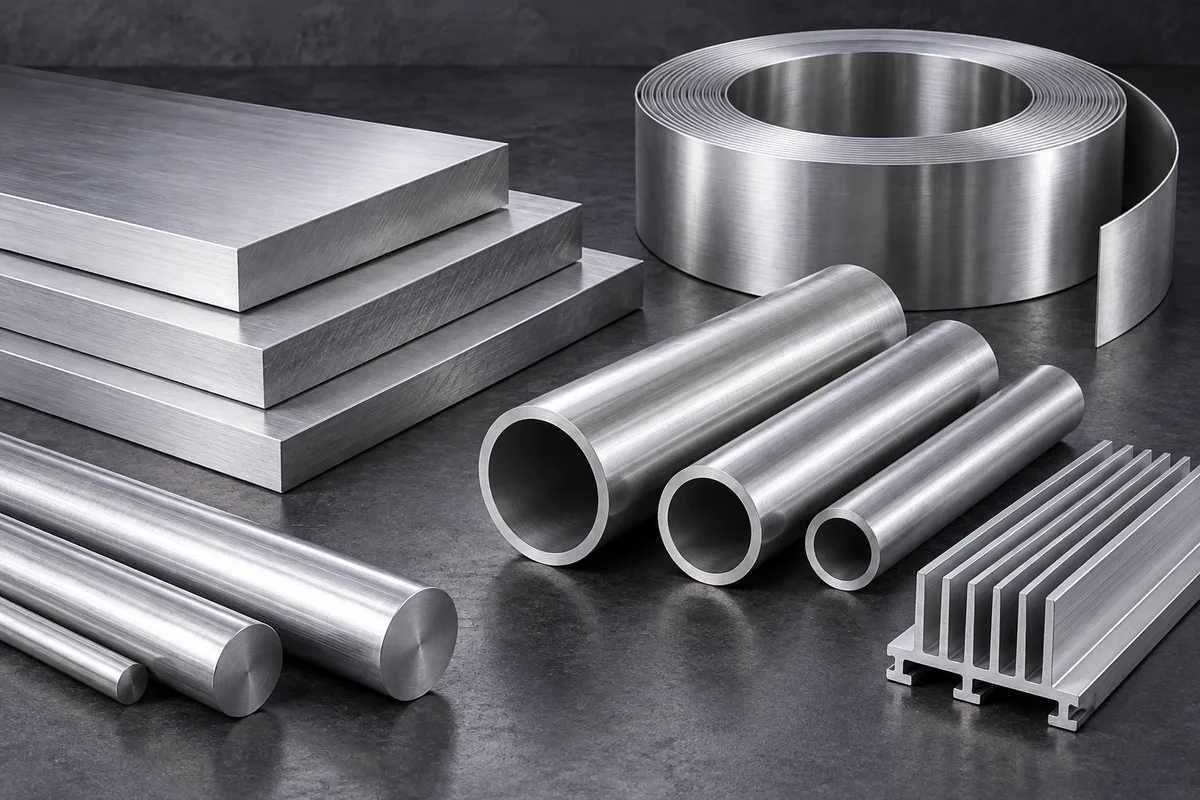
Ordinary primary aluminium from a smelter is about 99.7 % pure. Commercial "pure" wrought grades such as 1050 and 1070 are 99.5 % and 99.7 %. High-purity aluminium starts at 99.99 %, which means the sum of the measured impurities is no more than 100 parts per million.
Purity is usually written with the "N" (nines) shorthand. 4N is 99.99 %, 4N5 is 99.995 %, 5N is 99.999 % (10 ppm of impurities) and 6N is 99.9999 % (1 ppm). Each extra nine cuts the allowed impurity by a factor of ten and needs an additional refining step, so price rises steeply with purity. The skill in buying high-purity aluminium is choosing the lowest grade that meets the real requirement, and specifying the impurities that actually matter for the application rather than only the headline number.
Removing impurities changes the metal in useful ways. Electrical and thermal conductivity rise, because dissolved iron, silicon, titanium, vanadium and chromium scatter electrons. Reflectivity and anodised brightness improve, because there are fewer intermetallic particles at the surface. The metal becomes softer and more ductile, recrystallises at lower temperature and develops a more controllable grain texture, which matters for capacitor foil and sputtering targets.
| Grade | Aluminium (min.) | Total impurities | Typical designations | Typical applications |
|---|---|---|---|---|
| 3N (commercial high purity) | 99.9 % | ≤ 1,000 ppm | 1090, 1A90 | Reflector base metal, chemical equipment, high-conductivity parts |
| 4N | 99.99 % | ≤ 100 ppm | 1199, EN AW-1199, 1A99, JIS 1N99 | Electrolytic capacitor foil, bright reflectors, alloy feedstock, research |
| 4N5 | 99.995 % | ≤ 50 ppm | Specified by analysis | High-voltage anode foil, electronic foil, target blanks |
| 5N | 99.999 % | ≤ 10 ppm | Specified by analysis | Sputtering targets, semiconductor and display metallisation, evaporation sources |
| 5N5 – 6N | 99.9995 – 99.9999 % | ≤ 5 – 1 ppm | Specified by analysis | Cryogenic and superconductor stabilisers, physics research, advanced targets |
Up to 4N the registered alloy designations apply. AA 1199 (EN AW-1199, Al99.99) sets maximum limits of a few thousandths of a percent for each of silicon, iron, copper, magnesium and zinc, with even tighter limits for manganese, titanium and other elements. Above 4N there is no single public designation: the grade is defined by a purchase specification listing each impurity in ppm, the analytical method, and whether gases such as oxygen and carbon are counted.
Smelter metal cannot be purified simply by electrolysing it again in the normal way. Three main refining processes are used, often in sequence.
Peritectic impurities such as titanium, vanadium, zirconium and chromium behave differently from iron and silicon in crystallisation refining; they are often reduced by a boron treatment before refining. That is why a 4N certificate can show very different trace profiles depending on the route.
Values are typical published figures for annealed material at room temperature. Exact values depend on purity, temper and test method; use them for comparison, not as guaranteed minimums.
| Property | 1199 (99.99 %) | 1070 (99.7 %) | 1050 (99.5 %) |
|---|---|---|---|
| Electrical conductivity | About 64 – 65 % IACS | About 61 – 62 % IACS | About 61 % IACS |
| Thermal conductivity | About 240 W/m·K | About 225 – 230 W/m·K | About 220 – 230 W/m·K |
| Tensile strength, O temper | About 45 MPa | About 70 MPa | About 75 MPa |
| Yield strength, O temper | About 10 MPa | About 25 – 30 MPa | About 30 MPa |
| Density | 2.70 g/cm³ | 2.70 g/cm³ | 2.70 g/cm³ |
| Melting point | 660 °C | About 645 – 657 °C | About 645 – 657 °C |
At cryogenic temperatures the gap widens dramatically. The residual resistivity ratio (RRR), the resistance at room temperature divided by that at 4.2 K, is only a few tens for commercial aluminium but can run into the thousands for 5N metal and far higher after zone refining. That is why 5N and 6N aluminium are used to stabilise superconducting magnets and in cryogenic heat links.
The low strength is the price of purity. High-purity aluminium is easy to scratch and dent, recrystallises even near room temperature after heavy cold work, and cannot be heat treated for strength. Parts are designed with that softness in mind, or the metal is used as a coating, conductor or feedstock rather than a structural member.
Remelt stock for alloy making, foil rolling and target production; round ingots in diameters from a few centimetres up to several hundred millimetres.
Rolled or forged plate, typically from about 3 mm to 50 mm thick, for target machining and further rolling.
Thin sheet from roughly 0.6 – 2.5 mm for reflectors, electronic parts and laboratory use.
Foil from a few tens of micrometres, for capacitor, electronic and research applications.
Round blanks in common target diameters (for example 2, 4, 6 and 8 inch) and rectangular blanks, ready for bonding.
Round and flat wire for bonding-wire feedstock and evaporation; pellets and shot for thermal evaporation sources.
| Application | Usual purity | Why purity matters |
|---|---|---|
| Electrolytic capacitor anode foil | 4N – 4N5 | Low iron and silicon and a strong cube texture allow uniform tunnel etching and a high-quality oxide dielectric |
| Capacitor cathode and electronic foil | 3N – 4N | Stable etching and conductivity at lower cost |
| Sputtering targets and evaporation sources | 5N and above | Impurities transfer into thin films; alpha-emitting U and Th must be at very low levels for memory and logic devices |
| Bonding wire and ribbon | 4N – 5N (pure or with about 1 % Si) | Softness and consistent drawing for fine wire; low defects at the bond |
| Lighting reflectors | 4N base or bright 1085 / 1090 | Fewer surface particles give higher specular reflectance after brightening and anodising |
| Cryogenics and superconductors | 5N – 6N | Very high conductivity at low temperature (high RRR) |
| Master alloys and research | 4N – 5N | Clean base metal so that alloy additions are the only variables |
The most common problem with high-purity aluminium is a certificate that says "99.999 %" but does not say which elements were measured. Purity is normally calculated by difference: 100 % minus the sum of the listed impurities. If only ten elements are analysed, the headline number can look better than the metal really is.
Common mistakes include specifying 5N where 4N would do (paying many times more for no benefit), machining high-purity blanks with steel tooling that leaves iron at the surface, and storing foil or targets in humid conditions where the surface oxide thickens.
4N aluminium is 99.99 % pure, with no more than 100 ppm of measured impurities in total. It corresponds to alloy 1199 (EN AW-1199) and is the usual grade for capacitor foil, bright reflectors and alloy feedstock.
4N5 allows up to 50 ppm of impurities and 5N up to 10 ppm. 5N needs additional refining and GDMS analysis and is mainly used for sputtering targets and semiconductor processes.
Not in the technical sense. 1050 is 99.5 % and 1070 is 99.7 % aluminium. They are excellent for general conductive, reflective and chemical uses, but high-purity grades start at 99.99 %.
By analysing individual impurities and subtracting their sum from 100 %. Spark OES or ICP-OES is used for 4N; GDMS is used for 5N and above. Always check which elements were included.
Only slightly, by cold work. It is not heat treatable, and cold-worked high-purity aluminium can soften again over time. If strength is needed, use a dilute alloy or a commercial grade.
Yes. Metline supplies 4N to 5N aluminium in ingot, plate, sheet, foil, disc and wire form worldwide, with a certificate of analysis for each lot and clean export packing.
Tell us the purity grade, critical impurities, form and quantity. Metline will confirm the analysis method and reply with a delivered price.





