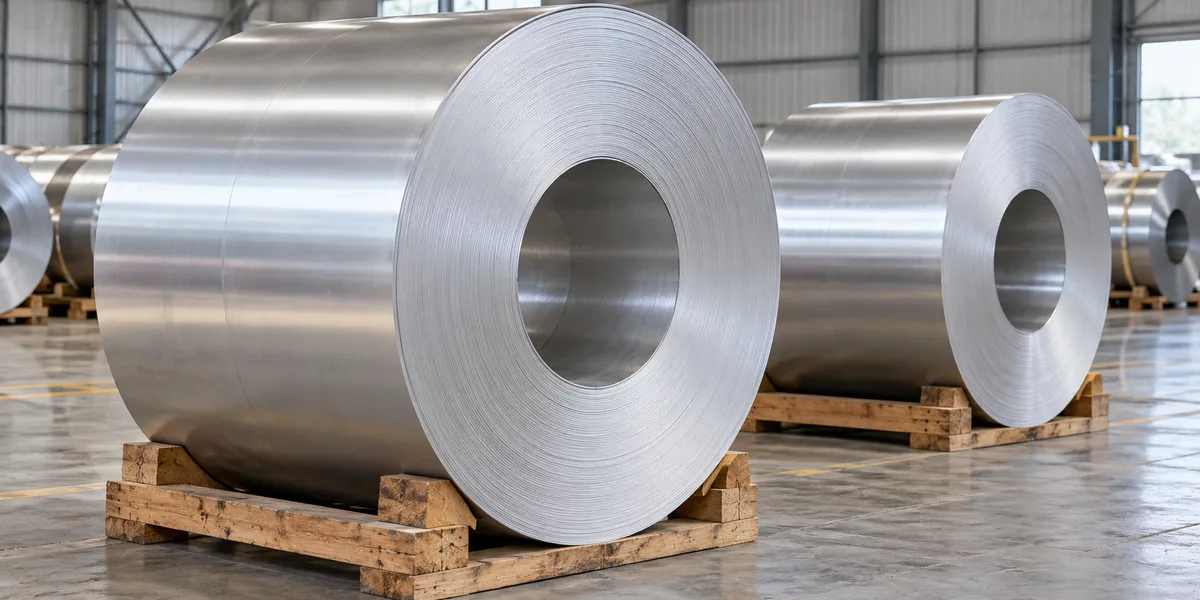
Aluminium Brazing Strip & Clad Coil for Heat Exchangers
Aluminium brazing strip is clad brazing material slit into narrow coils, typically 0.15 – 3 mm thick, that feeds tube mills, folding lines and progressive presses. Most of it becomes high-frequency welded or folded flat tubes for radiators, heater cores and charge-air coolers, or headers and side plates. This guide explains the clad structures, how strip is turned into tubes, what to specify and how to avoid common problems.
Brazing strip is the same roll-bonded composite as brazing sheet, a higher-melting core with an aluminium-silicon filler layer on one or both faces, but supplied as narrow, precision-slit coil. Its job is to feed continuous forming lines without stopping.
In a heat exchanger, the strip usually becomes the tube. A narrow coil is roll-formed into a flat or round tube and either welded along its seam by high-frequency (HF) welding, or folded into a "B" profile that is closed during brazing. The outside of the tube carries filler that will braze to the fins and headers; the inside is often lined with 7072 to protect it from coolant corrosion.
Strip also feeds presses that stamp headers, side plates, turbulators and small plates. Compared with cut sheets, coil feeding lets these parts be made at high speed with minimal scrap. For thin fin material, see our brazing foil guide; for wide sheet and plate, the brazing sheet guide.
Clad structures
Clad structures for tubes, plates and headers
Structure
Where used
Why
4343 / 3003 / 7072
HF-welded radiator, heater and charge-air cooler tubes
Filler outside brazes to fins and headers; 7072 inside protects the coolant side
4343 / 3003 + Zn
Tubes and plates needing an anodic core
Zinc-bearing core resists perforation by making corrosion spread sideways
4343 / 3003 / 4343
Folded B-tubes, plates and turbulators brazing on both faces
Filler on both sides closes the fold and joins internal webs
4045 / 3003
Single-side clad headers and side plates
More fluid filler for wide or uneven header joints
4343 / long-life 3xxx core / 7072
Tubes for long-life radiators and heater cores
Modified core resists silicon penetration and pitting
4343 / 6951 / 4343
High-strength plates and side supports
Heat-treatable core regains strength after brazing; check flux compatibility
Bare 3003 or 3102
Tube or plate stock where filler is supplied by the mating part
Lower cost when fins or headers are clad
Magnesium-bearing cores such as 6951 or 6061 do not braze reliably with standard potassium fluoroaluminate flux in CAB. Use caesium-modified flux or vacuum brazing, and confirm by trial.
Process
How brazing strip becomes heat exchanger tube
HF-welded flat tube
The strip is roll-formed into a tube, its edges heated by high-frequency current and forged together, the outer weld bead is scarfed off, and the tube is sized to a flat oval. Requires very consistent width, edge condition and thickness.
Folded B-tube
Double-clad strip is folded so that a central web is formed and the edges overlap; the tube is closed and the web joined during brazing. Allows very thin walls and internal reinforcement.
Round welded tube
Clad strip formed and welded into round tube for heat exchangers, connection tubes and manifolds.
Stamped plates and headers
Strip fed from coil into progressive dies to make header plates, end plates and turbulators.
Each route places different demands on the strip. HF welding is sensitive to edge burrs and to variation in width, because the seam must meet evenly. Folded tubes need good elongation and accurate clad ratios on both faces. Deep-drawn headers need O or H24 temper. Tell your supplier which route the strip is for, not just its dimensions.
Alloys
Filler, core and liner alloys
Alloy
Role
Main alloying
Approx. melting / solidus
4343
Filler
Si 6.8 – 8.2 %
577 – 613 °C
4045
Filler
Si 9.0 – 11.0 %
577 – 591 °C
4047
Filler
Si 11.0 – 13.0 %
577 – 582 °C
3003
Core
Mn 1.0 – 1.5 %
Solidus about 640 °C
3102
Core
Mn 0.05 – 0.40 %
High conductivity, lower strength
6951
Core
Mg 0.40 – 0.8 %, Si 0.20 – 0.50 %
Solidus about 615 °C; heat-treatable
7072
Liner
Zn 0.8 – 1.3 %
Sacrificial; not a filler
Values are Aluminum Association composition limits and published melting ranges. Many radiator tube cores are proprietary long-life variants of 3003; specify the corrosion and post-braze strength performance you need, and the core chemistry can be matched.
Supply range
Supply range and what to specify
Typical supply range
Thickness
approx. 0.15 – 3.0 mm; thinner material is supplied as foil
Slit width
From about 10 mm upwards, to tube circumference or blank width
Clad ratio
Typically 5 – 15 % per clad face; liner ratio to specification
Tempers
O, H12, H14, H22, H24
Coil
Pancake or traverse-wound; inner and outer diameter to suit the line
Surface
Degreased, low residual oil; edge condition suited to welding
Weight per metre of strip is width × thickness × density. With a composite density of about 2.73 g/cm³:
Thickness × width (mm)
kg per metre
metres per kg
0.20 × 30
0.0164
61.1
0.25 × 40
0.0273
36.6
0.27 × 50
0.0369
27.1
0.30 × 60
0.0491
20.4
0.40 × 50
0.0546
18.3
0.50 × 80
0.1092
9.2
1.00 × 100
0.2730
3.7
1.50 × 120
0.4914
2.0
2.00 × 150
0.8190
1.2
Quality
Tolerances, testing and certification
Thickness: tight tolerance, because tube wall thickness sets burst pressure and weld quality
Slit width and camber: controlled for even seam welding and accurate tube perimeter
Edge condition: burr-free, with no cracks or slivers at the slit edge
Clad ratio: per face, checked on cross-sections across the width
Mechanical properties: as delivered and, on request, after a simulated braze cycle
Corrosion: SWAAT (ASTM G85 Annex A3) or similar tests are often used by heat exchanger makers to compare tube materials
Certificate: EN 10204 3.1 mill certificate with chemistry of each layer and mechanical results
Troubleshooting
Common problems with brazing strip
Problem
Possible cause
What to check
Weld defects on HF tube
Burrs, width variation, camber
Slitting quality and width tolerance
Tube leaks after brazing
Core erosion by filler; thin spots
Clad ratio, braze cycle time and temperature
Fin joints weak on tube surface
Filler on wrong face, oil residue, low flux
Clad side marking, cleanliness, flux load
Early coolant-side pitting
No or thin 7072 liner; aggressive coolant
Liner ratio, coolant quality, core alloy
Cracking when folding or forming
Temper too hard for the forming route
Order O or H24 for severe forming
Applications
Applications of aluminium brazing strip
Automotive radiators and heater cores: HF-welded or folded flat tubes, headers and side plates
Charge-air coolers and oil coolers: thicker tubes, turbulators and plates
Mainly for making heat exchanger tubes by HF welding or folding, and for stamping headers, side plates and turbulators. The clad filler brazes the tubes to fins and headers in the furnace.
Why do radiator tubes have a 7072 layer inside?
7072 contains about 1 % zinc, which makes it anodic to the core. It corrodes preferentially and sideways, protecting the core from pitting through the tube wall on the coolant side.
What is the difference between welded and folded tubes?
Welded tubes are formed from single- or three-layer strip and seam-welded before brazing. Folded B-tubes use double-clad strip folded into shape and closed during brazing, which allows thinner walls and an internal web.
Which temper should I order for tube strip?
It depends on the forming route. HF tube mills commonly run H14 or H24 strip; severe folding and deep-drawn headers need O or H24. Agree the temper with your tube mill operator.
Can 6061-cored brazing strip be CAB brazed?
Not reliably with standard flux, because magnesium poisons potassium fluoroaluminate flux. Use caesium-modified flux, a low-Mg core, or vacuum brazing.
How should I specify slit width?
Give the nominal width and tolerance, the camber limit and the required edge condition, plus the coil inner and outer diameter and winding type for your line.
Need aluminium brazing strip?
Send the clad structure, thickness, slit width, temper, coil size and forming route. We reply with supply options, certification and delivery terms.