O and H111
Fully annealed. Maximum elongation and lowest springback. Ideal for deep-drawn shields and brackets, but soft parts dent easily and very flat panels may lack stiffness.



Internal parts of computers, communication devices and consumer electronics (the "3C" sector) are stamped, bent and drawn from thin aluminium sheet at high speed, and they must stay flat afterwards. This guide explains which alloys and tempers form best, how to control springback, flatness and residual stress, and what to specify so that LED back plates, keyboard plates, mid-plates and brackets come off the press consistently.
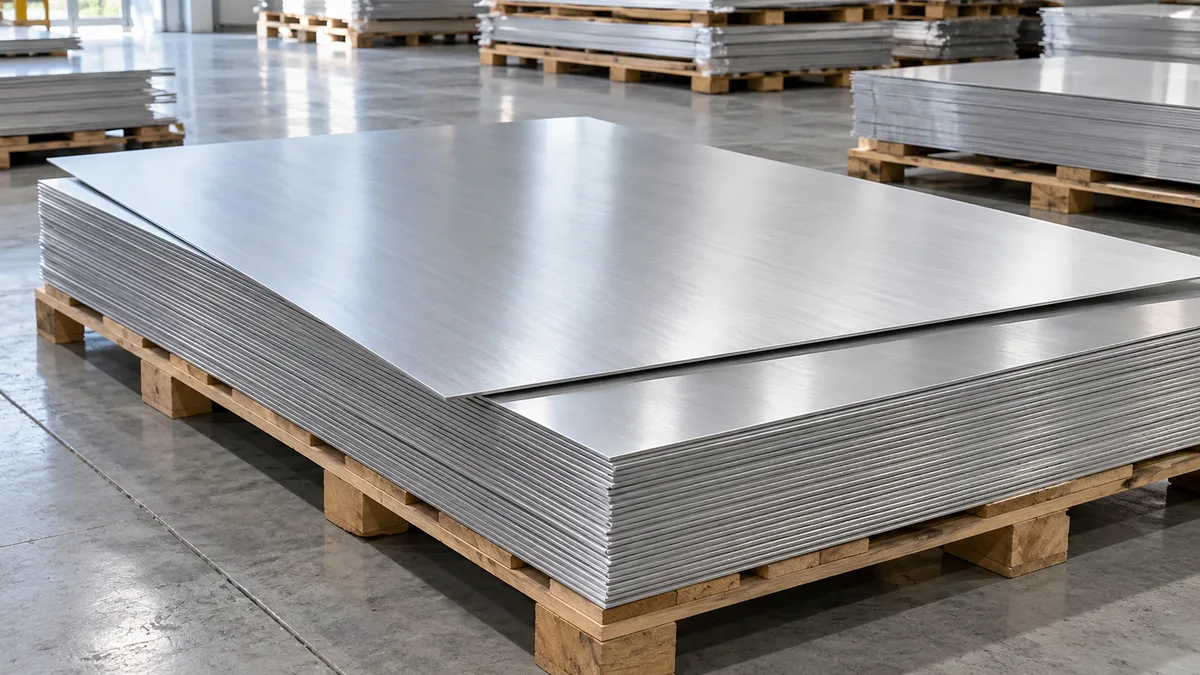
Housings get the attention, but most of the aluminium inside a laptop, monitor, television, router or phone is hidden: back plates that carry LED strips and spread their heat, keyboard support plates, mid-plates, shields and brackets. These parts are stamped in progressive or transfer dies at tens of strokes per minute, and they must fit a tightly packed assembly with almost no tolerance for warp.
That combination makes formability the first selection criterion, ahead of maximum strength. A sheet that cracks at a tight bend, wrinkles in a shallow draw or springs open after forming will scrap parts and damage dies. A sheet that is formable but carries locked-in stress will look fine off the press and then bow after piercing or trimming releases that stress. The right material balances elongation, a predictable yield strength, flatness and a clean surface for bonding or anodising.
Exterior shells are a different problem, where cosmetic anodising and stiffness lead the choice; see our 3C housing sheet guide for that route. This page is about the internal structure.
| Part | Main forming operations | Key material demand | Common alloys |
|---|---|---|---|
| LED / display back plate | Blanking, embossing ribs, flanging, shallow drawing | Flatness over a large area, heat spreading | 1050, 3003, 3104, 5052 |
| Backlight frame and reflector carrier | Bending, piercing, drawing of corners | Dimensional stability, clean surface for films | 5052, 5754, 1050 |
| Keyboard support plate | Fine piercing of hundreds of holes, embossing, bending | Flatness after heavy piercing, stiffness | 5052-H32, 5050, 6061 |
| Mid-plate / middle frame (inner) | Stamping plus CNC machining | Strength in thin gauge, machinability | 5052, 6061, 6063, 7075 |
| Internal brackets and shields | Progressive-die bending and drawing | Tight bend radii without cracking | 5052-O/H32, 5754, 3003 |
| Heat spreaders and conductive parts | Blanking, bending, sometimes riveting | Thermal and electrical conductivity | 1050, 1060, 6101 |
The table lists tensile and yield ranges from EN 485-2 for thin sheet (roughly 0.5 – 1.5 mm). Exact limits depend on thickness and are printed on the mill certificate. Use them to compare formability: the lower the yield and the wider the gap between yield and tensile strength, the more forming the sheet tolerates.
| Alloy and temper | Tensile strength Rm (MPa) | 0.2 % proof Rp0.2 min (MPa) | Forming character |
|---|---|---|---|
| 1050A-O | 65 – 95 | 20 | Extremely ductile; deep draws, tight bends, low strength |
| 1050A-H14 / H24 | 105 – 145 | 85 / 75 | Moderate bends; H24 (partially annealed) bends better than H14 |
| 3003-O | 95 – 135 | 35 | Very formable, a little stronger than 1050 |
| 3003-H14 / H24 | 145 – 195 | 125 / 115 | General stamped parts and back plates |
| 5052-O / H111 | 170 – 215 | 65 | Deep drawing and complex brackets |
| 5052-H32 | 210 – 260 | 160 | The default for stiff stamped plates with moderate bends |
| 5052-H34 | 230 – 280 | 180 | Stiffer, needs larger bend radii |
| 5754-O / H111 | 190 – 240 | 80 | Complex forming with higher final strength than 5052-O |
| 5754-H22 / H32 | 220 – 270 | 130 | Formed structural parts |
| 6061-T4 | ≥ 205 | 110 | Form in T4, then age to T6 for strength |
| 6061-T6 | ≥ 290 | 240 | Light bends only; mostly machined parts |
Other alloys earn a place for specific reasons. 3104 (Al-Mn-Mg, the can-body alloy) offers more strength than 3003 with good drawability and controlled earing. 5050 sits between 3003 and 5052 and is often used for thin keyboard plates. 6063 and 6101 are chosen when thermal or electrical conductivity matters together with heat-treatable strength. 7075 is used where a thin plate must be very stiff and strong, usually machined rather than formed. For these, ask for the certificate values for your gauge rather than relying on generic figures.
Values are standard limits for comparison, not design data for a particular coil. ASTM B209 gives equivalent limits in ksi for US orders.
Fully annealed. Maximum elongation and lowest springback. Ideal for deep-drawn shields and brackets, but soft parts dent easily and very flat panels may lack stiffness.
Cold rolled to a set hardness. H14 is half hard. Higher yield for stiff plates, but elongation falls and bends crack sooner, especially along the rolling direction.
Rolled harder, then back-annealed to the same strength level as H1x. H24 has noticeably better elongation and bendability than H14 at similar strength, and is often the smarter choice for bent back plates.
Used for 5xxx alloys, which slowly soften at room temperature if not stabilised. H32 is quarter hard with good bendability and is the workhorse temper for 5052 stamped parts.
For 6xxx sheet: form in the soft, naturally aged T4 condition, then artificially age to T6. Gives formed parts with machined-plate strength.
Annealed 5xxx sheet can show stretcher-strain marks (Lüders bands) on stretched areas. For visible surfaces use H111, H2x or a lightly temper-rolled condition, which suppresses the effect.
A consistent yield strength keeps burr height and dimensions stable. Harder tempers give cleaner shear edges; very soft O temper can drag and form burrs.
Bend across the rolling direction where possible. Annealed and H2x tempers accept tighter inside radii than H1x. Check minimum bend radii against the EN 485-2 bend tables for your thickness.
Choose O or H111 in 5052, 5754 or 3003. A higher n-value and r-value resist thinning and wrinkling. Lubrication and blank-holder force matter as much as the alloy.
Keyboard plates may have hundreds of holes, each releasing a little stress. Low residual stress (tension-levelled or stretched material) is essential to keep the plate flat.
Soft 1xxx and O tempers clog cutters. For machined mid-plates use 5052-H32, 6061-T6 or 7075-T6, which chip cleanly.
A clean, oil-free surface helps adhesive bonding, film lamination, painting and anodising. If the part will be anodised, specify anodising quality so grain and inclusions do not show.
Most problems with internal 3C parts are not cracks but shape errors. Three material factors drive them:
Thickness and flatness tolerances for cold-rolled sheet and strip follow EN 485-4 or ASTM B209 (ANSI H35.2) unless the drawing sets tighter limits. Many 3C buyers ask for tighter thickness tolerance than standard because thickness variation translates directly into springback variation; agree that figure at quotation stage.
Tell us your press line and die feed so the coil format arrives ready to run.
| Document | What it confirms |
|---|---|
| Mill test certificate (EN 10204 3.1) | Alloy, temper, chemical composition and tensile results for the lot |
| Dimensional report | Thickness, width, length, flatness and edge condition against the order |
| Surface inspection | No scratches, dents, oil stains, roll marks or corrosion spots beyond agreed limits |
| Packing list and photos | Quantities, coil and bundle identities, packing condition before dispatch |
| Traceability | Coil and lot numbers linked to the certificate for repeat orders and quality tracking |
5052 in O or H32 is the most common all-round choice for stamped and drawn parts. 1050 and 3003 suit back plates where heat spreading and easy forming matter more than strength, 5754 handles complex forming, and 6061 or 7075 is used for thin parts that are mainly machined.
Yes. It combines good stiffness with enough elongation for moderate bends and shallow draws, and it is stabilised so its properties do not drift in storage. For deep draws or very tight bends, use 5052-O or H111.
Typically 1050, 3003 or 3104 in H14, H24 or similar tempers, because they form easily and conduct heat well. 5052 is chosen when the plate must be stiffer or thinner.
Order tension-levelled or stretch-levelled material with low residual stress, keep thickness and yield within a narrow window, choose the lowest temper that meets stiffness, and balance features such as ribs and holes symmetrically across the part.
Both have similar tensile strength. H14 is reached by cold rolling alone; H24 is rolled harder and then partially annealed back, which gives more elongation and better bendability. For bent parts, H24 is usually the better choice.
Yes. Metline supplies cut-to-size sheet, slit strip and coil to your dimensions, with protective film and export packing, to customers worldwide.
Send the drawing, forming process and annual volume. We will recommend the alloy and temper and quote sheet, strip or coil delivered to your plant.





