Colour range
Black, grey, dark blue and other deep colours work well. Bright silver, light gold and pastel shades are harder because of the alloy's natural yellow-grey tint.



7075-T6 and T651 sheet and plate are used for smartphone middle frames, mid-plates and small structural parts because they give the highest strength of the common aluminium alloys in a thin, CNC-machinable section. The challenge is not strength but consistency: flatness, low residual stress and a fine, even grain that anodises without streaks. This guide covers specifications, properties, the anodising trade-offs and what to check when buying.
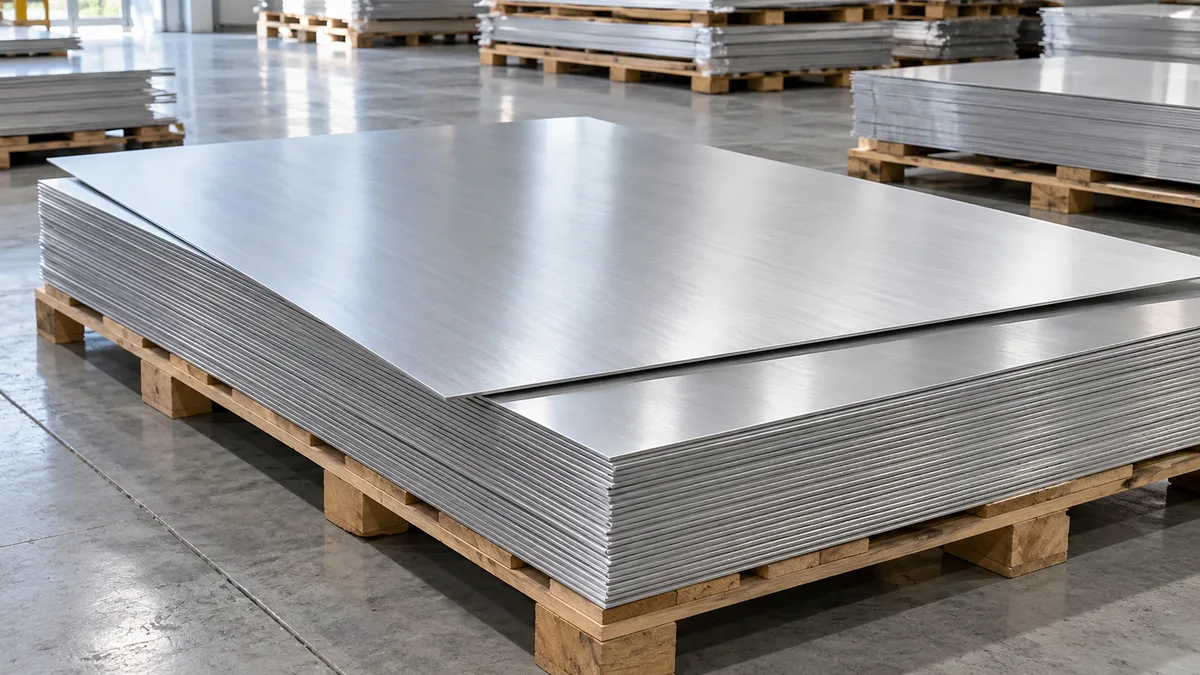
A phone middle frame is the metal skeleton between the display and the back glass. It carries the screen, battery, boards and buttons, acts as part of the antenna system and must resist bending when the phone is sat on or dropped. Mid-plates are the thin internal plates that stiffen the assembly and spread heat from the processor.
Most aluminium frames are CNC-machined from flat stock, with 60 – 90 % of the metal removed. 7075-T6 has roughly twice the yield strength of 6063 and about 1.8 times that of 6061, so the frame can be thinner and narrower for the same bend resistance. That frees space for a larger battery and keeps weight down.
The cost of that strength is cosmetic. Zinc and copper make 7075 anodise to a slightly darker, more yellow-grey shade than 6xxx alloys, and grain or segregation defects show up more readily as streaks. That is why material for visible frames is bought to tighter internal specifications than general engineering 7075, and why some brands use modified 7xxx alloys with lower copper for bright colours.
Frame blanks are often cut to the size of a single frame or a strip of several, which reduces handling and scrap at the CNC stage.
Standard 7075 limits apply. For cosmetic frames, buyers often add internal limits on iron and silicon and on inclusion levels, because coarse iron-bearing particles become visible after polishing and anodising.
| Element | Minimum | Maximum | Role in the alloy |
|---|---|---|---|
| Silicon (Si) | — | 0.40 | Impurity; kept low for toughness |
| Iron (Fe) | — | 0.50 | Impurity; forms coarse constituents that cut fatigue life |
| Copper (Cu) | 1.2 | 2.0 | Adds strength and improves stress-corrosion behaviour |
| Manganese (Mn) | — | 0.30 | Minor grain control |
| Magnesium (Mg) | 2.1 | 2.9 | Combines with Zn to form the MgZn2 strengthening phase |
| Chromium (Cr) | 0.18 | 0.28 | Controls recrystallisation and stress-corrosion cracking |
| Zinc (Zn) | 5.1 | 6.1 | Main alloying element |
| Titanium (Ti) | — | 0.20 | Grain refiner |
| Others, each / total | — | 0.05 / 0.15 | |
| Aluminium (Al) | Remainder | About 87 – 91 % |
| Property | Typical value (T6 / T651) |
|---|---|
| Tensile strength | 572 MPa (83 ksi) |
| Yield strength (0.2 %) | 503 MPa (73 ksi) |
| Elongation | About 11 % |
| Brinell hardness | 150 HB |
| Modulus of elasticity | 71.7 GPa |
| Density | 2.81 g/cm³ |
| Thermal conductivity | 130 W/m·K |
| Electrical conductivity | 33 % IACS |
Typical values per ASM. Specified minimums depend on thickness and are listed in ASTM B209 and EN 485-2; the mill certificate shows the values for your lot.
For comparison, 6061-T6 has a typical yield strength of 276 MPa and 6063-T6 about 214 MPa. Titanium and stainless steel frames are stiffer and more scratch-resistant but far heavier or more expensive to machine; see our article on middle frame substrate choices for that comparison.
Black, grey, dark blue and other deep colours work well. Bright silver, light gold and pastel shades are harder because of the alloy's natural yellow-grey tint.
Sulphuric acid anodising works on 7075, but film quality and dye uptake differ from 6xxx alloys, so bath temperature, current density, sealing and dye control must be qualified for this alloy.
Coarse or mixed grain shows as streaks, "orange peel" or bands after chemical polishing. Uniform fine grain in the sheet is the main prevention.
Oxide films and large intermetallic particles pull out during polishing and leave pits. Clean melt practice and filtration upstream reduce them.
Keep degreasing, etching and chemical polishing times consistent. 7075 etches faster than 6xxx alloys, so recipes cannot simply be copied.
Run anodised colour trials on frames machined from the actual lot before releasing production.
For back covers and visible housings that need bright colours rather than maximum strength, 5xxx and 6xxx sheet are often a better fit; see our guides to 6013, 6063 and 7021 electronics sheet.
| Check | Why it matters | How to specify |
|---|---|---|
| Flatness | Thin frames magnify any bow | Flatness per metre or per blank on the order |
| Residual stress | Causes distortion after machining | T651 for plate; stretch-levelled sheet |
| Grain size | Controls anodised appearance | Maximum grain size or reference micrograph |
| Inclusions and porosity | Pits after polishing | Ultrasonic test or cosmetic acceptance sample |
| Surface protection | Scratches waste machining time | PVC film, interleaving, edge protection |
| Certification | Traceability and consistency | EN 10204 3.1 certificate per lot |
7075-T6 has about 1.8 times the yield strength of 6061-T6, so the frame can be thinner and lighter while resisting bending. 6061 anodises to brighter colours, so it is still chosen for frames where appearance matters more than strength.
Dark and deep colours are easy. Bright silver and pale shades are harder because zinc and copper give the oxide a slight yellow-grey tint. Low-copper 7xxx alloys or 6xxx alloys are used where bright colours are essential.
Thin sheet is supplied as T6. For plate thicker than about 6 mm that will be heavily machined, order T651, which is stretched to relieve stress and distorts far less.
Frame blanks are commonly machined from roughly 6 – 12 mm plate, depending on frame depth, while mid-plates and small brackets use thinner sheet from about 1.5 mm.
Usually non-uniform grain structure or segregation in the sheet, sometimes combined with inconsistent etching. Specify fine, uniform grain and run colour trials on each new material lot.
Send thickness, blank size, temper, finish requirements and volumes. Our team will reply with availability, certification and a delivered price.





