Notebook covers
Bottom (D) covers and some lid (A) covers, stamped and anodised or painted.



5052 is the standard aluminium alloy for stamped electronics housings, keyboard plates and display back panels. With 2.2 – 2.8 % magnesium it reaches about 215 – 265 MPa tensile strength in H32 and 235 – 285 MPa in H34, roughly 50 % more than 5005, while still bending and drawing well and anodising cleanly. Metline supplies 5052 sheet and slit strip in O to H38 tempers to electronics manufacturers worldwide.
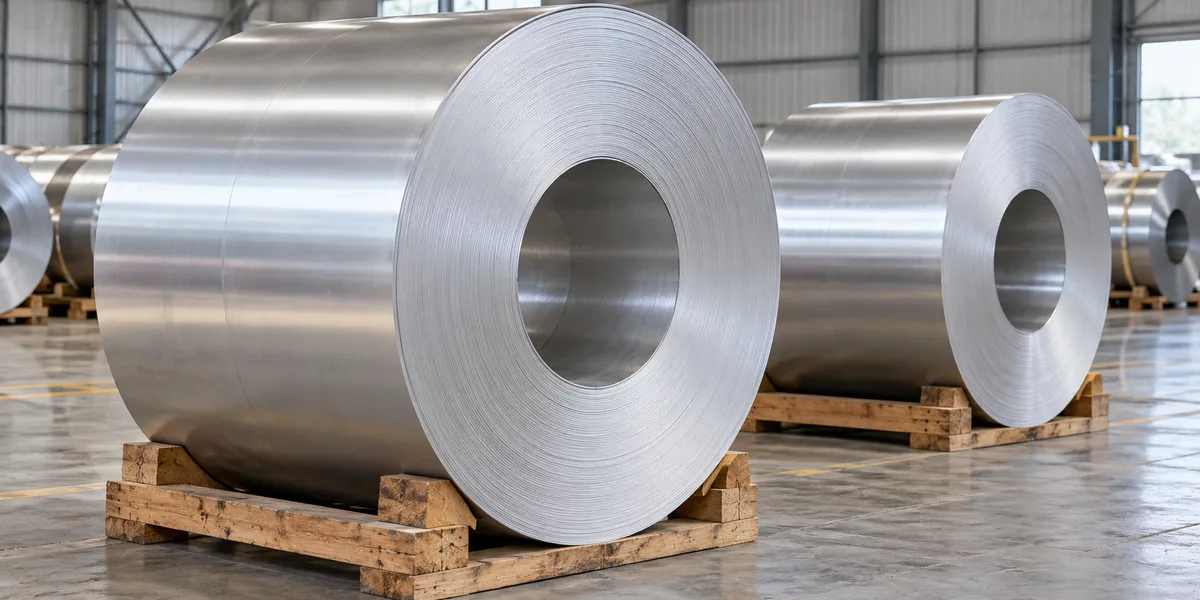
A notebook bottom cover or a monitor back panel has to be thin, stiff, dent-resistant and formed in a progressive or transfer die at high speed, then anodised or painted. 5052 balances those needs better than any other common alloy. It is strong enough for 0.6 – 1.2 mm covers to hold their shape, ductile enough for drawn corners and hemmed edges, and its chromium addition gives a fine grain that keeps formed surfaces smooth.
Being non-heat-treatable, 5052 gets its strength from magnesium and cold rolling, so the temper is chosen to suit the forming severity: O for deep drawing, H32 for most bending and shallow drawing, H34 – H38 for flat or lightly formed parts that must be stiffer. Unlike 6xxx sheet, it does not change properties after delivery or need ageing after forming.
Compared with 5005, 5052 gives a slightly warmer, less transparent anodic film, which is rarely an issue for black, grey and dark colours but is worth trialling for very light or clear finishes. For bright trim, 5252 is the specialist choice; for CNC-machined unibody parts, 6063, 6013 or 7xxx plate is used instead.
| Element | Limit | Note |
|---|---|---|
| Magnesium (Mg) | 2.2 – 2.8 | Main strengthening element |
| Chromium (Cr) | 0.15 – 0.35 | Grain control, stress-corrosion resistance |
| Silicon (Si) | 0.25 max | |
| Iron (Fe) | 0.40 max | |
| Copper (Cu) | 0.10 max | |
| Manganese (Mn) | 0.10 max | |
| Zinc (Zn) | 0.10 max | |
| Others, each / total | 0.05 / 0.15 | |
| Aluminium | Remainder |
| Temper | Tensile strength (MPa) | Yield min (MPa) | Elongation min (%) | Best for |
|---|---|---|---|---|
| O | 170 – 215 | 65 | 14 – 19 | Deep drawing, complex shells |
| H32 | 215 – 265 | 160 | 5 – 12 | Bent and shallow-drawn housings, keyboard plates |
| H34 | 235 – 285 | 180 | 4 – 10 | Flat back panels, brackets |
| H36 | 255 – 305 | 200 | 3 – 8 | Stiff flat parts |
| H38 | 270 min | 220 | 3 – 7 | Springy clips, flat stiffeners |
Ranges summarised from ASTM B209 and EN 485-2; elongation minimums rise with thickness. Typical H32: 228 MPa tensile, 193 MPa yield. Density 2.68 g/cm³, thermal conductivity about 138 W/m·K, electrical conductivity about 35 % IACS.
Allow inside bend radii of about 0.5 – 1 × thickness for H32 and 1 – 1.5 × for H34 in thin gauges, bending across the rolling direction where possible. Springback increases with temper, so tooling tuned for H32 will not give the same angles with H34.
| Thickness (mm) | Precision tolerance often agreed (mm) |
|---|---|
| 0.25 – 0.50 | ±0.01 – 0.02 |
| > 0.50 – 1.00 | ±0.02 – 0.03 |
| > 1.00 – 2.00 | ±0.03 – 0.04 |
| > 2.00 – 4.00 | ±0.05 – 0.06 |
| > 4.00 – 6.00 | ±0.08 – 0.10 |
Standard tolerances follow EN 485-4 or ASTM B209; precision values are agreed per order.
Bottom (D) covers and some lid (A) covers, stamped and anodised or painted.
Mechanical and membrane keyboard plates and bases where flatness and corrosion resistance matter.
LCD and LED TV and monitor back covers and frames.
Enclosures and heat-spreading covers.
Stamped shells, shields and internal frames.
Power-bank shells and charger housings.
| Point | 5005-H34 | 5052-H32 | 6061-T6 | 6013-T6 |
|---|---|---|---|---|
| Typical tensile (MPa) | 160 | 228 | 310 | about 400 |
| Main process | Stamping | Stamping, drawing | CNC machining, light bending | CNC machining |
| Anodised appearance | Very clear | Good | Good | Good |
| Formability | Very good | Good | Limited in T6 | Limited |
| Relative cost | Low | Low | Medium | Higher |
H32 for covers with bends, drawn corners or hems; H34 for flat or lightly formed panels that need more stiffness. Tooling should be tuned to the temper you choose.
Yes, with a dense, hard film that suits dark and dyed finishes. Very light or clear finishes show a faint warm tint, so trial them first.
Commonly 1.0 – 1.5 mm in 5052-H32 or H34, depending on stiffness and key-switch mounting.
Yes, slit to width on 405, 505 or 605 mm cores, tension-levelled for flatness if required.
5052 contains no restricted RoHS substances above limits; declarations can be supplied with the order.
Send temper, size, surface grade and quantity. We reply with availability, certification and a delivered quote.





