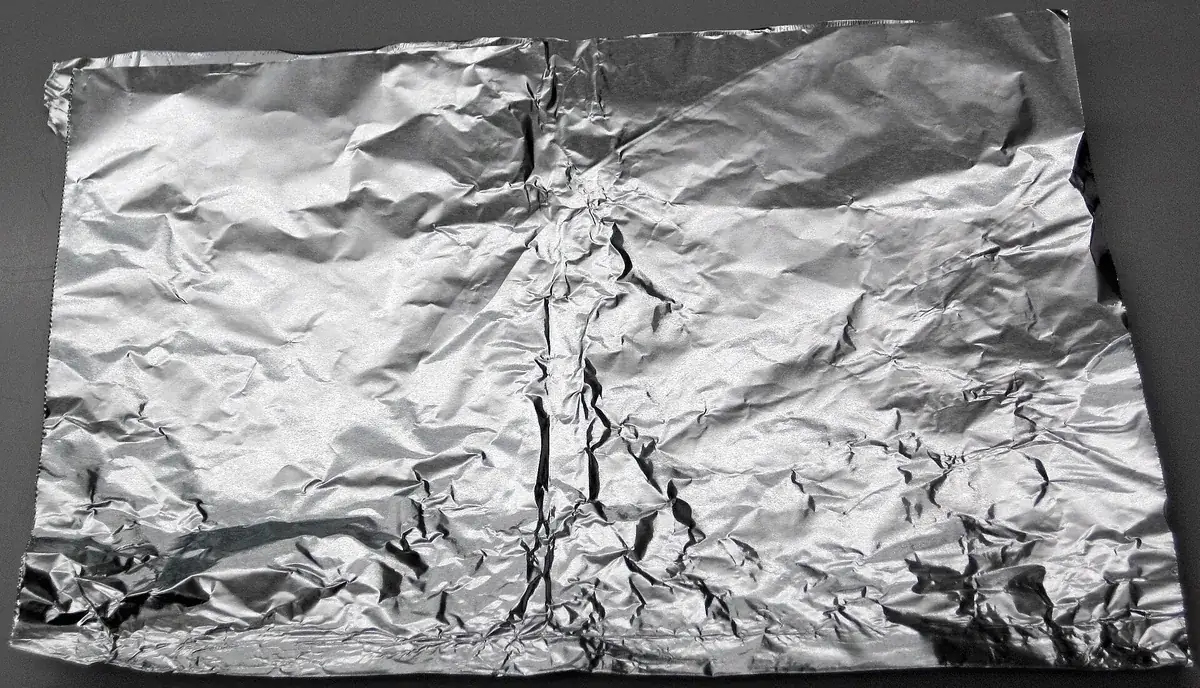
Bare reflective foil
Plain, bright 1050 foil, usually 7 – 40 µm, laminated or loose-laid under roof sheeting as a radiant barrier and vapour control layer.



1050 roofing foil is 99.5 % pure aluminium used in three ways on roofs: as a bare, low-emissivity radiant barrier, as a colour-coated weathering layer, and as the facing of laminated insulation such as foil-bubble and foil-scrim-kraft. A clean, bare face reflects about 95 % of radiant heat, but coatings change that figure, so the type you choose decides the performance. This guide explains the types, coatings, standards and checks.
Heat crosses a roof in three ways: conduction through solid materials, convection in air, and radiation across air gaps. Bulk insulation such as mineral wool slows conduction. Aluminium foil tackles radiation, which in a sunlit roof is often the largest heat path in summer.
A clean aluminium surface has a thermal emittance of roughly 0.03 – 0.05, which means it emits only 3 – 5 % as much long-wave infrared radiation as an ideal black surface and reflects around 95 % of what falls on it. When the foil faces an air gap under hot roof sheeting, very little of the sheeting's heat reaches the ceiling below. ASTM C1313 defines a sheet radiant barrier as a material with at least one surface of emittance 0.1 or less, a level only bright metal surfaces reach.
1050 is a popular choice because its 99.5 % purity gives a bright, corrosion-resistant surface and excellent ductility for rolling to thin gauges, laminating and embossing. It costs less than higher-purity 1070 and has more consistent surface quality than recycled-content foil.
Plain, bright 1050 foil, usually 7 – 40 µm, laminated or loose-laid under roof sheeting as a radiant barrier and vapour control layer.
Foil bonded to kraft paper and glass scrim (FSK), woven polyethylene, PE bubble film or foam. The foil provides the low-e face; the backing provides strength and puncture resistance.
Thicker foil, typically 0.05 – 0.15 mm, coated with polyester or PVDF paint for use as a visible, self-adhesive or bonded weathering layer on membranes and panels.
Micro-perforated so the layer breathes, used where a vapour-open radiant barrier is needed.
Foil with pressure-sensitive adhesive for sealing laps and penetrations in foil-faced insulation.
Strip of about 0.3 – 3 mm up to very wide widths for roofing sheet and composite panels, where fewer seams are wanted.
| Coating | Typical dry film | Character | Choose for |
|---|---|---|---|
| Lacquer / primer only | A few µm | Protects the foil and aids bonding | Laminating and adhesive membranes |
| Polyester (PE) | Around 18 – 25 µm on coil-coated products | Economical, good colour range | Moderate climates, interiors |
| PVDF (fluorocarbon) | Around 25 µm or more | Best UV and chalking resistance | Hot, sunny and coastal exposures |
Film thickness and expected life depend on the paint system and exposure. Ask for the coating maker's warranty terms and test data (salt spray to ASTM B117, UV ageing to ASTM G154) for your climate.
| Element | Max % |
|---|---|
| Si | 0.25 |
| Fe | 0.40 |
| Cu | 0.05 |
| Mn | 0.05 |
| Mg | 0.05 |
| Zn | 0.07 |
| Ti | 0.05 |
| Others, each | 0.03 |
| Al | ≥ 99.50 |
| Property | Value (typical) |
|---|---|
| Density | 2.71 g/cm³ |
| Melting range | 646 – 657 °C |
| Thermal expansion | 24 × 10⁻⁶ /K |
| Specific heat | 900 J/kg·K |
| Thermal conductivity | ≈ 229 W/m·K |
| Elastic modulus | 69 GPa |
| Electrical conductivity | ≈ 61 % IACS |
| Bare-surface emittance | ≈ 0.03 – 0.05 |
Composition per EN 573-3 for EN AW-1050A. Foil weight is 2.71 g/m² for every micron of thickness: 25 µm foil weighs about 68 g/m².
| Area | Standards | What they cover |
|---|---|---|
| Material | EN 573-3, EN 546-2, EN 485-2, ASTM B209 / B479 | Chemistry, foil and sheet properties, tolerances |
| Radiant barrier performance | ASTM C1313, ASTM C1224, ASTM C1371, EN 16012 | Emittance, reflective insulation, declared thermal performance |
| Durability | ASTM B117, ASTM G154 | Salt-spray corrosion and UV ageing of coated foil |
| Building membranes and fire | AS/NZS 4200.1, EN 13501-1, ASTM E84 | Pliable membranes, reaction to fire, surface burning |
| Moisture | ASTM E96 | Water vapour transmission of the laminate |
The foil supplier normally certifies the material (chemistry, gauge, temper). Performance standards such as ASTM C1313 or AS/NZS 4200.1 apply to the finished laminated product, so ask the laminator for those test reports.
A clean, bare aluminium face reflects about 95 % of long-wave radiant heat (emittance about 0.03 – 0.05). It only works when that face looks onto an air space; foil sandwiched tight between two materials gives little radiant benefit.
Yes. Paints have emittance around 0.8 – 0.9, so a coated face does not act as a radiant barrier. Use coloured foil for weathering and appearance, and keep a bare or low-e lacquered face towards the air gap.
1050 gives a bright, corrosion-resistant surface and good strength in the gauges used for roofing. 8011 is stronger and common in packaging; 1235 is used for very thin foil. All three can work as radiant barriers when laminated.
Facings on laminated insulation are usually about 7 – 25 µm. Self-supporting or colour-coated roofing foils are thicker, typically 0.05 – 0.15 mm.
Unperforated foil is practically impermeable to water vapour. Place it on the warm side of insulation in cold climates, or use perforated foil where the assembly must breathe.
Send the foil type, gauge, width, coating and quantity. We will confirm availability, certification and a delivered price.






