Radiant barrier laminates
Foil on one or both faces of kraft paper, woven PE or reinforced scrim. Fixed under rafters or over purlins with the foil facing an air gap.



1200 is a commercially pure aluminium (99.0 % Al minimum) that is rolled into foil for roof radiant barriers, insulation facings, underlays and colour-coated roofing laminates. Bright aluminium reflects about 95 % of radiant heat and has an emittance near 0.03–0.05, so a foil layer facing an air space cuts heat gain through hot roofs. This guide covers grade, product types, performance standards and the installation details that decide whether it works.
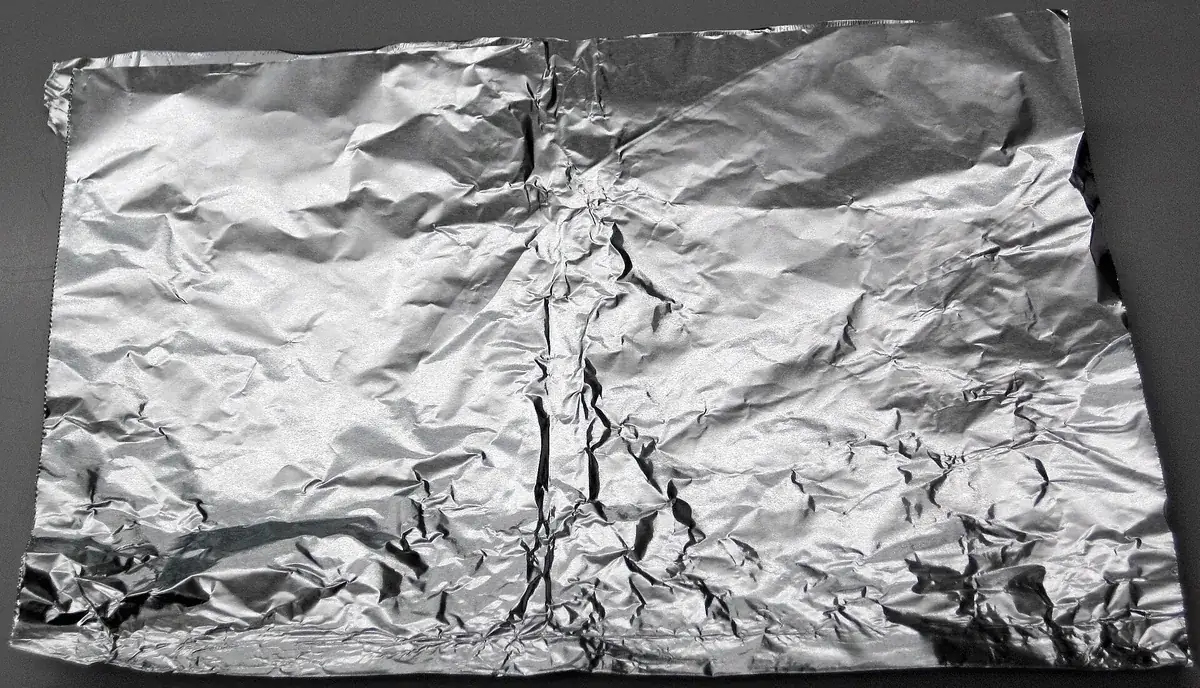
Heat enters a building through a hot roof mainly as radiation from the underside of the roof covering. A surface with low emittance radiates very little heat, and a surface with high reflectance sends incoming radiation back. Bright aluminium does both, which is why a thin foil can reduce heat flow far more than its thickness suggests.
1200 is a good fit for this job. Its 99.0 % purity gives a bright, corrosion-resistant surface; it rolls easily to thin gauges; and it is slightly stronger than 1050 or 1060 because it carries more iron and silicon, which helps with handling and lamination. 8011 and 8079 are alternatives where higher strength or better pinhole performance at very thin gauges is needed.
Roofing foil is almost never used on its own. It is laminated to kraft paper, woven polyethylene, polyester film, bubble film or foam, or bonded to bitumen and metal sheet. The foil supplies reflectance and vapour resistance; the backing supplies strength, puncture resistance and fixing.
| Element | Limit (%) |
|---|---|
| Silicon + iron (Si + Fe) | ≤ 1.00 |
| Copper (Cu) | ≤ 0.05 |
| Manganese (Mn) | ≤ 0.05 |
| Zinc (Zn) | ≤ 0.10 |
| Titanium (Ti) | ≤ 0.05 |
| Others, each / total | ≤ 0.05 / ≤ 0.15 |
| Aluminium (Al) | ≥ 99.00 |
Foil on one or both faces of kraft paper, woven PE or reinforced scrim. Fixed under rafters or over purlins with the foil facing an air gap.
Foil laminated to one or two layers of polyethylene bubble or foam. Adds a small amount of resistive insulation and acts as a vapour barrier.
Foil-scrim-kraft (FSK) and foil-faced boards for mineral wool, PIR and glass wool used in roofs and ducts.
Polyester or PVDF lacquered foil for visible underlays, bitumen membrane surfacing and decorative laminates.
Pressure-sensitive foil tape to seal laps and penetrations so the vapour barrier stays continuous.
Embossed or coloured foil bonded to butyl or bitumen for roof flashings and repairs.
Products sold as "roofing foil" in 0.3–3 mm thickness are in fact sheet or coil, not foil. Corrugated or profiled roofing in that range is normally made from 3003, 3105 or 5052, not 1200.
| Parameter | Typical range | Comment |
|---|---|---|
| Foil thickness | 0.006 – 0.2 mm | Thinner for laminates, thicker for exposed or coated foil |
| Temper | O (soft) for laminating; H14–H18 for coated or embossed foil | Soft foil follows backing contours; hard foil resists tearing on lines |
| Width | Up to about 1600 mm foil; laminates commonly 1000 – 1500 mm and 48 in | Slit to order |
| Core | 76 mm (3 in) or 152 mm (6 in) | To suit laminating machines |
| Coating | Polyester or PVDF lacquer, a few to over 20 µm | Colour to RAL or sample |
| Surface tension | ≥ 32 dyn/cm typical for lamination | Clean annealed surface needed for adhesion |
Buyers of radiant barriers and reflective insulation should ask for test data to recognised methods, not only for brochure claims.
| Standard | What it covers |
|---|---|
| ASTM C1313 | Sheet radiant barriers for building construction: emittance, vapour permeance, tear, corrosion and flammability requirements |
| ASTM C1224 | Reflective insulation for building applications |
| ASTM C1158 | Guide to the use and installation of radiant barrier systems |
| ASTM C1371 / ASTM E408 | Measurement of surface emittance |
| ASTM E96 | Water vapour transmission of the laminate |
| ASTM E84 | Surface burning characteristics of the finished laminate |
| ASTM B479 | Specification for the foil itself |
Under ASTM C1313, a radiant barrier surface must have an emittance of 0.1 or less. Clean bright 1200 foil achieves this easily; a lacquer or clear coating raises emittance, and dust on an upward-facing surface raises it over time.
Benefits are largest in hot, sunny climates with air-conditioned spaces, where radiant gain through the roof dominates. In cold climates, foil contributes more as a vapour barrier than as insulation.
Clean, bright aluminium reflects about 95 % of radiant heat and has an emittance around 0.03–0.05. Real savings depend on the air gap, orientation, dust and climate.
Yes. The low-emittance surface must face an air space to reduce radiant transfer. Without a gap it works mainly as a vapour barrier.
1200 is purer and slightly more corrosion resistant; 8011 is stronger and has fewer pinholes at thin gauges. Both are widely used; choose by gauge and laminating process.
Yes, mainly as a vapour control layer on the warm side of insulation. Its radiant benefit is smaller than in hot climates.
Laminated radiant barriers typically use foil from about 6 to 25 µm; exposed or coated foils are thicker. The backing provides most of the strength.
Yes. We supply 1200 foil and laminated or coated roofing foils to your gauge, width and specification, with certificates and export packing.
Send gauge, width, temper, coating or laminate type and quantity. We will reply with a specification and a delivered price.






