6063 (architectural)
The default for trim and visible channel. Extrudes into thin, sharp-cornered sections with a smooth surface and gives the most even anodised finish. Typically supplied T5 or T52.



Aluminium U channel is an extruded section with a flat base (web) and two parallel legs (flanges), used for edging, framing, tracks and load-carrying members. Metline supplies architectural channel in 6063 and 6060 and structural channel in 6061 and 6082, in standard metric and inch sizes or to your drawing, cut, finished and shipped worldwide.
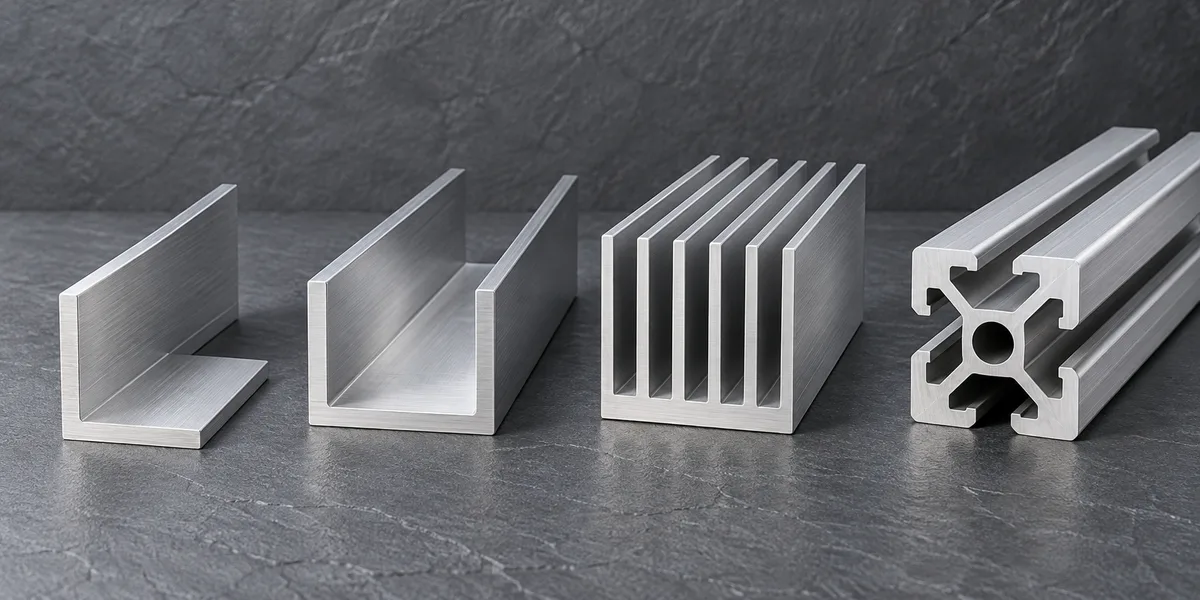
A U channel is the simplest open extrusion after the angle: a base with two legs on the same side, giving a section that is stiff in one direction, easy to fix through the base and open on one face to receive a panel, a cable, a runner or another profile.
The name covers two quite different products. Architectural or trim channel has sharp inside and outside corners, a uniform wall and usually equal legs. It is extruded in 6063 or 6060, sold in small sizes, and used to cap the edges of panels, glass and boards, to make sliding tracks and to hide cables or LED strip. Structural channel is extruded in 6061 or 6082, has radiused inside corners (fillets) that reduce stress concentration, and comes in larger sizes whose section properties are tabulated for design.
Within structural channel there are two families. Aluminum Association (AA) standard channels have flanges of constant thickness and generous fillets; they are lighter for a given strength and are the usual choice for new aluminium designs. American Standard channels copy the steel C-section, with flanges that taper from thick at the root to thin at the toe; they are specified where an aluminium part must replace a steel one of the same nominal size. Both are supplied in 6061-T6 to ASTM B308.
The words "U channel" and "C channel" are used loosely by many buyers. On this site, U channel means a section with straight, parallel legs and no lips; a channel with inward-turned lips at the leg tips is a C channel, and a channel with outward flanges is a hat channel.
The default for trim and visible channel. Extrudes into thin, sharp-cornered sections with a smooth surface and gives the most even anodised finish. Typically supplied T5 or T52.
Very close to 6063 with slightly lower strength. Widely used in Europe for window, door and furniture channel; excellent for anodising.
A low-iron variant of 6063 chosen when the channel will be bright-dipped or chemically polished for a mirror-like trim finish.
About 70 % stronger than 6063-T5 in specified yield. Used for structural channel to ASTM B308, trailer and truck bodies, machine frames and marine fittings.
The European structural alloy, slightly stronger than 6061 in thick sections. Common for channel designed to Eurocode 9 (EN 1999).
Medium-high strength with better extrudability than 6082, so it suits thinner-walled or more complex structural channels such as rail and bus parts.
Chemical composition limits for these alloys are below. The magnesium and silicon content sets strength; low iron and copper give the brighter, more uniform anodised appearance of 6063 and 6463.
| Alloy | Si | Fe | Cu | Mn | Mg | Cr | Zn | Ti |
|---|---|---|---|---|---|---|---|---|
| 6060 | 0.30 – 0.6 | 0.10 – 0.30 | 0.10 | 0.10 | 0.35 – 0.6 | 0.05 | 0.15 | 0.10 |
| 6063 | 0.20 – 0.6 | 0.35 | 0.10 | 0.10 | 0.45 – 0.9 | 0.10 | 0.10 | 0.10 |
| 6463 | 0.20 – 0.6 | 0.15 | 0.20 | 0.05 | 0.45 – 0.9 | — | 0.05 | — |
| 6061 | 0.40 – 0.8 | 0.7 | 0.15 – 0.40 | 0.15 | 0.8 – 1.2 | 0.04 – 0.35 | 0.25 | 0.15 |
| 6005A | 0.50 – 0.9 | 0.35 | 0.30 | 0.50 | 0.40 – 0.7 | 0.30 | 0.20 | 0.10 |
| 6082 | 0.7 – 1.3 | 0.50 | 0.10 | 0.40 – 1.0 | 0.6 – 1.2 | 0.25 | 0.20 | 0.10 |
Single values are maximums. Others 0.05 % each, 0.15 % total; aluminium is the remainder. Limits follow the Aluminum Association registrations and EN 573-3.
Extruded channel is bought by temper. T5 means cooled from the press and artificially aged; T6 means solution heat-treated (or press-quenched to an equivalent condition) and aged to full strength; T52 is a controlled-cooling temper used for architectural 6063; T6511 is a 6061 temper that has been stretched to relieve stress and straightened.
| Alloy and temper | Standard and size band | Tensile strength, min. | Yield strength (0.2 %), min. | Elongation, min. |
|---|---|---|---|---|
| 6060-T5 | EN 755-2, wall ≤ 5 mm | 160 MPa | 120 MPa | 8 % |
| 6063-T5 | ASTM B221, ≤ 12.5 mm | 150 MPa (22 ksi) | 110 MPa (16 ksi) | 7 – 8 % |
| 6063-T52 | ASTM B221 | 150 – 205 MPa (22 – 30 ksi) | 110 – 170 MPa (16 – 25 ksi) | 8 % |
| 6063-T6 | ASTM B221 / EN 755-2 | 205 – 215 MPa (30 ksi) | 170 MPa (25 ksi) | 8 % |
| 6061-T6 / T6511 | ASTM B221 / B308 | 260 MPa (38 ksi) | 240 MPa (35 ksi) | 8 % |
| 6005A-T6 | EN 755-2, open profile ≤ 5 mm | 270 MPa | 225 MPa | 8 % |
| 6082-T6 | EN 755-2, open profile ≤ 5 mm | 290 MPa | 250 MPa | 8 % |
Specified minimums for extruded profiles; thicker walls fall into different bands. Typical values run 10 – 20 % higher (6061-T6 typically 310 MPa tensile, 276 MPa yield). Design to the minimums and the actual figures on the mill certificate.
Because the modulus is a third of steel, an aluminium channel of the same shape deflects three times as much under the same load. For stiffness-critical members, choose a deeper section rather than a stronger alloy: doubling the leg height increases bending stiffness about the strong axis far more than any change of temper.
Custom sections are extruded from a new die to your drawing; existing dies cover a wide range of common sizes.
The weight of a square-cornered U channel is the cross-sectional area multiplied by the density: area = t × (B + 2H − 2t), and weight in kg/m = area in mm² × 0.0027. Real sections with fillets weigh a few per cent more. The table gives reference weights for common metric sizes.
| Base × leg × wall (mm) | Area (mm²) | Weight (kg/m) | Weight per 6 m length (kg) |
|---|---|---|---|
| 20 × 20 × 2 | 112 | 0.30 | 1.8 |
| 25 × 25 × 2 | 142 | 0.38 | 2.3 |
| 30 × 20 × 2 | 132 | 0.36 | 2.1 |
| 40 × 20 × 2 | 152 | 0.41 | 2.5 |
| 40 × 40 × 3 | 342 | 0.92 | 5.5 |
| 50 × 25 × 3 | 282 | 0.76 | 4.6 |
| 50 × 50 × 4 | 568 | 1.53 | 9.2 |
| 60 × 30 × 3 | 342 | 0.92 | 5.5 |
| 80 × 40 × 4 | 608 | 1.64 | 9.8 |
| 100 × 50 × 5 | 950 | 2.56 | 15.4 |
| 120 × 60 × 6 | 1368 | 3.69 | 22.2 |
| 150 × 75 × 6 | 1728 | 4.67 | 28.0 |
In inch catalogues, a U channel is usually described as leg × outside base × inside base × wall, for example 1/2 in leg × 1 in OD × 3/4 in ID × 1/8 in wall. The inside width is the figure that matters when the channel must receive a panel or runner, so state it explicitly on enquiries.
As extruded. Lowest cost and the right choice for hidden or structural channel, or where you will finish parts after fabrication.
Clear, champagne, bronze or black anodic film. For exterior architectural work, specify film thickness: about 15 – 25 µm, for example AAMA 611 Class I (≥ 18 µm) or a Qualanod class of 20 or 25 µm.
Polyester powder in any RAL colour, typically 60 – 80 µm thick. Specify a Qualicoat class or AAMA 2603 / 2604 / 2605 for the exposure.
Mechanically brushed (satin) or polished before anodising, for furniture, retail and interior trim.
Sublimation print over a powder base coat, used for interior door and furniture channel.
PE film on visible faces to protect the finish through fabrication and installation.
| Requirement | ASTM / North America | EN / ISO |
|---|---|---|
| Material and properties | ASTM B221 (extrusions); ASTM B308 (6061-T6 structural shapes); AMS-QQ-A-200/8 for 6061 | EN 755-1 and EN 755-2 |
| Chemical composition | Aluminum Association registration | EN 573-3 |
| Dimensional tolerances | ANSI H35.2 (H35.2M metric) | EN 755-9; EN 12020-2 for precision 6060/6063 profiles |
| General wrought extrusions | — | ISO 6362 |
| Structural design | Aluminum Design Manual (Aluminum Association) | EN 1999 (Eurocode 9) |
Tolerances on leg height, base width and wall thickness depend on the size of the section and the circumscribing circle, and are tighter for precision profiles to EN 12020-2. Straightness, twist and the angle between legs and base are also controlled. If a channel must hold a panel or slide on a runner, put a tolerance on the inside width on your drawing rather than relying on the general tables.
Every delivery is checked for dimensions, straightness and surface, and is supplied with a mill test certificate to EN 10204 3.1 showing chemistry and tensile results for the lot. Hardness checks and coating thickness reports for anodised or powder-coated channel are available on request.
Saw with a fine-tooth carbide blade and lubricant. Cut-to-length service with mitres and length tolerance to your drawing.
Drilling, slotting and punching of fixing holes in the base. 6061 and 6082 in T6 machine with short chips; 6063 is softer and can smear without sharp tools.
Channel can be rolled into curves around its weak or strong axis. Soft tempers (T4 or O) bend far more easily; T6 channel needs generous radii and may crack at the leg tips.
MIG or TIG with ER4043 or ER5356. The heat-affected zone loses much of its T6 strength, so welded structural channel is designed to reduced strength values.
Rivets, self-tapping screws and bolts through the base are common; stainless fasteners need isolating washers in wet environments to prevent galvanic corrosion.
Channels are often slid over panel edges with an EPDM or PVC insert, which absorbs tolerances and reduces rattle.
| Section | Shape | Strengths | Typical use |
|---|---|---|---|
| U channel | Base and two straight legs | Simple, open, easy to fix through the base | Edging, tracks, light and medium frames |
| C channel | U with inward lips | Lips retain trolleys, nuts and panels; stiffer leg tips | Slide tracks, strut systems |
| Hat channel | U with outward flanges | Flanges fix flat to a surface | Furring, stiffeners, cladding battens |
| Box section | Closed rectangle | Much higher torsional stiffness | Columns, frames under twisting loads |
| I-beam | Web with two flanges | Best bending efficiency, symmetric | Beams and spans |
An open channel is weak in torsion and, when loaded through its base, tends to twist because its shear centre lies outside the section. Where a member carries a load off its centre line or spans long distances, a box section or an I-beam is usually the better choice; where the open face is needed to receive something, the U channel is hard to beat.
6061-T6 has a specified minimum yield of 240 MPa against 110 MPa for 6063-T5, so it is used for load-bearing channel and usually has radiused inside corners. 6063 extrudes sharper, thinner sections with a better surface and anodised finish, so it is used for trim, edging and architectural channel.
Aluminum Association channels have flanges of constant thickness and larger fillets and are lighter for the same strength. American Standard channels have tapered flanges matching steel channel dimensions, and are used where aluminium replaces a steel section of the same size.
Multiply the cross-sectional area by the density. For a square-cornered channel, area = wall × (base + 2 × leg − 2 × wall) in mm², and weight in kg/m is area × 0.0027. A 50 × 25 × 3 mm channel weighs about 0.84 kg/m.
Yes. Channels are roll-bent into arcs about either axis. Soft tempers bend most easily; T6 channel needs larger radii and, for tight bends, may need to be supplied in T4 and aged after forming.
6063 or 6061 channel anodised to at least 15 – 20 µm, or powder coated to a recognised architectural standard, performs well outdoors. In coastal or marine settings, use isolating washers with stainless fasteners and choose a thicker anodic film.
Yes. Send a dimensioned drawing with tolerances, alloy, temper, finish and annual quantity. A new die is made for non-standard sections, and samples can be checked before full production.
Send the section size, alloy, finish, lengths and destination. We will reply with availability, certification and a delivered price.





