Mill finish
As extruded. Economical for hidden structures or parts that will be welded and painted.



Aluminium box section is a square or rectangular hollow extrusion: a closed tube with flat faces that gives high bending and torsional stiffness for its weight. Metline supplies box sections from 12.7 × 12.7 mm (½ in) up to 200 × 200 mm, with walls from about 1.2 to 6 mm, in 6063, 6061, 6082 and higher-strength grades, mill finish, anodised or powder coated and cut to length for customers worldwide.
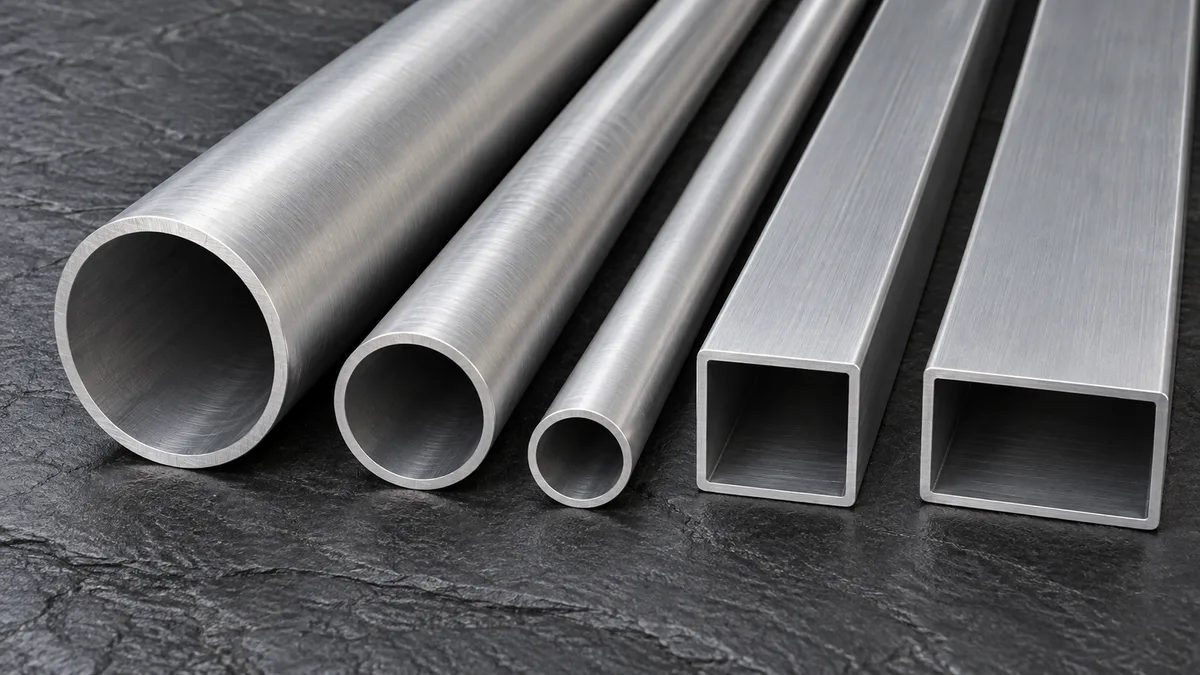
"Box section" is the British and Commonwealth name for square and rectangular hollow sections, called square tube or rectangular tube in North America. Both describe the same product: an extruded closed shape with four flat walls and small corner radii.
Placing the metal at the outside of the section is what makes a box section efficient. A 50 × 50 × 3 mm aluminium box weighs about 1.5 kg/m, yet it is roughly eight times stiffer in bending than a solid square bar of the same weight (about 24 mm square). The closed shape also resists twisting far better than an open channel or angle of the same weight, which is why box section is used for frames that see torsion: trailers, gates, furniture, ladders and machine bases.
Most aluminium box sections are extruded through porthole (bridge) dies, which split the metal around a mandrel and weld it back together inside the die. The resulting longitudinal seams are fully bonded and have no practical effect on structural use. For pressure applications or where a specification calls for it, seamless tube extruded over a mandrel from a hollow billet is available instead.
| Alloy and temper | Min. tensile | Min. yield | Strengths | Typical use |
|---|---|---|---|---|
| 6060-T6 | 190 MPa | 150 MPa | Very smooth surface, easy to bend | Trims, shopfitting, light frames |
| 6063-T5 | 175 MPa | 130 MPa | Excellent finish, economical | Windows, furniture, displays |
| 6063-T6 | 215 MPa | 170 MPa | Finish plus moderate strength | Handrails, partitions, frames |
| 6061-T6 | 260 MPa | 240 MPa | Strong, weldable, machinable | Structures, trailers, machine frames |
| 6082-T6 | 295 – 310 MPa | 250 – 260 MPa | Highest-strength common 6xxx grade | Structures, scaffolding, transport |
| 7075-T6 | about 540 MPa | about 480 MPa | Very high strength, poor weldability | Aerospace, motorsport |
Minimums for thin walls per EN 755-2 (6060, 6063, 6082) and ASTM B221 / EN 755-2 (6061); 7075 approximate. Values for thicker walls are slightly lower; the mill certificate gives actual results.
The table lists common metric sizes with the weight per metre and the bending properties about the major axis. Values are calculated for sharp corners from the nominal dimensions and density 2.70 g/cm³, so real profiles with corner radii are within a few per cent.
| Size B × H × t (mm) | Area (mm²) | Weight (kg/m) | Ix (cm4) | Zx (cm³) |
|---|---|---|---|---|
| 20 × 20 × 1.5 | 111 | 0.30 | 0.64 | 0.64 |
| 25 × 25 × 1.5 | 141 | 0.38 | 1.30 | 1.04 |
| 25 × 25 × 2 | 184 | 0.50 | 1.63 | 1.31 |
| 30 × 30 × 2 | 224 | 0.60 | 2.94 | 1.96 |
| 40 × 40 × 2 | 304 | 0.82 | 7.34 | 3.67 |
| 40 × 40 × 3 | 444 | 1.20 | 10.20 | 5.10 |
| 50 × 50 × 2 | 384 | 1.04 | 14.77 | 5.91 |
| 50 × 50 × 3 | 564 | 1.52 | 20.85 | 8.34 |
| 60 × 60 × 3 | 684 | 1.85 | 37.14 | 12.38 |
| 75 × 75 × 3 | 864 | 2.33 | 74.78 | 19.94 |
| 80 × 80 × 4 | 1216 | 3.28 | 117.38 | 29.35 |
| 100 × 100 × 3 | 1164 | 3.14 | 182.71 | 36.54 |
| 100 × 100 × 5 | 1900 | 5.13 | 286.58 | 57.32 |
| 150 × 150 × 5 | 2900 | 7.83 | 1017.42 | 135.66 |
| 200 × 200 × 6 | 4656 | 12.57 | 2923.35 | 292.33 |
| 40 × 20 × 2 | 224 | 0.60 | 1.44 | 1.44 |
| 50 × 25 × 2 | 284 | 0.77 | 2.96 | 2.37 |
| 60 × 40 × 2 | 384 | 1.04 | 10.23 | 5.11 |
| 80 × 40 × 3 | 684 | 1.85 | 18.43 | 9.21 |
| 100 × 50 × 3 | 864 | 2.33 | 37.44 | 14.98 |
| 120 × 60 × 4 | 1376 | 3.72 | 84.77 | 28.26 |
| 150 × 50 × 4 | 1536 | 4.15 | 68.58 | 27.43 |
| 200 × 100 × 5 | 2900 | 7.83 | 512.42 | 102.48 |
For rectangular sections, H is the dimension in the direction of the load (the "strong" axis). Ix = second moment of area; Zx = elastic section modulus. Use the rectangular tube weight calculator for other sizes.
Imperial sizes are equally common in the UK, India and North America. Walls are often given in gauge: 18 swg = 1.22 mm, 16 swg = 1.63 mm, 14 swg = 2.03 mm, 12 swg = 2.64 mm and 10 swg = 3.25 mm, or as fractions such as 1/16 in (1.59 mm), 1/8 in (3.18 mm), 3/16 in (4.76 mm) and 1/4 in (6.35 mm).
| Imperial size | Metric equivalent (mm) | Approx. weight (kg/m) |
|---|---|---|
| ½ × ½ in × 16 swg | 12.7 × 12.7 × 1.63 | 0.19 |
| ¾ × ¾ in × 16 swg | 19.1 × 19.1 × 1.63 | 0.31 |
| 1 × 1 in × 16 swg | 25.4 × 25.4 × 1.63 | 0.42 |
| 1 × 1 in × 10 swg | 25.4 × 25.4 × 3.25 | 0.78 |
| 1½ × 1½ in × 16 swg | 38.1 × 38.1 × 1.63 | 0.64 |
| 1½ × 1½ in × 10 swg | 38.1 × 38.1 × 3.25 | 1.22 |
| 2 × 1 in × 10 swg | 50.8 × 25.4 × 3.25 | 1.22 |
| 2 × 2 in × 10 swg | 50.8 × 50.8 × 3.25 | 1.67 |
| 3 × 2 in × 10 swg | 76.2 × 50.8 × 3.25 | 2.11 |
| 3 × 3 in × ¼ in | 76.2 × 76.2 × 6.35 | 4.79 |
| 4 × 2 in × 10 swg | 101.6 × 50.8 × 3.25 | 2.56 |
| 4 × 4 in × ¼ in | 101.6 × 101.6 × 6.35 | 6.53 |
| 6 × 6 in × ¼ in | 152.4 × 152.4 × 6.35 | 10.02 |
| Region | Material and property standard | Tolerance standard |
|---|---|---|
| Europe / UK | EN 755-1, EN 755-2; chemistry to EN 573-3 | EN 755-8 (porthole tubes), EN 755-7 (seamless tubes), EN 755-9 (profiles) |
| North America | ASTM B221 (extruded tube), B241 (seamless), B429 (structural pipe and tube) | ANSI H35.2 / tolerance tables in ASTM B221 |
| India | IS 733, IS 1285 (extruded tube and hollow sections) | As per IS 1285 or the order |
| Australia / New Zealand | AS/NZS 1866 (extruded rod, bar, solid and hollow shapes) | AS/NZS 1866 |
| Structural design | EN 1999-1-1 (Eurocode 9); Aluminum Design Manual (US); AS/NZS 1664 | — |
Standard tolerances on outside dimensions, wall thickness, straightness, twist and corner radius depend on size and alloy group. As a guide, small sections are held to a few tenths of a millimetre on width and to roughly ±10 % of nominal wall, while straightness is typically held within about 1 mm per metre on general profiles. Tighter "precision" tolerances can be agreed for shopfitting, sliding fits and telescopic sections.
As extruded. Economical for hidden structures or parts that will be welded and painted.
Silver, black, bronze, champagne and other colours; 15 – 25 µm film for outdoor use.
White, black and any RAL colour; durable choice for furniture, railings and facades.
Mechanical finish, often clear anodised, for shopfitting and premium furniture.
Sublimated wood effect over powder coat for fencing, screens and pergolas.
PE film on visible faces to prevent marks during fabrication and installation.
Black and white box sections are among the most requested finishes. They are supplied either anodised (black only) or powder coated; powder coating gives a more uniform colour match between batches, while anodising gives a harder, thinner film that will not chip.
Carbide-tipped circular saws with a negative-rake blade for non-ferrous metals give clean, square or mitred cuts. Laser and CNC routing suit holes and slots.
Rotary draw or mandrel bending prevents the walls from buckling. Use 6063 or 6060 in T4 or T5 for tight radii; 6061-T6 and 6082-T6 need larger radii. A guide is a centreline radius of at least 3 – 4 times the section height.
TIG or MIG with ER4043 or ER5356 filler after removing the oxide layer. The heat-affected zone of T6 sections loses roughly a third to half of its strength; account for this in design.
Blind rivets, flow-drill screws, threaded inserts, internal corner connectors and plastic or aluminium plugs give weld-free assemblies.
Plastic insert caps close open ends for safety and appearance; sizes match the outside dimension and wall.
Isolate box sections from steel fixings with nylon washers or use stainless fasteners with a barrier to avoid galvanic attack outdoors.
A hollow square section is stronger in bending than a solid bar of the same weight because more material sits away from the neutral axis. It is not stronger than a solid bar of the same outside size, so for very short, heavily loaded parts a solid square bar can still be the right choice.
Typical example: a powder-coated 6063-T6 50 × 25 × 2 mm box is a common choice for a balcony balustrade top rail, while a 100 × 50 × 3 mm 6082-T6 box might serve as a trailer chassis member, with fully welded joints designed to the reduced weld-zone strength.
None in practice. "Box section" is the common British and Indian term for square and rectangular hollow extrusions; "square tube" and "rectangular tube" are the usual terms in North America.
Weight per metre equals the cross-sectional area in mm² multiplied by 0.0027. For example, 25 × 25 × 2 mm weighs about 0.50 kg/m, 50 × 50 × 3 mm about 1.52 kg/m and 100 × 50 × 3 mm about 2.33 kg/m.
Among standard grades, 6082-T6 is strongest, followed closely by 6061-T6. 6063 is weaker but has a better finish. For very high strength, 7075 can be supplied in limited sizes, but it cannot be welded reliably.
Yes, with rotary draw or mandrel bending to stop the walls collapsing. Softer tempers such as 6063-T4 or T5 allow tighter radii. Send the radius, angle and section so we can advise.
TIG or MIG with ER4043 or ER5356 filler, after cleaning off oil and the oxide layer. Expect reduced strength around the weld in T6 material and design for it.
Yes. Metline can cut to your list and supply mill finish, anodised or powder-coated box section, packed for export and shipped worldwide.
Send sizes, alloy, finish and quantities. We will reply with availability, cutting options and a delivered price.





